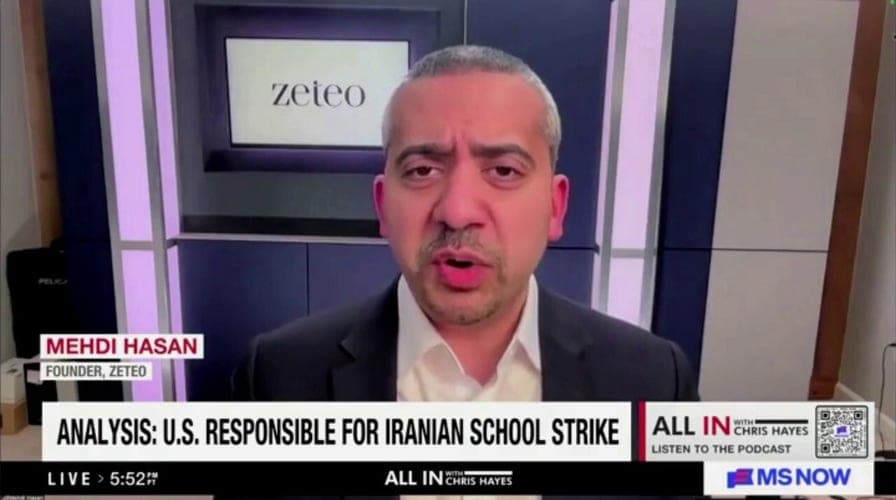
What Mehdi Hasan Actually Said
On MS-NOW, in a live conversation with host Chris Hayes, commentator Mehdi Hasan declared that "even the Nazis" conducted themselves with more legal restraint than Trump's military. That is the quote. Not paraphrased. Verbatim. And it tells you everything about where cable news commentary has gone in 2026.
The comparison wasn't incidental. Hasan built his career on escalating outrage, each take more combustible than the last. He spent years at Al Jazeera English before becoming a fixture in MSNBC's streaming world, cultivating a reputation for aggressive, prosecutorial interview style. Aggressive is fine. Combative is fine. But there's a line between combative and calling American servicemembers worse than the Wehrmacht, and Hasan crossed it on live television while the host sat quietly.
The United States military comprises roughly 1.3 million active-duty personnel. These are not abstractions. They are people. Invoking the Third Reich as a benchmark for their behavior isn't edgy commentary, it's slander dressed as moral authority. And it ran without a single pushback from the host.
Nazi Comparisons Are the Last Refuge of Someone Who's Run Out of Arguments
Godwin's Law exists for a reason. When someone reaches for Hitler, or the Nazis, or the Third Reich, in a political argument, it signals they've abandoned analysis for emotional detonation. The Nazi comparison is designed not to illuminate but to short-circuit. It demands your opponent defend themselves against an accusation so extreme that any response sounds like minimization.
Hasan's specific claim appears to reference the laws of armed conflict, Common Article 3 of the Geneva Conventions and the Hague Regulations. The implication: Trump's military has violated these norms more egregiously than Wehrmacht commanders who orchestrated the Einsatzgruppen massacres, ran a systematic extermination program, and killed six million Jews and millions more across occupied Europe. The Geneva Conventions, it bears noting, were established after the war precisely because of what the Nazis did. To invoke them as a standard the Nazis met but Trump's military fails isn't historical analysis, it's rhetorical theft of the worst kind.
What specific military action triggered this comparison? Hasan didn't say. What court ruling, what documented atrocity, what verified incident formed the basis for this extraordinary claim? None was offered. This is what it looks like when moral gravity is stripped from language until the words mean nothing.
I've covered media criticism for twelve years. I've watched commentators push every boundary for ratings, for clicks, for the viral moment that pays. But comparing U.S. servicemembers unfavorably to a military that saw its own commanders tried and hanged at Nuremberg isn't commentary. It's a lie with a microphone.
MSNBC's Race to the Bottom Has No Floor
MSNBC's streaming and daytime lineup has become a closed feedback loop of mutual radicalization. Producers greenlight claims that would have ended careers fifteen years ago. The audience has been trained to expect escalation, so each segment must out-do the last.
In 2023, MSNBC's primetime viewership averaged roughly 958,000 per night, less than half of Fox News's 2.1 million average for the same period. The network's response to declining relevance has not been to moderate. It has been to intensify. When ratings drop, the editorial logic becomes: louder, more extreme, more outrageous. Self-defeating, but consistent.
Chris Hayes, who hosted the segment, did not push back on Hasan's Nazi comparison. Not once. That silence is its own editorial statement. When a commentator on your program claims American soldiers behave worse than Nazis, and you nod along, you've endorsed the claim. Hayes is a Yale-educated journalist. He knows exactly what he heard. He made a choice.
This Is a Standards Issue, Not a Speech Issue
Hasan has every right to say what he said. The First Amendment protects deeply offensive speech, that's not the debate. The question is whether media institutions that claim journalistic credibility should platform claims with no evidentiary basis, no named sources, no documented incidents, and no purpose beyond incitement.
The pattern is familiar. Make a sensational claim. Refuse to specify. When challenged, treat the gravity of the original accusation as its own evidence. It's a closed loop built to be unfalsifiable, because the Nazi comparison was never constructed from facts in the first place.
The American military operates under the Uniform Code of Military Justice. It has a Judge Advocate General Corps that investigates misconduct allegations. It has been subject to more international legal scrutiny than virtually any military force in human history. That doesn't put it above criticism. But criticism requires facts. Hasan offered none.
The Real Cost Is Trust, and It's Already Gone
Gallup's 2025 survey found that only 31% of Americans have a "great deal" or "fair amount" of trust in mass media. That's near the historic low of 32% recorded in 2021. The numbers have never recovered from the collapse that began around 2016.
This isn't because Americans can't handle hard truths. It's because they've watched the industry trade accuracy for impact, nuance for noise. Every time a commentator compares American institutions to the Third Reich without evidence and without consequence, the credibility of everyone in the profession drops a little further.
That erosion doesn't stop at MSNBC. It reaches every local reporter covering a city council meeting, every journalist who still believes the job is to get things right. They all carry the weight of what Hasan said and what Hayes chose not to say.
Next week, Hasan will have a new take, a new comparison, a new combustible outrage. The segment will be forgotten. The damage won't be. And that 31% trust number will keep falling, one Nazi comparison at a time.