I spent three years as a crime reporter at a mid-sized Midwestern paper before moving into media analysis. In that time I covered dozens of missing-persons cases. I learned something that took me a while to say plainly: public interest and press interest are not the same thing. Not even close.
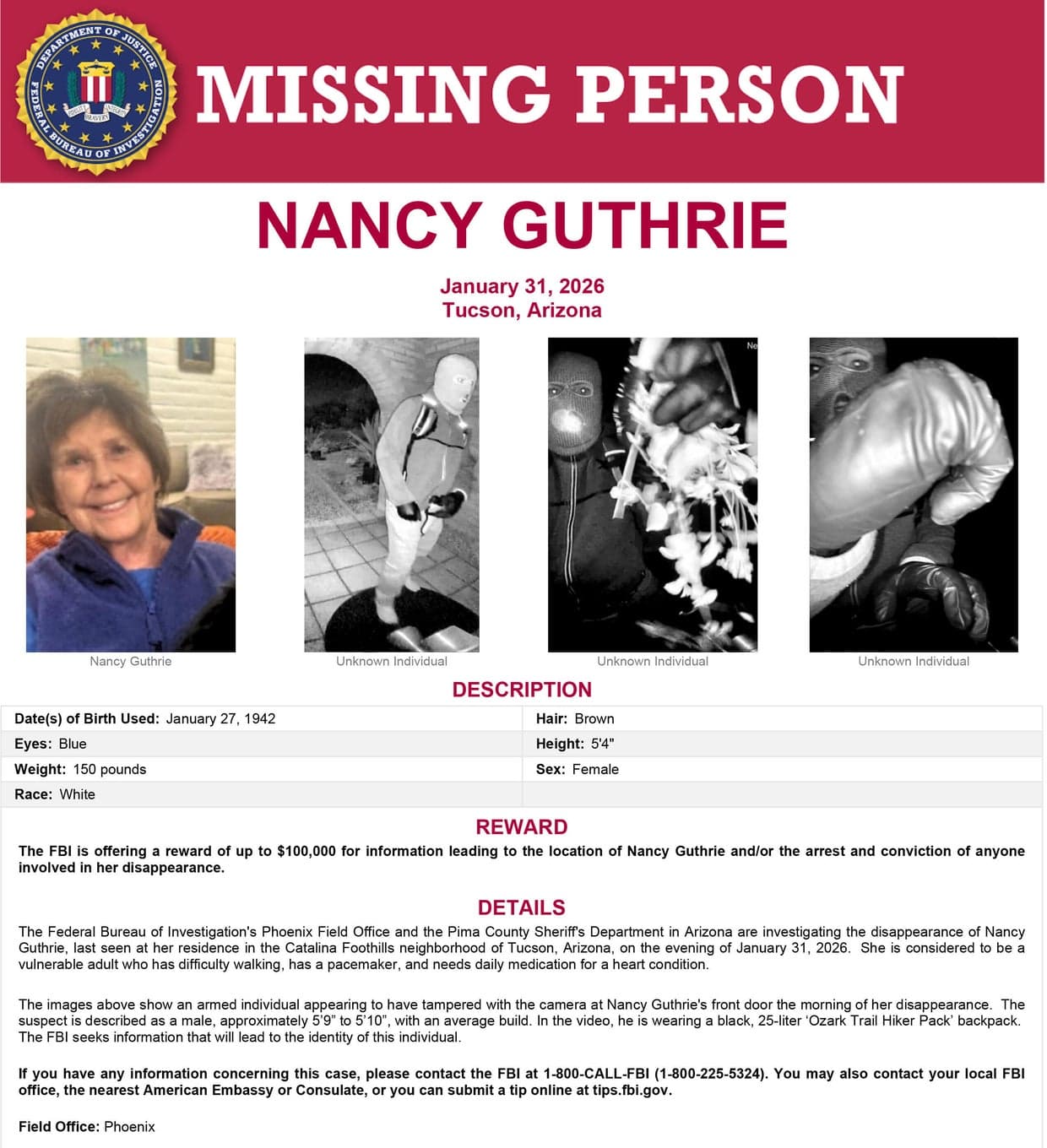
The FBI has confirmed it received more than 4,000 tips in connection with the disappearance of Nancy Guthrie. That number deserves more than a brief follow-up and a slot in the crime-news rotation. Routine missing-persons cases rarely generate federal involvement at all. When the FBI goes national, broadcasting a case, coordinating outreach, standing up a tip line, it's because agents believe witnesses exist who haven't come forward yet, and because the stakes are high enough to commit federal resources. Four thousand public responses means the American people are paying attention. The question is whether the press is.
What 4,000 FBI Tips Actually Signals About a Case
When the FBI receives more than 4,000 tips on a single missing-persons investigation, it signals that the bureau has assessed the disappearance as serious, likely criminal, and requiring broad public engagement that investigators cannot generate alone. That is not routine volume for a missing-adults inquiry. It represents active federal urgency.
The FBI's tip infrastructure receives millions of contacts annually across all case categories. For a single case to generate 4,000-plus responses requires aggressive, coordinated public outreach, media partnerships, digital channels, law enforcement broadcasts across jurisdictions. The National Center for Missing & Exploited Children has documented that public tip campaigns for missing adults typically exhaust their highest-yield responses well before reaching four-figure totals. Passing 4,000 means escalation happened, the public responded in force, and investigators still believe they need more to crack the case open.
Marc Klaas, founder of the KlaasKids Foundation and one of the most prominent missing-persons advocates in the country, has argued that "the media has enormous power to keep a case alive, or to kill it." The tip volume in Guthrie's case suggests the public wants this case kept alive. The coverage volume suggests the press made a different calculation.
The Pattern Behind Who Gets Sustained Coverage
Missing-persons coverage in American media follows patterns that are only partly about news value. The rest is about something editors rarely say out loud.
In 2010, the Gannett Foundation published research documenting that missing white women received disproportionately more national news coverage than missing persons of other demographics, a phenomenon sociologists had been calling "Missing White Woman Syndrome" since at least 2004. The critique came from the left. It was largely accurate. But the argument almost never got pushed to its logical conclusion: if editorial decisions are systematically distorted, the distortion runs in every direction depending on which factors align with a given outlet's interests at a given moment.
A missing person who generates 4,000 FBI tips but doesn't fit the current editorial frame disappears from the news cycle as surely as they've disappeared from wherever they went. I watched this happen when I was still writing those stories. I watched editors weigh newsworthiness against story fit, against demographics, against timing, against what was already running. The honest conversation about missing-persons coverage has never been about a single variable. It's about the full matrix, and the press rarely admits the matrix exists.
Nancy Guthrie's case has FBI involvement. It has more than 4,000 public tips. It has a family waiting for answers. What it apparently doesn't have is whatever makes an editor say keep running it.
Why Sustained Coverage Is an Operational Necessity for Active Investigations
Active missing-persons investigations depend on sustained public attention in ways other criminal cases do not. Witnesses to disappearances often don't recognize the significance of what they saw. They need repeated exposure to case details, a name, a timeline, a described vehicle, a specific location, before the connection registers. This is documented in dozens of cold cases where renewed media attention generated tips that solved investigations years after they stalled.
The Charley Project, which tracks unsolved missing-persons cases nationally, currently maintains files on more than 12,000 active cases across the United States. The overwhelming majority receive no sustained coverage after the initial report. Research in the criminology literature consistently finds that cases with multiple national follow-up stories in the weeks after a disappearance generate significantly more actionable tips than cases that receive a single story and go quiet.
Nancy Guthrie's case generated 4,000 tips without sustained coverage. What would it generate with it? Someone knows something about what happened to her. The more people who see her name, hear her story, and understand the FBI is still actively working the investigation, the higher the probability that person comes forward. Every published story is a potential witness reached. Every day the press moves on is the inverse of that.
The Simple Version of the Media Criticism
I'm not claiming to know the editorial reasoning inside network newsrooms. I don't have those production transcripts. But 4,000 FBI tips represents extraordinary public engagement, and extraordinary public engagement that doesn't translate into sustained journalistic attention is a gap that deserves to be named, not rationalized as normal news prioritization.
The press has real, documented influence over which missing-persons cases receive the public bandwidth needed to surface witnesses. That influence is not evenly distributed. It is not applied on consistent principles. The people who pay the cost for the inconsistency are not editors or producers. They're families without answers and investigators waiting for the tip that opens a case.
Nancy Guthrie is still missing. The FBI is still working. Four thousand people cared enough to call. The press has moved on to other things.
That's the story.