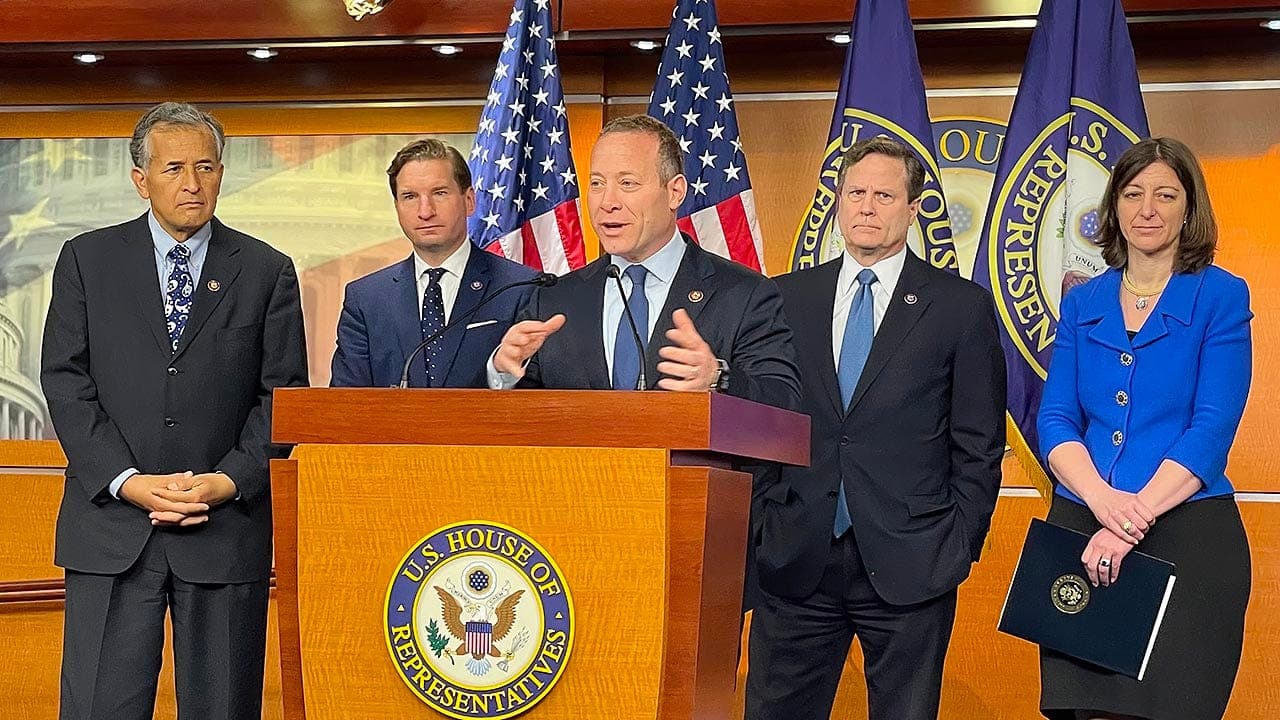
The vote was 207 to 213. That's the whole story, short version. House Democrats blocked a continuing resolution to keep the Department of Homeland Security funded while congressional leadership was receiving classified briefings on an active Iranian threat to American infrastructure. April 2026. Middle of a live geopolitical flashpoint. And the minority found time to play procedural games with the agency that secures the homeland.
The Vote Was About Kristi Noem, Not National Security
House Democrats voted 207-213 to block DHS funding in April 2026, with minority leadership explicitly citing the continued tenure of Secretary Kristi Noem as their stated objection. The agency responsible for border security, customs enforcement, cybersecurity, and disaster response is now running on emergency protocols because Democrats want a cabinet secretary's head. That's not an oversight mechanism. That's a hostage situation.
Senate Minority Leader Chuck Schumer told reporters last Tuesday that DHS had been transformed into something unrecognizable.
"DHS leadership has become an arm of partisan enforcement.", Senate Minority Leader Chuck Schumer
He wasn't wrong about the politics. He was completely wrong about the timing. When U.S. intelligence officials are briefing Congress on Iranian assets conducting surveillance near American power grid infrastructure, is a grudge against a cabinet secretary worth the operational cost?
For Democrats, apparently yes. I've watched shutdown theater in Washington for two decades. The funding cliff is the minority's last available leverage when it can't win on substance. They pull it out not to fix problems but to manufacture them, then offer resolution at a political price. The American people are the hostage and the collateral damage, both at once.
What a Libertarian Actually Thinks About DHS
DHS operates on a $103 billion annual budget, roughly $282 million per day. The agency employs over 260,000 people across 22 component offices, many of which overlap in ways that would make any private sector auditor weep into their coffee. I've covered government bureaucracy long enough to know that the fat absorbs most shutdowns. The FBI still shows up. CBP still patrols. TSA still runs its security theater at a 95% undercover detection failure rate. But this particular shutdown has teeth.
The active threat environment changes everything. TSA screening operations at 440 airports are running on voluntary overtime. Customs and Border Protection has recalled agents from leave but can't process new hires because HR systems are locked in shutdown mode. The Coast Guard, already underfunded at $13.6 billion annually, is covering both Atlantic surveillance and Gulf patrol with no reserve capacity to draw on. These aren't abstract concerns for a think tank report. These are operational gaps right now.
Congressman Mark Green of Tennessee, chairman of the House Homeland Security Committee, said it plainly.
"We are deliberately degrading our own security apparatus during an active threat period because of internal political grievances.", Rep. Mark Green (R-TN), Chairman, House Homeland Security Committee
Green is a Republican, so Democrats will dismiss this. The math doesn't have a party affiliation. The shutdown does.
The Iran Factor Democrats Won't Acknowledge
The threat making this shutdown reckless isn't vague or speculative. In the 72 hours before the House vote, National Security Advisor Mike Waltz reportedly presented intelligence to congressional leaders showing Iran-backed assets had conducted surveillance operations near three American power grid substations. The FBI arrested two Iranian nationals in Houston during the same period, allegedly conducting pre-operational surveillance on a federal facility.
Democrats voted to defund the agency protecting that infrastructure anyway.
Irresponsible? Yes. Shocking? Only if you haven't been paying attention. The modern Democratic Party has made a consistent calculation: administrative and political objectives supersede operational continuity at federal security agencies. They made it during the government shutdown of 2023. They made it during the FISA debate of 2024. Each time, the security apparatus is the hostage. Each time, Democrats calculate that the political upside exceeds the operational risk.
The problem is that Iran doesn't read the congressional calendar. Iranian intelligence assets don't observe shutdown procedures. The people most motivated to exploit a degraded DHS are the least likely to care why it got degraded.
What Should Happen Next
The continuing resolution needs to pass. DHS needs to be funded through at least October 1st. The question of Kristi Noem's performance, genuinely mixed, with legitimate criticisms on the record, can and should be litigated through oversight hearings, inspector general investigations, and the mechanisms the Constitution designed for accountability. Those processes exist. Use them.
Using a funding cliff as a political weapon during an active Iranian threat period isn't oversight. It's malpractice dressed in procedural language. There's a difference between holding an administration accountable and holding the homeland hostage to do it.
The 213 Democrats who voted to continue the shutdown read the same intelligence briefings their Republican colleagues read. They saw the same threat assessments. They made a calculation: political leverage now, operational risk later, someone else's problem. That calculation deserves to be on the public record, permanently.
The vote was 207 to 213. Write those names down.