My daughter came home from ninth grade last spring with a homework worksheet that described capitalism as "a system historically used to concentrate wealth among the powerful." That was the exact language. Not a paraphrase. I kept the paper. I sat with it for a while, trying to figure out what world my kid was being educated in, and when it had quietly become this world without anyone consulting me.
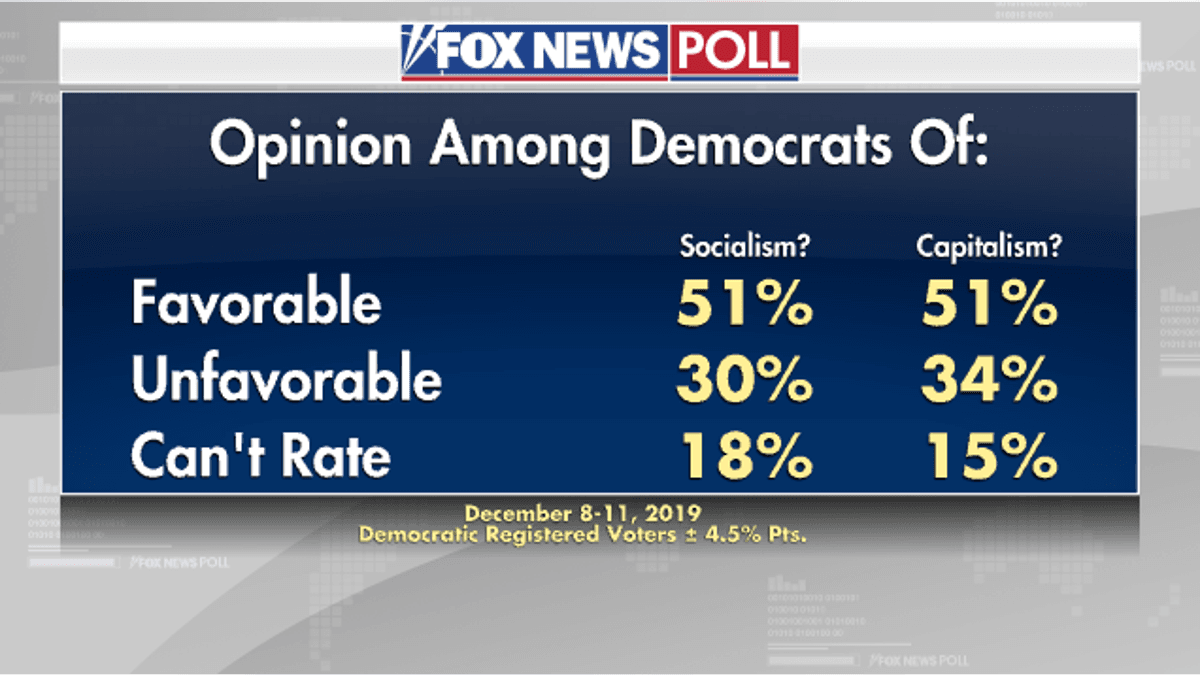
Now a Fox News poll says socialism is gaining ground among American voters. Can't say I'm surprised.
What the Numbers Actually Show
The Fox News poll found that favorable views of socialism have risen measurably among American voters, with the sharpest increases among those under 35, where positive views of socialism now approach or rival positive views of capitalism in several demographic segments. About 36 percent of all respondents expressed positive views of socialism overall. Gallup's longer-horizon data tells the same story: in 2010, 36 percent of Americans held a positive view of socialism; by 2019, that number had climbed to 43 percent.
This isn't one poll or one question phrased ambiguously. It's a consistent, multi-decade shift. Bernie Sanders won 13 million votes in the 2016 Democratic primary. Alexandria Ocasio-Cortez's Green New Deal attracted more than 100 congressional co-sponsors by 2021. The polling isn't documenting a fringe. It's documenting a mainstream drift that built steadily over two decades while most conservatives were busy shouting at cable news.
The conservative response to these numbers has mostly been outrage. Social media posts. Rally speeches where everyone already agrees. Calling people socialists and expecting the label to land the way it did in 1985 is not a strategy. It's a habit. And the habit has not moved the trend lines.
How We Lost the Classroom, And When
American K-12 classrooms shifted on economics not through a coordinated conspiracy but through a replicable pipeline: university education departments train teachers in progressive economic frameworks, those teachers enter schools, and those frameworks follow them into lesson plans that reach children before parents think to ask what's in the curriculum. By the time a parent notices, the materials have been running for three years and changing them requires a 12-month review process and a board majority.
The worksheet my daughter brought home came from materials adopted by her district, sourced from a nonprofit whose board includes former Obama-administration education officials. I looked it up. The curriculum lists "economic justice" as a stated learning objective. The word "profit" appears in a lesson plan framed around exploitation. Not competing perspectives. One frame, presented as settled.
I've talked to dozens of parents across Texas over the last two years who describe variations of the same experience: their kid came home uncertain about whether private property was a good thing, or whether the American Founders were heroes or villains, or whether free markets had caused more harm than good. These aren't radical schools. These are suburban public schools in conservative states where parents assumed the culture was fine.
"We've allowed the left to colonize the very institutions that are supposed to transmit our values across generations," Dr. Robert George, Princeton legal philosopher and co-founder of the American Principles Project, said in a 2023 interview. "And now we're surprised that the next generation doesn't hold those values."
He's right. We were not paying attention. We outsourced civic formation to institutions with different values, for decades, because the neighborhood seemed fine and nobody wanted to be that parent at the school board meeting.
Why Outrage Alone Won't Turn This Around
Conservative outrage at socialism's polling gains has not moved the trend lines because outrage is aimed at symptoms rather than causes. The 22-year-old who views socialism favorably didn't arrive there by watching MSNBC last week. She arrived through twelve years of schooling, four years of university, and a social media environment that consistently framed capitalism as the cause of housing costs, student debt, wage stagnation, and environmental damage. When did we decide that posting about socialism on social media was a substitute for showing up to the school board meeting?
The arguments that actually move people aren't louder conservative rhetoric. They're the affirmative case that most conservatives stopped making two decades ago. The story of what free enterprise actually produced: the largest reduction in global poverty in human history, concentrated in the decades after World War II when market economies spread across East Asia and eventually Eastern Europe. The story of entrepreneurship as one of the only paths to prosperity that doesn't require either inheritance or government favor. The story of what happened in every country that implemented socialism at scale, Venezuela, Cuba, the Soviet Union, Maoist China, not as abstract history but as the lived experience of real people, including people in American communities whose families left those places.
We stopped telling those stories in the venues where young people spend their time. We ceded classrooms. We ceded universities. We mostly ceded the entertainment culture. And now we're surprised that a generation told one story for twenty years believes it.
What Parents Can Actually Do Right Now
I'm not a policy analyst. I'm a parent who received the worksheet and had to explain to my daughter why it was wrong, specifically, with evidence, not slogans. So I'll speak from that place, not from a think tank report.
Request the curriculum materials. Most states require districts to provide them on request. Read the actual documents, not the district's summary, the documents themselves. If you find content that misrepresents economic history or presents capitalism as inherently exploitative without counterweight, bring specific objections to the school board with specific citations. Page numbers. Exact sentences. Not talking points. That specificity is what creates a record, what gets taken seriously, and what makes it harder to dismiss you as a culture warrior rather than a parent who did her homework.
Talk to your kids about money in concrete terms. How your household earns and spends. What you've built and at what risk. What a profit margin actually represents in terms of whether a business survives and pays people next month. Children who understand economics from the ground up, from watching a family business operate, from being responsible for part of a household budget, are far more resistant to abstract ideological claims than children who only encounter these questions as theory in a classroom.
The poll numbers are a symptom. The disease is a generation that wasn't taught the affirmative case for free markets, private property, and individual economic liberty. That's fixable. Not through outrage cycles and social media posts. Through engagement, the kind that reads the curriculum packet, shows up to the board meeting, and talks to its own children like the stakes are real.
They are. Start with the worksheet.