The state of California requires a 10-day waiting period, a "good cause" showing that most county sheriffs reject outright, a $200-plus fee, a full fingerprint submission, a live-fire qualification test, and a state-approved safety training course before it will issue a concealed carry permit. That's not a regulatory framework. That's a suppression scheme dressed in administrative clothing.
New Jersey is worse. Hawaii has issued essentially zero concealed carry permits to ordinary civilians in its recorded history, not because residents don't want to carry, but because the state treats the Second Amendment as an opt-out provision available to any sufficiently hostile legislature.
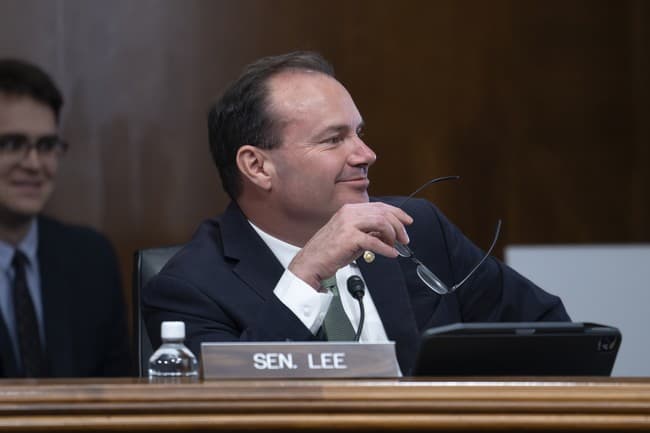
Senator Mike Lee of Utah filed legislation last week to end all of it. The Constitutional Carry Reciprocity Act would require every state to honor carry permits issued by any other state, and would bar states from imposing additional requirements on out-of-state permit holders. Lee called the existing state permitting regimes "hostile" to the Second Amendment. That's putting it diplomatically.
What Lee's Bill Does, and the Constitutional Basis for Doing It
The Constitutional Carry Reciprocity Act establishes a floor of Second Amendment protection that no state can strip from a lawful permit holder who crosses its border. It doesn't nationalize gun laws. It doesn't eliminate state permitting systems within a state's own jurisdiction. What it does is simple: a background-checked, trained, licensed adult citizen doesn't lose her constitutional right because she drove across a state line.
The legal foundation rests on two constitutional pillars. First: the Second Amendment, incorporated against state governments through the 14th Amendment's Due Process Clause following McDonald v. City of Chicago in 2010. Second: the Full Faith and Credit Clause, which already requires states to honor each other's driver's licenses, marriage certificates, and court judgments. Lee's bill extends that principle to a constitutionally protected individual right, which is precisely where it should have applied from the beginning.
Thirty-four states currently allow some form of permitless or constitutional carry. Sixteen states, concentrated in the Northeast and on the Pacific coast, maintain permitting regimes ranging from onerous to functionally prohibitive. The problem Lee's bill addresses is specific: a lawful Texas carry permit holder who drives into Illinois faces potential felony exposure for exercising a right that 34 other states recognize without question. That's a bureaucratic trap. Not federalism.
The Case That Defines What "Hostile" Actually Looks Like
Shaneen Allen was a licensed Pennsylvania carry permit holder, a single mother, a phlebotomist, a law-abiding citizen, when she crossed the Delaware River into New Jersey with her lawful firearm. She had no idea her Pennsylvania license didn't transfer. New Jersey charged her with a second-degree felony. The case drew national attention before Governor Chris Christie granted her a pardon in 2014. She came within a sentence of prison for not knowing one state's rules about a right she was legally exercising in another.
What is the point of a concealed carry permit if it becomes a felony charge the moment you cross a state border without memorizing that state's exceptions?
New York City's permit process requires $340 in fees, four character references, employment verification, an in-person interview, and a wait that commonly runs past a year. The city's approval rate for ordinary civilians runs under 5%. After the Supreme Court's Bruen decision struck down New York's "proper cause" standard in 2022, the state responded with the Concealed Carry Improvement Act, piling on location-based restrictions that federal courts have been dismantling one injunction at a time ever since.
I drove from Texas to New York with a friend who holds a Texas carry permit. The legal research he had to do before that trip, which states honored his permit, which required him to transport the firearm unloaded in the trunk, which would charge him with a felony for having it at all, ran 14 pages. Fourteen pages of regulatory maze to exercise a constitutional right. That's not safety administration. That's designed deterrence.
Why Federalism Doesn't Protect What These States Are Doing
The standard objection to Lee's bill runs through states' rights language: states should determine their own gun regulations based on local conditions, population density, and political preferences. That argument holds only if the Second Amendment doesn't apply to state governments. McDonald settled that in 2010. The 14th Amendment's Due Process Clause incorporated the Second Amendment against state action. The argument from federalism fails at exactly that point.
Federalism is a genuine constitutional value, but it doesn't give states authority to nullify provisions of the federal Constitution. The 10th Amendment reserves to states powers not delegated to the federal government and not prohibited to states by the Constitution. The 2nd and 14th Amendments prohibit states from infringing the right to keep and bear arms. Those provisions sit in direct conflict with what California, New Jersey, and Hawaii are doing. The Constitution is explicit about which controls.
"The Second Amendment is not a second-class right," Lee said when introducing the bill, citing language from Bruen, which itself cited Heller. The Supreme Court has said this three separate times since 2008. Sixteen states still haven't adjusted their permitting regimes accordingly. Lee's bill is the enforcement mechanism that should have accompanied McDonald in 2010. The correct answer was always federal reciprocity. Pass it.