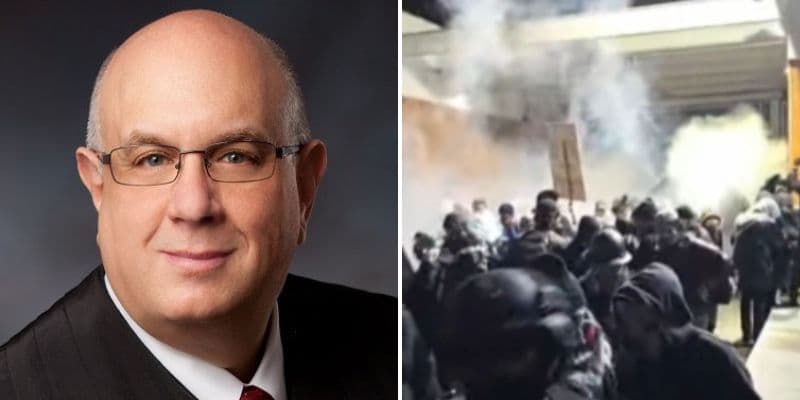
What the Judge Actually Did
U.S. District Judge Marco Hernandez issued an order restricting federal agents' use of tear gas and other crowd-control munitions against protesters outside Portland's ICE detention facility. The ruling came in response to demonstrations that, by documented accounts, included thrown projectiles, attempted fence breaches, and sustained harassment of federal law enforcement personnel. The judge determined that deployment of crowd-control measures violated the protesters' First and Fourth Amendment rights.
Let me be precise about the practical effect. Federal agents assigned to protect a federal immigration facility now face judicially imposed restrictions on how they can respond to crowds actively attempting to breach that facility. The restriction applies regardless of what those crowds are doing at any given moment. The constitutional right being protected, apparently, is the right to press against federal fencing with impunity from the non-lethal tools available to the officers on the other side of it.
This is not a close constitutional call dressed in reasonable language. It's judicial policymaking that happens to align with a specific set of political preferences about immigration enforcement, wearing constitutional clothing. The distinction matters because the rationale will be cited in future litigation, in other cities, against other federal facilities.
The Portland Pattern That Got Us Here
Portland has become, over several years, a detailed case study in what happens when local political culture systematically undermines federal law enforcement operations. The protests outside the ICE facility aren't new, they've been a recurring feature since the first Trump administration. The city's political establishment has been either openly supportive of the demonstrations or conspicuously silent while federal property was damaged and federal personnel were threatened.
The 2020 protests produced weeks of sustained attacks on the federal courthouse. Federal officers were repeatedly assaulted with commercial-grade fireworks, frozen water bottles, laser devices aimed at eyes, and improvised explosive devices. Ninety-six federal law enforcement officers were injured during those months. The federal response was subjected to multiple lawsuits, judicial orders, and sustained political condemnation from Oregon's congressional delegation. The people who organized the attacks faced minimal consequences. Several of them went on to help organize the current ICE facility demonstrations.
That's the context for this ruling. Not a novel First Amendment question arising in a vacuum of civic goodwill. The latest chapter in a sustained, organized effort to use federal courts to constrain federal law enforcement from protecting federal facilities while the people doing the constraining operate with effective impunity. I've talked to federal agents who've been pulled off active enforcement operations to stand post at that facility for weeks at a stretch. They know exactly what's being done here. They knew it in 2020 too.
What the Ruling Gets Wrong
First Amendment protections apply to speech and peaceful assembly. They do not apply to throwing objects at law enforcement officers, attempting to breach fencing around a federal facility, or obstructing the lawful operation of a federal building. Federal courts have established this in numerous prior rulings. Crowd-control munitions deployed in response to active attempts to breach federal perimeter security aren't a First Amendment violation, they're an operational response to conduct that has left First Amendment protection behind.
Judge Hernandez's order treats the crowd as a monolithic First Amendment-protected entity. That's legally convenient and factually false. A protest that includes both peaceful demonstrators and individuals actively attempting to breach federal fencing isn't a single entity entitled to blanket constitutional protection from any law enforcement response. Officers facing an actively hostile crowd don't have the luxury of sorting each individual by their level of constitutional protection in real time, while projectiles are incoming.
The ruling also refuses to engage with the downstream logic: if federal agents cannot use non-lethal crowd-control munitions against crowds actively attempting to breach a federal facility, the available options narrow significantly. More severe force, or surrender of the facility's security perimeter. Neither outcome serves the people the ruling claims to protect, and neither serves the detained immigrants inside the facility whose safety depends on that perimeter remaining intact.
The Bureaucratic Cost Nobody Calculates
Here's what doesn't get discussed in coverage of these rulings: resource allocation. Every judicial restriction on crowd-control measures, every injunction requiring new protocols, every legal challenge requiring government attorneys to respond and brief, these consume finite federal resources. Agents get pulled from enforcement operations. Legal staff spend weeks on litigation responses. Training gets revised. Equipment gets reviewed and possibly replaced. None of that activity produces a single immigration enforcement outcome. It's pure friction, deliberately manufactured, and federal courts have been willing partners in generating it.
The organizations driving this legal strategy know exactly what they're doing. They're not primarily trying to win on constitutional merits, though they'll take the wins when they get them. They're trying to make enforcement expensive, complicated, and uncertain enough that the administrative apparatus eventually calculates that the cost of operating in Portland exceeds the operational value. It's been working, in degrees, for years. A federal judge just handed them another tool and another precedent.
The ICE facility will keep operating. The protests will keep coming. The legal briefs will keep getting filed. And the American taxpayers funding both the federal enforcement operation and the court system being used to undermine it will keep paying for a performance neither side is interested in ending, because the performance itself is the point.