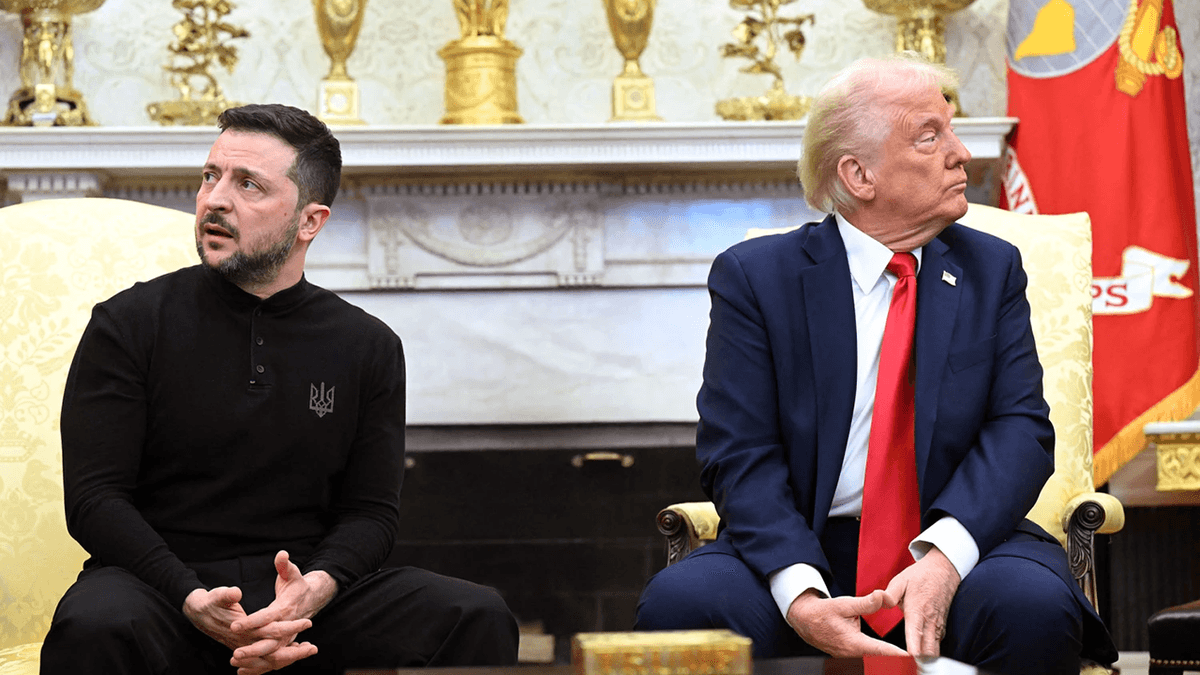
The Endless Ask
Volodymyr Zelenskyy sat down with Fox News this week and did what he's done for three years running: asked for more. More weapons, more aid, more time, more commitment from Western allies willing to fund a war that entered its fifth year without a ceasefire in sight. He questioned whether peace talks with Russia could lead anywhere real. He suggested conditions aren't right for negotiations. He's been saying some version of this since February 2022.
Here's what he didn't say: what victory actually looks like in 2026.
The United States has sent Ukraine more than $175 billion in military and economic assistance since Russia's invasion began. That's more than the entire annual GDP of Hungary. Roughly 600,000 soldiers, Ukrainian and Russian combined, have been killed or wounded, according to most serious estimates. The front lines today sit within a few miles of where they were eighteen months ago.
At what point does persistence become stubbornness?
The Cost Has a Number
$175 billion is the floor, not the ceiling. The Biden administration pushed through multiple supplemental packages through 2024, and the pressure to keep spending hasn't stopped. American taxpayers have been funding a war on the other side of the globe while border patrol agents are understaffed, veterans wait months for care, bridge infrastructure sits unrepaired, and military readiness budgets get squeezed to cover the gap.
I'm not saying Ukraine doesn't matter. I'm saying the accounting matters.
When Congress debated the last major Ukraine supplemental in 2024, it passed 311 to 112 in the House. That was the bipartisan consensus. But consensus doesn't make a policy correct, it just makes it popular with people who won't be paying for it personally. Defense contractors certainly didn't object. Raytheon's stock has performed exceptionally since February 2022. There's a reason for that.
Zelenskyy told Fox News he's skeptical that peace talks will produce anything real right now. That skepticism about Russian intentions is warranted, Vladimir Putin has shown no interest in a settlement that doesn't hand him something significant. But the alternative to imperfect talks isn't victory. It's a frozen conflict that bleeds both sides for another decade.
What Trump Gets Right About This War
Donald Trump said repeatedly during the campaign that he could end the war in 24 hours. That was always a campaign-trail overstatement. But his core instinct, that the United States should be pushing hard for a negotiated settlement rather than funding an open-ended commitment indefinitely, is correct. Trump's peace envoy Keith Kellogg has been in contact with Ukrainian officials since January. The framework reportedly involves a ceasefire along current lines of control, security guarantees for Ukraine short of NATO membership, and an economic reconstruction package. Ukraine cedes territory. Russia keeps what it took. Nobody wins outright. The dying stops.
Zelenskyy's position that any deal ceding Ukrainian territory is unacceptable to him is understandable for a national leader. It is not a viable negotiating posture when the alternative is another three years of attrition warfare with no clear endpoint.
Ukraine's stated position in the Fox News interview was unambiguous: no territorial concessions in exchange for peace.
Fine. But what exactly is being traded? Something has to give. That's not pessimism. It's arithmetic.
What Does a Ukrainian Victory Actually Look Like?
Nobody in Washington answers that question honestly, because the honest answer is uncomfortable. Recovering Crimea would require defeating a nuclear-armed adversary on its own territory, not a strategy, a fantasy. Retaking the full Donbas means fighting through years of fortified Russian defensive positions with no air superiority. Holding current lines while Russia exhausts itself is possible in theory, but "waiting it out" has a price tag attached to it, and Americans are paying it whether they agreed to or not.
I spent time in Warsaw in 2023 talking to Ukrainian refugees, families who had fled Kharkiv, Mariupol, Odessa, and Zaporizhzhia. They wanted their homes back. Of course they did. But they also wanted it to stop. The women I spoke with who had lost husbands weren't talking about military victory. They were talking about survival. There's a gap between what governments demand and what families actually need. That gap is what diplomacy is supposed to close.
American public support for Ukraine stood at roughly 66% in early 2022. It sits below 50% now and declining. That's not isolationism. That's four years of "as long as it takes" with no end visible on any horizon.
The Fifth Year Should Be the Last One
Ukraine's war entering a fifth year is not a milestone to be commemorated. It's an indictment of the diplomatic failure that has kept this conflict burning while the world watched and wrote checks. Russia should never have invaded. That is a fact. But facts don't end wars. Negotiations do.
The administration needs to apply real pressure on both sides, including conditioning future American assistance on Ukrainian willingness to engage in serious talks, not performative ones. That's not betraying Ukraine. That's giving Ukraine the only thing that actually saves it: a path out of a war it cannot win on the maximalist terms it currently demands.
Zelenskyy is a remarkable leader who has shown genuine courage under impossible conditions. He deserves respect and real support. He also deserves an honest partner willing to say what American allies have been unwilling to tell him: that the United States will not fund this war indefinitely, that territorial maximalism isn't achievable with current forces and current political will, and that a flawed peace today is worth more than a perfect peace that never arrives.
The fifth year of this war should be the year someone in Washington finally says that out loud. Clearly. Without hedging.


