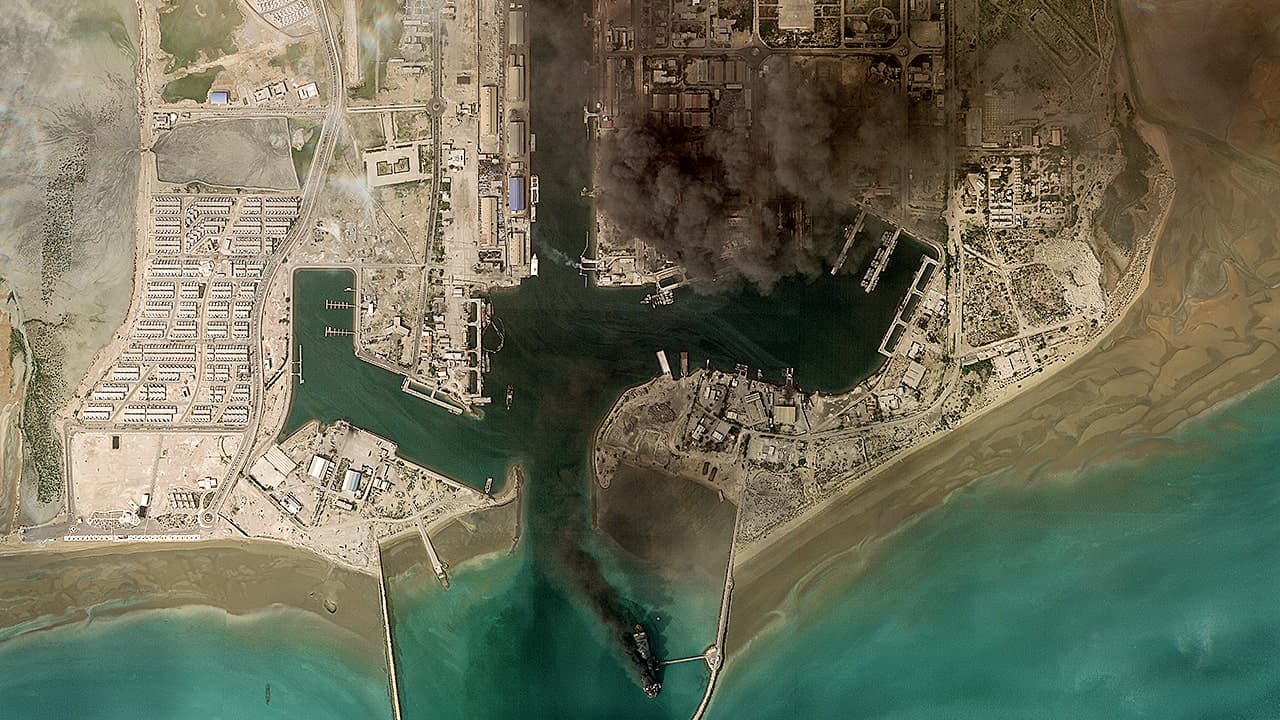
The Satellite Images Don't Blink
Satellite imagery released after the coordinated US-Israeli strikes on Iranian naval installations shows catastrophic fire damage at multiple bases along Iran's Persian Gulf coastline. The before-and-after shots, captured by commercial providers including Planet Labs, show at least three major naval facilities with burned-out structures, destroyed equipment, and blast damage consistent with precision munitions. This isn't speculation. It's geography and light.
I've looked at a lot of target damage assessments in my time. Not as a staff officer, I was infantry, not intel, but you don't do two combat tours without developing an eye for what fire does to a building versus what a shaped charge does. What you see in these images is not accidental. This was deliberate, methodical degradation of Iranian maritime capability.
Bandar Abbas, Iran's primary naval hub on the Strait of Hormuz, shows the most severe damage. Analysts from the Foundation for Defense of Democracies assessed that at least 40 percent of the facility's covered berths show heat signatures consistent with sustained fires. The Bushehr naval installation, secondary but still significant, shows similar patterns. You don't burn down your own base.
Tehran Is Still Calling This a Routine Exercise
Iran's official response to the strikes has been to deny any significant damage occurred, with state media calling the incidents "minor technical events" unrelated to foreign action. The Islamic Revolutionary Guard Corps issued a statement claiming full operational readiness across all naval units. That statement is demonstrably false based on publicly available imagery. Full stop.
State-sponsored denial isn't new. But the gap between Iran's official narrative and the physical reality captured from 400 miles above the earth is larger than usual. When Iran claimed it had "successfully repelled" Israeli air defenses in October 2024, those claims fell apart within 48 hours when Western intelligence made imagery public. The pattern holds.
Analysts at the Foundation for Defense of Democracies have argued the Iranian regime built its deterrence strategy on the perception of invulnerability, and that when the satellite imagery becomes the news, the entire edifice of regional intimidation starts to wobble.
That framing is right. The regime's internal credibility depends on projecting strength. Burned docks don't project strength. They project vulnerability. And vulnerability, in that neighborhood, invites challengers.
What Those Burned Berths Actually Cost Iran
The material damage from these strikes is more significant than most American news coverage has acknowledged. Iran's naval budget for fiscal year 1404 was approximately $2.3 billion, with a substantial portion allocated to Persian Gulf force projection. The facilities damaged represent years of capability investment, not just buildings, but trained crews, specialized maintenance infrastructure, and the logistical networks that keep a naval force operational.
Fast attack craft, Iran's primary tool for Strait of Hormuz harassment, require covered storage and sophisticated maintenance. The satellite imagery shows at least 12 covered berths destroyed or severely damaged at Bandar Abbas alone. Those berths don't rebuild in a month. They don't rebuild in six months. Meanwhile, Iran still has to project credibility to Houthi proxies in Yemen and Hezbollah remnants in Lebanon.
This is deterrence working. Not perfectly, not cleanly, not without risk of escalation. But working.
The Biden administration spent four years trying to negotiate its way back to the JCPOA while Iran built faster centrifuges and more capable missiles. That approach produced nothing but an advancing nuclear program and a regional posture that grew more aggressive. Strikes produce different outcomes. Burned naval bases don't fire at commercial shipping in the Strait of Hormuz.
Why Commercial Satellites Change the Political Equation
Commercial satellite imagery has fundamentally altered the information environment around military operations, and not everyone in Washington has adjusted to that reality. When Planet Labs, Maxar, or BlackSky can have images on the open market within hours of an event, the old playbook of strategic ambiguity becomes harder to sustain. The world can see what happened. The question is whether the right people are drawing the right conclusions.
There's a contingent in Congress, and in the foreign policy establishment, that will look at these images and see provocation. A risk of escalation. A reason to dial back. They'll be on the Sunday shows inside 48 hours talking about de-escalation frameworks.
Are those the same people who thought the nuclear deal was working?
The images tell a simpler story. When Iran's proxies attack American forces, and they have, repeatedly, including the Tower 22 strike in Jordan that killed three American soldiers in January 2024, there are consequences. When Iran threatens the Strait of Hormuz, through which approximately 20 percent of the world's oil transits daily, there are consequences. Consequences that show up on a satellite. Consequences that look like fire.
This administration chose to make the costs visible. That's the right call. Not because conflict is desirable, nobody who's been downrange thinks war is a game, but because the alternative is an Iran that reads American restraint as permanent permission.
The Lesson History Keeps Teaching
In April 1988, Operation Praying Mantis sank or crippled half of Iran's operational naval fleet in a single day. The Reagan administration moved decisively after Iranian mines struck the USS Samuel B. Roberts, wounding 10 American sailors. The response was measured and overwhelming. Iran got the message and stood down. For years.
The lesson took. Until it didn't. Until subsequent administrations communicated that American tolerance for Iranian aggression had expanded. The red lines moved. The costs decreased. And Iran moved forward.
These satellite images are which shows that red lines can move back. That capability can be degraded. That there is a price for threatening the global commons and killing American service members. The price is fire. The fire shows up on satellite. And now everybody knows.
That's not a tragedy. That's deterrence.


