The Announcement the Commentariat Didn't Know How to Process
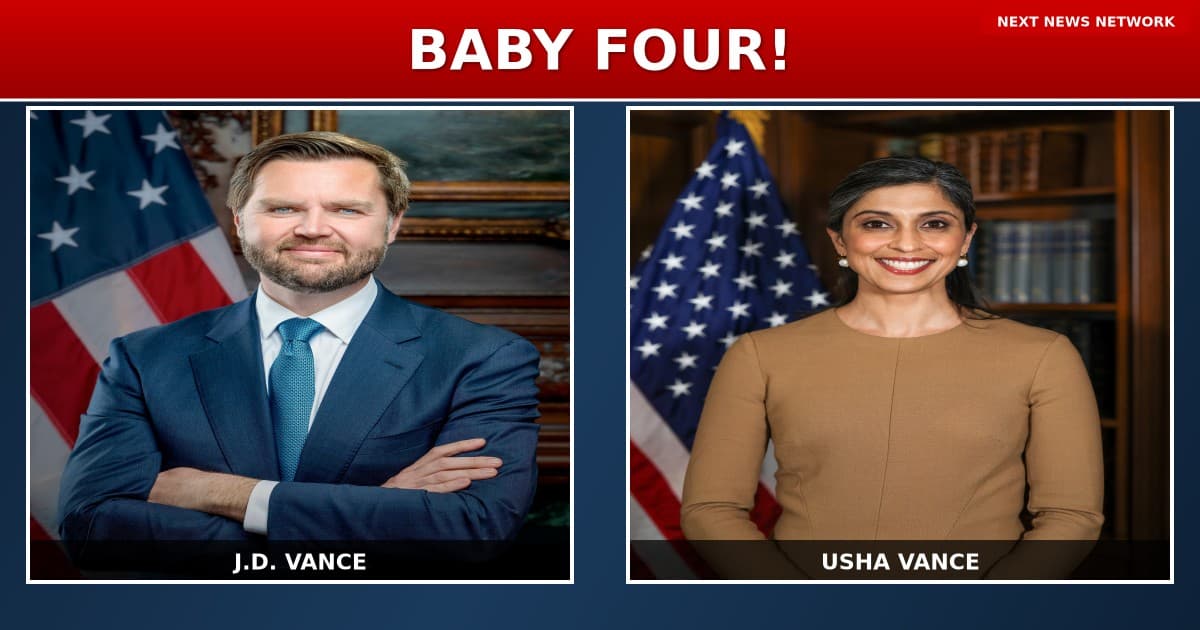
The White House confirmed it Tuesday: Second Lady Usha Vance and Vice President JD Vance are expecting their fourth child. A family growing. Nothing contentious about that, unless you've spent the past decade building an identity politics framework that can't accommodate it.
I teach political theory. My colleagues spend department meetings talking about the moral urgency of representation in public life. They celebrate the elevation of women and people of color to positions of influence, and they should. And then Usha Vance walks into the second-highest office in the land, and the celebration goes quiet. Not awkward. Not uncertain. Quiet.
Usha Vance is the daughter of Indian immigrants. She attended Yale Law School, clerked for Chief Justice John Roberts, and built a career on exactly the credentials that progressive institutions exist to celebrate. Then she married JD Vance. She stood beside him at the Republican National Convention in Milwaukee in July 2024. She introduced him with pride. And now they're expecting baby number four.
What exactly did she do wrong?
Why the Left Finds Large Conservative Families Threatening
A growing conservative family in the second-highest office in the land is a cultural challenge that progressivism hasn't resolved. The left's dominant discourse on birth rates runs one direction: anxiety about overpopulation, celebration of child-free lifestyles, the framing of parenthood as a burden to be negotiated rather than a vocation to be embraced. Four children, raised in a faith-conscious household, cuts against all of that cleanly.
JD Vance converted to Catholicism in 2019. Usha, raised Hindu, has spoken openly about the role of tradition in their home. Their three children, Ewan, Vivian, and Mirabel, are being raised in a household that takes commitment seriously. The fourth will be, too.
The numbers sharpen the point. The U.S. total fertility rate dropped to 1.62 in 2023, according to CDC data, the lowest ever recorded and well below the 2.1 replacement threshold. A 2023 Pew Research Center study found that 44 percent of non-parents under 50 said they were unlikely to ever have children, up from 37 percent just five years earlier. That shift tracks neatly with a cultural establishment that stopped treating children as a good thing. When someone visible, not in a press release but with their actual life, says otherwise, it registers as a rebuke.
The Double Standard Is Not Even Hidden Anymore
Had Usha Vance married a Democratic vice president, her story would be everywhere. The credentials are right. The immigrant narrative is right. The professional achievement is right. She's exactly the woman the magazine profiles are designed to celebrate. But she married the wrong man and is having the wrong number of children, and so the profiles don't exist.
That's not an accident. It's a choice.
At the Republican National Convention in Milwaukee last July, JD Vance stood before the crowd and said: "I'm the happy husband of a brilliant wife, and the proud father of three great kids." That count goes to four this year. The announcement came without fanfare, without a coordinated media rollout, just the news, offered plainly. And every institution that claims to care about representation has made its position clear through its silence.
I've had students come to my office hours, genuinely confused about how to think about Usha Vance. Not because she's inconsistent, she's remarkably consistent, but because the framework they've been handed doesn't have a slot for her. An Indian-American Yale lawyer who chooses conservatism and a large family doesn't compute in the representation framework as currently designed. That's a failure of the framework. Not of her.
What a Fourth Child Actually Means in 2026
Having a fourth child is, at this moment in American life, a cultural statement. Not necessarily an intentional one, but a statement nonetheless. The Vances aren't having another child by accident or by lack of alternatives. They're having one because they want one. Because they believe children are a gift. Because their life together has confirmed it.
That should be, by any consistent feminist logic, celebrated as intentional, agentic womanhood. A Yale-educated attorney with a federal clerkship deciding how to structure her own life, on her own terms. But consistency isn't the operating principle here. Approval is.
What the Vances model is something the country could use more of. Two parents. Stable commitments. Children treated as the point rather than a detour. The U.S. birth rate will not recover from policy alone, it recovers when the culture stops treating family formation as a sacrifice and starts treating it as what it is: a life well spent.
The Part That Actually Matters
The cultural machinery that trained a generation to distrust large families, to treat religious conviction as a red flag, to view women who embrace traditional roles alongside professional ones as somehow diminished, that machinery is causing real harm. Not to the Vances, who are plainly flourishing. To the people absorbing the message.
I'm a Black academic. I vote differently than most people in my department. I know exactly what it's like to be the wrong credential pointing the wrong direction, to watch colleagues process the cognitive dissonance of someone who doesn't fit the framework. It doesn't change the facts. It just makes the facts lonelier to hold.
Usha Vance is the Second Lady of the United States, expecting her fourth child. Every institution that claims to care about representation should be finding a way to say congratulations, but it won't. Because the point was never representation. The point was compliance. And the Vances aren't complying. That's why this matters.