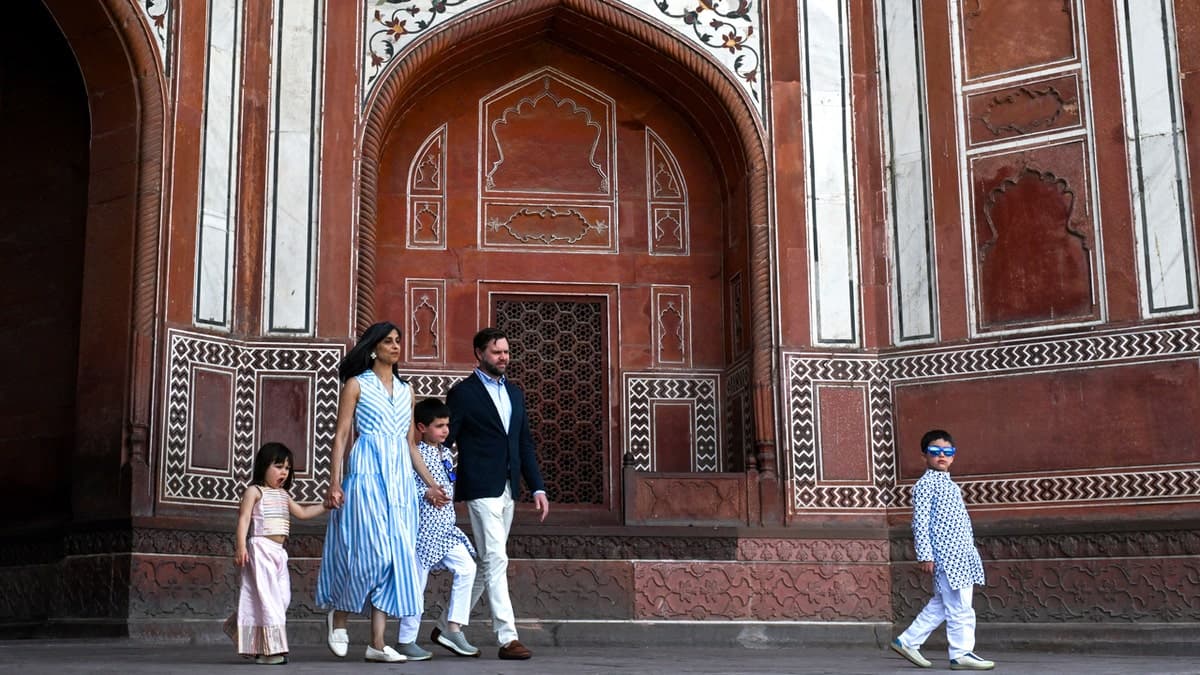
Usha Vance announced Tuesday that she and Vice President JD Vance are expecting their fourth child. By Wednesday morning, three mainstream media opinion writers had already explained, with visible irritation, why this was complicated. The announcement was warm and personal. The reception from certain corners was neither.
The Sneering Started Before the Congratulations Did
Usha Vance's pregnancy announcement drew a wave of media condescension within 48 hours, jokes about "breeding," dismissive commentary tying the pregnancy to the Vice President's policy positions, and multiple opinion pieces questioning whether large families are responsible in the current economic climate. The Vice President responded simply.
"Usha and I are overjoyed. Every child is a blessing beyond measure, and we are grateful beyond words.", Vice President JD Vance
The people writing the condescending takes don't have four children. Most don't have one. That's the tell of the anti-natalist cultural position: loudest about choices they'd never make themselves.
Four children is normal in most of America. In rural Ohio, in South Texas, in the evangelical and Catholic communities that form the backbone of the Republican coalition, a fourth child is cause for celebration. It's specifically inside the Manhattan media and San Francisco tech ecosystems that fourth pregnancies get treated as ideological statements requiring explanation or, worse, defense. The geography of contempt is very consistent.
The Vance announcement deserved warmth. What it got from a significant portion of the commentariat was a cultural audit, a public weighing of whether their family size was appropriate. It wasn't a question. It was a verdict delivered in advance.
What Four Children Means in 2026
The United States fertility rate hit 1.62 in 2023, the lowest recorded in the country's history, and nearly half a point below the 2.1 replacement rate needed to sustain the population without net immigration. That gap between 1.62 and 2.1 isn't a rounding error. It's a demographic trajectory with consequences that compound over decades: labor shortages, Social Security insolvency, a shrinking tax base supporting a growing entitlement obligation, and the slow hollowing of communities built around families who aren't forming them.
Japan sits at 1.20. South Korea collapsed to 0.72, below replacement by almost two-thirds. Japan's working-age population has declined for fifteen consecutive years. South Korea is building schools in active anticipation of closing half of them within a generation. These aren't abstractions from a demographer's presentation. They're the lived reality of countries that ran the experiment the cultural left is encouraging.
The families having more children in America are not the wealthy. Fertility rates are higher among working-class and middle-income households, among rural populations, among religious communities. The college-educated, coastal, media-adjacent demographic is the one most aggressively not having children, and the one most aggressively explaining why everyone else shouldn't either.
JD Vance grew up in Middletown, Ohio. His mother struggled with addiction. His grandmother raised him in the gaps his parents left. He wrote about this. He knows what family structure looks like when it's held together by willpower, not ease. A fourth child doesn't require an explanation in that context. It's just what building something looks like.
Yale Law Graduates Don't Have to Justify Their Families
Usha Vance clerked for Judge J. Harvey Wilkinson III on the Fourth Circuit and for Chief Justice John Roberts on the Supreme Court. She argued cases before federal courts. She had options, every option the cultural establishment respects. And she chose this: this family, this life, this fourth child. With full information about what else was available.
The cultural left has spent two decades building a consensus that ambitious women have small families, that professional success and a large household are in tension, that four children is what you have when you run out of better things to do. Usha Vance is a direct refutation of that framework. She has the credentials the establishment respects and the family it dismisses, and she apparently doesn't see a contradiction between them.
The media doesn't have a category for that combination. So they reach for condescension.
I have four children, two boys and two girls, ages seven through thirteen. When I told people at my son's school we were expecting our fourth, the reactions split cleanly: genuine delight from half the room, and from the other half, a quiet "Oh, was it planned?", asked by people who thought that was a supportive question. It wasn't. It was a reveal. The assumption underneath it was that a fourth child was probably a mistake, or at minimum a decision requiring justification. It didn't require justification then. The Vances' doesn't require it now.
Why the Demographic Math Makes This Political
Vice President Vance has been one of the few national politicians willing to discuss the demographic crisis directly and without apology. He's championed expanded child tax credits, housing affordability reform that enables family formation, and reduced childcare costs for working families who want children but can't afford the infrastructure surrounding them. His critics call this "pronatalist" with a sneer that implies only the unsophisticated want the country to produce the next generation of Americans.
The alternative is Japan at 1.20. The alternative is South Korea at 0.72. The United States is currently at 1.62 and declining. These are not political opinions. They are demographic measurements, and they have a direction.
The Vance announcement is good personal news. It's also a small act of cultural defiance in a media environment that has systematically discouraged exactly this choice, through messaging, through economic policy, through urban development that builds studios and one-bedrooms instead of houses with yards, through a university ecosystem that treats family formation as an impediment to professional identity.
The Vice President and Second Lady are making the alternative visible. That visibility has always mattered, demographics respond to signals as much as to policy. And the signal that accomplished, educated, professionally successful people choose large families is one the country has been missing for thirty years.
Welcome, baby Vance. The country needs you.