Twenty Thousand Bags, Zero Accountability, That's a Monopoly, Not a Market
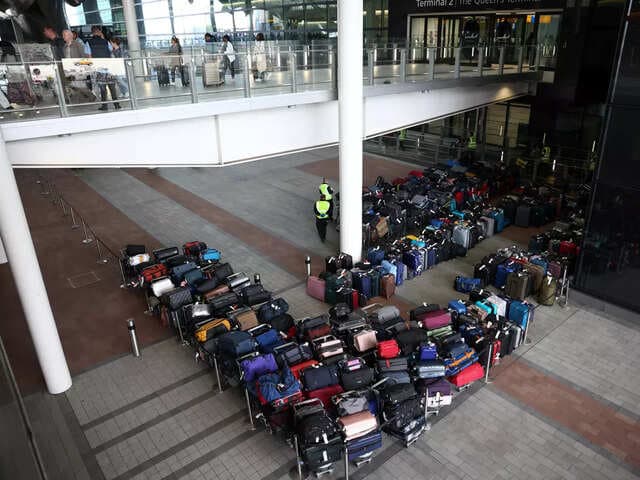
Heathrow Airport's baggage handling system failed on May 23, 2026, stranding an estimated 20,000 bags and leaving travelers scrambling across one of the world's busiest airports. The airport cited a "technical issue." No specific cause was publicly identified. No responsible party was named. No compensation timeline was given to affected passengers. No mechanism forced anyone at Heathrow to face a cost proportional to the disruption they caused.
This is what regulated quasi-monopoly infrastructure looks like when it fails. Not bankruptcy. Not market consequence. Not a competitor stepping in to handle your bags instead. Just a press release about a technical issue and a queue of 20,000 passengers who learned, again, that the entity holding their luggage faces no meaningful accountability to them as customers. Because they have no alternative. And everyone involved knows it.
My practice covers healthcare regulation and small business policy, and the structural pathology at Heathrow maps almost precisely onto what I see in state-regulated hospital monopolies. When an entity faces no competition, it faces no consequences. It faces press conferences and regulatory filings. The distinction matters enormously if you're the person whose insulin is in the delayed bag, or whose luggage is sitting on a Heathrow carousel while their connecting flight departs.
The Monopoly Structure of Major Airports Produces Exactly This Outcome
Heathrow is Europe's busiest airport and one of the five highest-volume airports in the world. It processed approximately 83 million passengers in 2024. It operates under a regulatory framework administered by the UK Civil Aviation Authority, which sets price caps on landing fees and passenger service charges but does not create competitive alternatives for baggage handling infrastructure. When Heathrow's system fails, affected passengers have no alternative. Zero.
The UK's Civil Aviation Act of 2013 gave the CAA enhanced powers over Heathrow's pricing structure and capital investment planning. Those enhanced powers have not produced a baggage handling system robust enough to avoid a 20,000-bag failure. They've produced a system where the regulator approves investment plans and Heathrow implements them on its own timeline, with no competitive pressure to prioritize customer-facing infrastructure over facilities that generate higher revenue per square foot.
Baggage handling is a cost center. In competitive markets, competitive pressure forces cost centers to be maintained to competitive standards because failing customers means losing customers. In a monopoly, failing customers means issuing a statement about a technical issue. Those are fundamentally different incentive structures, and they produce fundamentally different investment decisions over time.
The result is what you saw on May 23: a catastrophic single-point failure in a system that should have redundancy built across every critical node, because an airport processing 83 million passengers per year cannot afford not to have it. But "cannot afford not to" only applies when there's a consequence for not having it.
American Airports Have the Same Structural Problem
Before conservatives use this story as evidence of European infrastructure incompetence: the structural problems at Heathrow are present, in varying severity, at major American airports too. JFK, LAX, O'Hare, and Hartsfield-Jackson Atlanta all operate under regulatory frameworks that limit competition and insulate infrastructure operators from market consequences for service failures.
TSA is a federal screening monopoly with no competitive alternative at any US airport. Baggage handling at major US airports is contracted through a concentrated market, primarily Swissport, Menzies Aviation, and Worldwide Flight Services, operating under airport authority contracts. When those systems fail, affected passengers have no market recourse. The Bureau of Transportation Statistics reported US carriers mishandled approximately 5.4 bags per 1,000 passengers in 2024. That rate tracks poorly against the $35-70 per bag fees airlines now charge, fees that generated $7.9 billion in 2023 revenue, with no automatic compensation mechanism when the service fails.
The libertarian diagnosis is simple: the structure doesn't punish failure. Fixing the structure means creating automatic liability standards that compensate passengers for verified baggage delays at rates proportional to the delay, enforced without requiring the passenger to initiate a formal complaint process. Airlines and airports would then have a direct financial incentive to invest in resilient systems. The technology for real-time bag tracking has existed for years. The economic incentive to deploy it fully does not currently exist.
What Accountability Actually Requires in Regulated Infrastructure
The EU's Air Passenger Rights regulation, EC 261/2004, requires airlines to compensate passengers for significant flight delays and cancellations. It has enforcement teeth, national bodies can levy fines, and passengers can claim compensation through accessible processes. The regulation is imperfect and airlines dispute claims frequently. But it exists, and outcomes for delayed passengers are measurably better under it than without it.
No equivalent regulation exists for baggage handling failures. A passenger whose bag is stranded for three days, missing a business meeting, a medical appointment, or a wedding, has theoretical legal recourse under the Montreal Convention, which caps airline liability for lost or delayed luggage at approximately $1,700. That figure hasn't been updated to reflect current replacement costs and explicitly excludes consequential damages. The missed meeting, the purchased replacement clothing, the business loss, those are the passenger's problem.
Twenty thousand bags. One technical issue. Zero named accountability. This isn't an anomaly in monopoly infrastructure. It's Tuesday. The only thing that changes the outcome is a liability framework that forces airports and airlines to internalize the actual costs of their failures rather than passing them entirely to passengers who had no choice in the matter and no alternative when the system broke down.
The market can fix this. But markets need rules that make them work on behalf of the people they're supposed to serve. Right now, in this specific corner of regulated infrastructure, those rules don't exist.