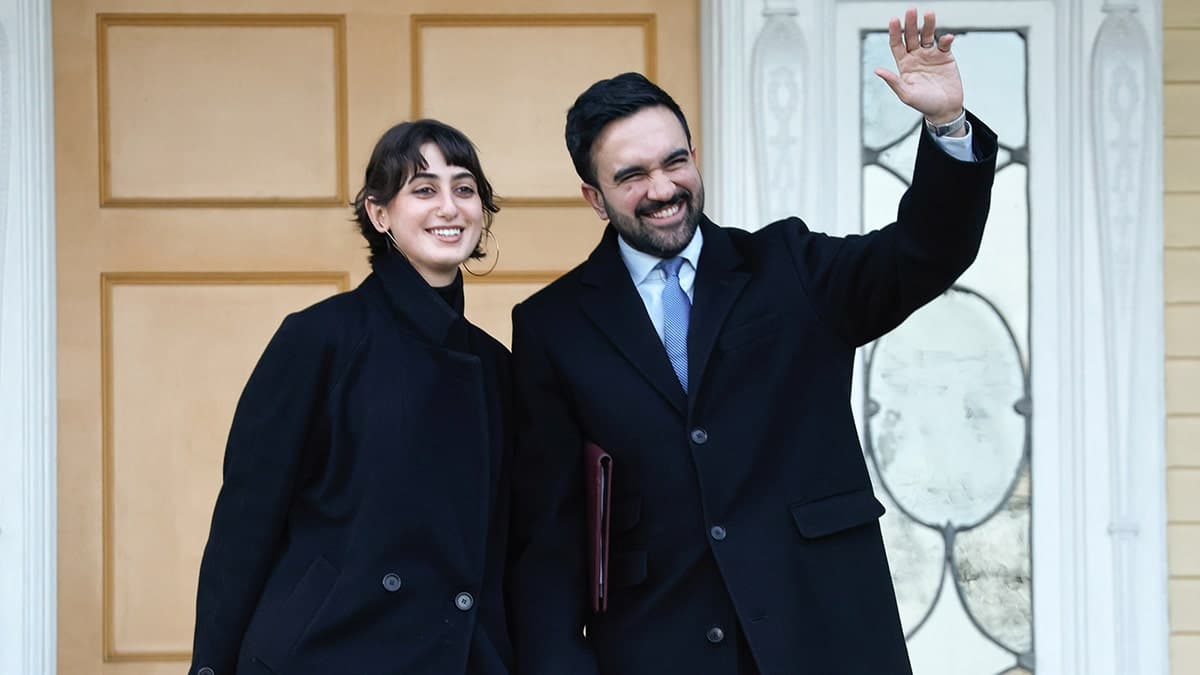
What Mamdani's Wife Liked
Zohran Mamdani won the Democratic primary for New York City mayor. His wife, Rama Mamdani, had liked social media posts celebrating the October 7 Hamas attack on Israeli civilians, an attack that killed 1,200 people in a single morning, including children at a music festival and families dragged from their homes. When this surfaced, the New York press corps covered it with a kind of performative reluctance, accepted a campaign statement, and moved on. Back to the rest of the race.
Let me be precise about what 'liked' means on social media platforms. A like is a public, deliberate action. It is not accidental. It is not ambiguous. You see a post, you decide you want to express positive engagement with it, you tap a button. That sequence takes conscious effort. A like on a post celebrating the slaughter of civilians at the Nova music festival is not a complicated thing to interpret, and yet the New York press corps found it remarkably easy to process and put down quickly.
That asymmetry is the story. Not Rama Mamdani. The press.
How the Soft Treatment Works
The mechanism isn't usually explicit bias in any provable, documented sense. It's subtler than that: a collective editorial judgment about what constitutes a genuinely damaging story versus a complicated one that requires careful handling to avoid looking unfair. Stories about Republican candidates with any proximity to January 6, any association with figures the press has designated as fringe, any statement readable as insufficiently supportive of any protected community, those get the full treatment. Multiple follow-up pieces. Congressional reaction roundups. Demands for explanation at every subsequent press availability.
Stories about Democratic candidates whose family members expressed sympathy for Hamas get a single news cycle and a campaign statement. Then the story becomes about whether it's appropriate to hold candidates responsible for family members' social media activity. Then it fades. I've been tracking media coverage of October 7-related statements by political figures since the attack. The pattern isn't random. It reflects institutional judgments about which communities deserve journalistic protection, which sympathies are understandable even if regrettable, and which voters the publication is ultimately trying to serve.
The New York press corps that covers City Hall, the Times, the Post, the Daily News, the various digital outlets that now set the city's media agenda, made a collective editorial decision about how hard to push this story. They pushed lightly. They moved on. That's a choice with consequences.
The Digital Trail Nobody Wants to Follow Consistently
Social media platforms create permanent, searchable public records of political sentiment. Likes, shares, follows, comments, all documented, timestamped, publicly accessible. We have more information about the expressed sympathies of political figures and their close associates than at any point in human history. The question is whether that information gets used consistently or selectively, and the answer in New York's 2025 mayoral race is: selectively.
For Republican figures, opposition research teams have become expert at mining these records. A decade-old tweet surfaces. A follow of the wrong account becomes a three-day story. The standard for relevance, applied consistently, is whether a digital record reveals something meaningful about a candidate's character and worldview. That's actually a fair journalistic standard. The problem is the word 'consistently' is doing heavy lifting in that sentence and failing to carry the weight.
Rama Mamdani's likes aren't ancient history or obscure corner-of-the-internet content. They're a direct window into the expressed sympathies of someone who will have significant informal influence in the next New York City mayoral administration. The press had the tools to examine that record thoroughly. The press made a choice about how thoroughly to use them. And New York, the city with the largest Jewish population outside Israel, a city that lost residents in the October 7 attack, a city with large Arab-American and Muslim communities whose concerns also deserve serious coverage, deserved better than managed journalism calibrated to minimize political discomfort.
What Gets Covered and What Doesn't
The press will argue this is because the likes were Rama's, not Zohran's. That the candidate himself never expressed those views. That it's unfair to hold a politician responsible for a family member's social media activity. These are reasonable objections, and I take them seriously. I'd take them more seriously if the same standard applied in the other direction with any consistency. It doesn't. Proximity matters in political journalism, or it matters selectively, which is its own form of bias.
New York City voters deserved a full picture, clearly reported, so they could make their own judgment. They didn't get that. They got coverage calibrated by outlets that had already decided, before the reporting was complete, what the appropriate weight of this story should be. That's not journalism. It's editorial advocacy with a press badge.
The Mamdani administration will face questions about its approach to Israel, to Hamas, to the city's Jewish communities, to the broader Middle East policy debates that now reach into every American city. The press that soft-pedaled this story during the campaign will be the same press covering the administration's policy choices. That's a credibility problem they've created for themselves. And it's one New Yorkers should keep in mind when they read the coverage going forward.