The Distinction Exists for a Reason
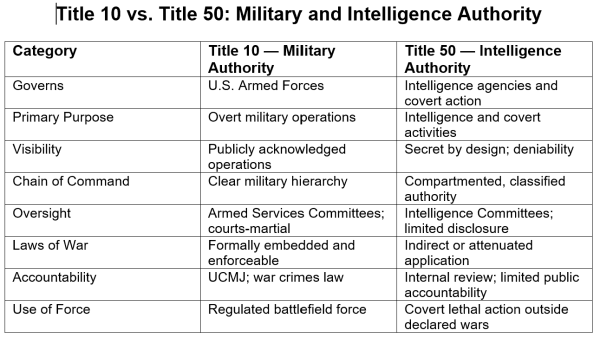
Title 10 of the United States Code is the legal framework that governs the armed forces. Title 50 is the framework that governs intelligence activities. They are not interchangeable. They were never meant to be. Congress wrote two different titles because military operations and intelligence operations carry two different sets of accountabilities, two different oversight structures, and two different relationships with the law of armed conflict. When practitioners blur the distinction, they are not being clever. They are degrading the architecture that lets a republic conduct both kinds of operations without losing the ability to know which is which.
Operationally, the difference shows up at the first slide of a briefing. A Title 10 operation is conducted by a uniformed force, under the chain of command of a combatant commander, with the law of armed conflict as its operating framework and the Armed Services Committees as its congressional oversight. A Title 50 operation is conducted by an intelligence agency under a presidential finding, with covert action authorities, and with the Intelligence Committees holding oversight. Same building, different room, different rules.
How the Blurring Happens
The blurring does not happen because anyone sits down and decides to launder authorities. It happens because the operational requirement crosses the line that Congress drew, and the practitioner reaches for whichever authority is closer to hand. When Cyber Command needs to act fast against a foreign adversary on a foreign network, the Title 10 authority is the closest tool. When the National Security Agency has the technical access already in place, the Title 50 authority is the closer tool. When the two are blended without clean documentation, the oversight system breaks downstream.
For the record, the legal architecture has been broadly stable since the 1991 Intelligence Authorization Act codified covert action under section 503 of the National Security Act. What has shifted is the operational tempo. The 2018 redesignation of U.S. Cyber Command as a unified combatant command, the 2018 publication of the Department of Defense Cyber Strategy with its persistent engagement framing, and the various executive orders since then have all pushed Title 10 cyber operations into territory that, in the older architecture, would have lived under Title 50.
Why It Matters to People Who Will Never Read a Statute
The people who feel this in their work are the operators on the floor and the lawyers in the building. Operators end up briefing the same activity to two different oversight bodies, sometimes simultaneously, and each oversight body sees a slightly different version of the same thing because the activity was authorized under two slightly different frames. The lawyer's job is to keep those framings consistent enough that nobody on the oversight side ends up reading a transcript that contradicts the version they read last week. The lawyer's job is harder when leadership does not respect the distinction.
The cost to morale on the operational floor is real and is rarely discussed. Workforce members who watched the architecture get built, and who learned the discipline as a condition of access, see the blurring and they recognize what it costs. The discipline is not a bureaucratic preference. The discipline is the reason the institutions hold up under scrutiny. When leadership treats the discipline as optional, the workforce that holds the building together starts looking for a different building.
The Honest Version
The honest version of the policy debate is that the U.S. needs both kinds of authorities and needs them executed cleanly. The debate is not whether to fuse Title 10 and Title 50 into a single new authority. The debate is whether to update each title in ways that reflect the operational realities of cyber, of artificial intelligence in collection, and of the speed at which adversaries move. That debate belongs in the open committees of jurisdiction. Some of it belongs in classified annexes. None of it belongs in the practitioner's expedient choice between two authorities that the practitioner does not have the authority to redesign.
Members of the House Permanent Select Committee on Intelligence and the House Armed Services Committee have been working through these questions in a series of joint sessions over the last several months. The work is slow because the questions are hard. The work is being done by people who take the architecture seriously. That is the work that produces durable authority. The expedient laundering is not.
What I Would Tell a New Officer
If you are a new officer arriving at a cyber unit and you are trying to figure out which authority applies to your work, ask the lawyer. Ask the lawyer before you ask the operations chief. Ask the lawyer in writing. Make the lawyer answer in writing. The lawyer's written answer is the document that protects you if the oversight committee ever wants to know who authorized what. The lawyer wants to give you that answer in writing because the lawyer also needs the document.
The senior officers who lasted thirty years in this work did so by treating the authority question as the first question, not the last. They did so because they understood that the authority answers the question before the politics does. That formula is older than any of us. It is also more reliable.


