The Statutory Problem and Its Origins
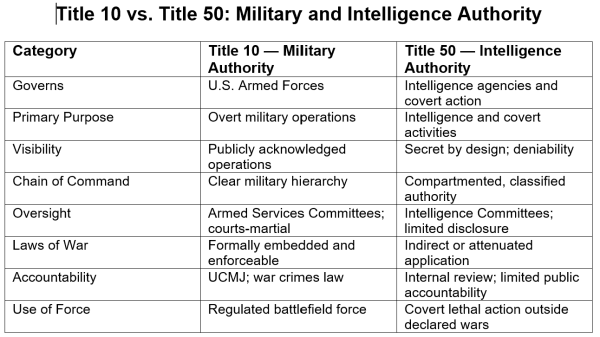
U.S. Cyber Command operates under a confusing legal mandate that splits its authority between two different statutory frameworks. Title 10, the Defense Department statute, governs military cyber operations: defensive action against military networks, support to combatant commanders, response to attacks on Department of Defense systems. Title 50, the Intelligence Authorization Act, governs covert action: offensive operations designed to advance policy objectives without attribution, operations conducted under presidential finding and requiring congressional notification, work done in the shadows to influence foreign governments or non-state actors.
In theory, the boundary is clear. In practice, it is murky. Cyber operations almost always have both military and intelligence dimensions. An operation to degrade an adversary's command-and-control infrastructure has military value, but it also generates intelligence about the adversary's network topology and operational capabilities. An operation to disrupt a terrorist group's financial systems has intelligence applications and early warning value, but it also has kinetic consequences: it makes people stop financing terrorism and stops a funding pipeline. Cyber Command has to navigate this ambiguity constantly. The costs of navigating it wrong range from minor bureaucratic friction to federal crimes. A Title 50 operation executed without proper authorization is espionage. A Title 10 operation conducted covertly can violate the covert-action statute.
The problem became acute after 2020, when Cyber Command transitioned from an organization that mostly supported special operations and combatant commanders to an organization that conducts independent offensive cyber operations under direct presidential authority. That transition required expanding Cyber Command's Title 50 authorities substantially. But Title 50 authorities require presidential finding, congressional notification, and inspector general oversight. They require lawyers to sign off. They require deniability infrastructure and compartmented access controls. Military commanders accustomed to operational independence under Title 10 found themselves answerable to civilian oversight structures that did not exist in the Title 10 world. That friction is still present and has become more pronounced as operational tempo has increased.
Operational Consequences and the Authority Bottleneck
The operational consequence is straightforward: authorities that should take days to exercise now take weeks or months. When a cyber threat emerges and Cyber Command has a window of a few hours to respond, the legal review process cannot keep pace with the threat timeline. Commanders have to make calls about whether they are operating under Title 10 or Title 50 authority, and those calls determine whether they have to go through civilian chains of command or military chains of command. Get the call wrong and you are exposing yourself to legal liability. Get it right and you move faster, but you might be exceeding your actual authorities. The ambiguity is the problem.
Inside Fort Meade, the consensus view among career operators is that Cyber Command has too many lawyers and too much process. That consensus exists because the legal processes impose real operational costs. An offensive cyber operation that requires Title 50 approval might take eight to twelve weeks to authorize and execute. The same operation might be achievable in forty-eight hours under Title 10 authority. But if the operation is genuinely covert action with policy consequences, then the Title 10 path is not legally available. The operator has to go the slow route. The operational reality is that adversaries do not wait for American bureaucracy to catch up. A threat window measured in days does not respect a legal review process measured in weeks.
The Congressional pressure to clarify the boundary has been building for three years. Intelligence Committee staffers have told Cyber Command leadership that Congress is prepared to legislate a cleaner split between Title 10 and Title 50 authorities. That legislation could actually expand Cyber Command's Title 10 authorities for clearly military operations while simultaneously clarifying that Title 50 operations require the full covert-action authorization structure. The practical effect would be faster execution of clearly military operations and slower but clearer execution of covert action. For an organization caught in legal ambiguity, clarity is worth slowing down some operations to speed up others.
The Broader Institutional Context and Career Implications
This debate is happening inside a larger conversation about whether Cyber Command should remain subordinate to NSA. The National Security Agency has its own Title 50 authorities rooted in its signals intelligence mission. Cyber Command inherited some of those authorities through the unified command structure. NSA leadership argues that keeping Cyber Command under NSA control ensures efficient coordination between offensive cyber operations and signals intelligence collection. Cyber Command leadership argues that the military mission requires operational independence and that NSA bureaucracy slows down military cyber operations. The distinction between Title 10 and Title 50 authority maps directly onto this organizational debate. If Title 10 authorities expand and become more clearly defined, military independence becomes more operationally plausible. If Title 50 authorities remain dominant as the primary path for significant offensive operations, NSA control makes structural sense.
The workforce impact is real and measurable. Cyber operators, intelligence analysts, and supporting specialists do not think about these distinctions in abstract legal terms. They think about them in career terms. A Title 10 operation keeps you in the military chain of command with military promotion and assignment tracks. A Title 50 operation keeps you answerable to intelligence oversight with intelligence career consequences. Over a thirty-year career, those distinctions matter for clearances, assignments, promotional track, and retirement benefits. Young operators are starting to specialize: some deliberately pursue Title 10 careers, some pursue Title 50 careers. That specialization is a sign that the distinction has operational teeth. It is also a sign that organizational clarity is needed.
The resolution will likely come from legislation, not internal restructuring. Congress has the interest and the authority to clarify the boundary. The question is how much that boundary clarification constrains military operational independence and how much it actually improves deniability and civilian control of covert action. That is a debate worth having explicitly rather than working through in the fog of legal ambiguity. The next Congress will probably take it up.


