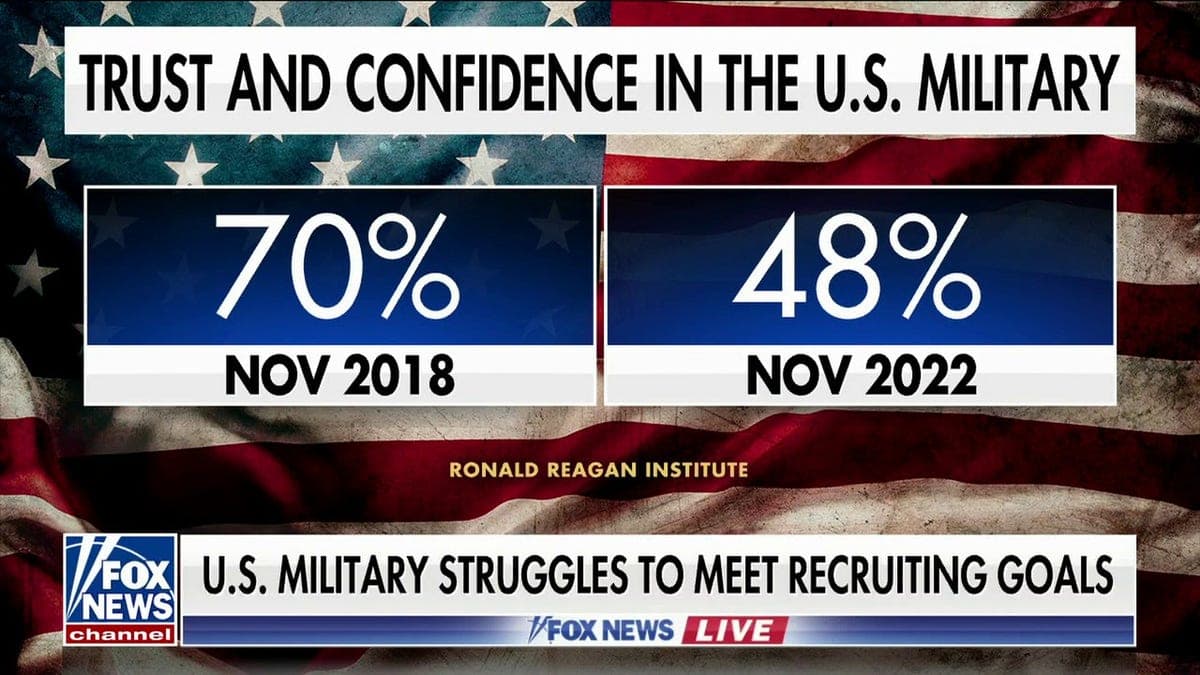
The Recruitment Shortfall
In February, the Army National Guard failed to meet monthly recruitment targets for the eighth consecutive month. The shortfall: 4,200 soldiers below goal. The cause isn't complicated. High school seniors reject military service at higher rates than any point in the all-volunteer era. A 2026 Pentagon analysis found that 77% of Americans aged 17-24 are ineligible for military service due to obesity, drug use, mental health conditions, or lack of educational attainment. Of the remaining 23%, roughly 9% expressed willingness to enlist. The pool of eligible, interested recruits has collapsed into a narrow demographic band.
Pentagon recruiters report that once-reliable recruitment zones have become hostile territory. Urban and suburban areas where recruiting stations operate report foot traffic down 40% compared to 2022. Rural areas, traditionally the military's recruitment backbone, are now being tapped out as small-town enlistment rates approach saturation. One Army recruiter told me that his station in rural Ohio recruited 18 soldiers in 2022. In 2025, that number was 8. In early 2026, it's tracking toward 4. Geographic recruiting advantage has evaporated. The military's margin for growth has compressed to near zero.
The military is competing for the same diminishing pool of recruits against tech companies, skilled trades, and college programs. Amazon offers $15-$20 per hour starting wages and benefits. Microsoft offers technical training programs with $18-$22 starting rates. The military offers $22,000 annually for basic training. On a pure economic basis, the military loses. On a cultural basis, it loses harder. Military service is perceived, particularly among younger Americans, as dangerous, restrictive, and ideologically suspect. A commercial aired during college sports games showing a gender-nonconforming soldier was designed to broaden recruitment appeal but generated backlash from the military's traditional recruitment base and did nothing to improve actual recruitment numbers.
Readiness Consequences
Understaffing directly impacts deployment readiness. The 82nd Airborne Division reported in March that its global response force, designed to deploy anywhere in the world within 18 hours, would require 72 hours to achieve full strength if activated. That's not acceptable for a rapid-response unit. Rapid response requires rapid deployment. A 54-hour delay in a crisis response is strategically significant. Other units report similar bottlenecks. The Special Operations Command reported that one of its active rotation squadrons cannot support projected deployment schedules without drawing personnel from non-deployment rotations. That cascades through the force.
Training pipelines are compressed. Recruits who would previously receive 12 weeks of individual training now get 8. Drill sergeants report that soldiers arrive at operational units less prepared than their predecessors. Technical competency on vehicle systems, weapons platforms, and communications networks is lower than historical baseline. The military is trading depth of training for speed of deployment. Over time, that trades readiness for appearance of readiness. It's a calculation that works until it doesn't.
The strategic implications are serious and acknowledged inside the Pentagon. If the U.S. faces simultaneous conflicts in the Pacific and Europe, the current active-duty strength cannot support sustained operations in both theaters for 18 months without drawing on reserve component forces. That was historically acceptable risk management. The strategy assumed rotating deployments through the reserve component and allied force support. But the reserve component is also understaffed at 87% of authorized strength. A comprehensive Pentagon war game conducted in early 2026 concluded that current force structure could not sustain a two-theater conflict beyond 9 months without significant casualties among the force due to fatigue and inadequate rotation cycles. The gaming was classified, but the conclusion leaked to Congressional staffers.
What Comes Next
Solutions exist but are unpopular. The military could increase basic pay substantially, which would cost roughly $4 billion annually and would need Congressional appropriation. It could reduce physical requirements, which would meet fierce resistance from traditionalists and from current service members who see lowered standards as devaluing their service. It could reduce deployment rotation lengths, which would increase strain on existing personnel and would cascade through family stability metrics. It could rely more heavily on private contractors, which creates dependency on commercial entities for core military functions and generates national-security vulnerabilities. Or Congress could authorize a limited return to conscription, which would generate the population replacement the military needs but would face enormous political resistance and would alter the military's character fundamentally.
For now, the military is relying on stop-gap measures: higher re-enlistment bonuses (up to $45,000 for experienced personnel), shortened service contracts to lower commitment barriers, and aggressive pursuit of prior-service recruits. These tactics address the symptom, not the cause. The cause is structural: the military is becoming less attractive as a career option to the population that has traditionally filled its ranks. Until that shifts, recruitment will continue to decline and readiness assessments will continue to deteriorate. The Pentagon knows this. Congress knows this. The question is whether the political will exists to make the structural changes required to reverse it.


