The Surface Debate And The Real Debate
The surface debate on cyber force structure has, for two years now, focused on whether to establish a separate uniformed service for cyber operations, modeled in part on the establishment of the United States Space Force in 2019. The proponents of a separate service argue that the cyber mission has grown beyond what the existing service branches can support. The opponents argue that the cyber mission is best executed through the existing branches with appropriate joint structures. The debate has produced congressional study committees, departmental working groups, and several Foreign Affairs articles that have read more like position papers than analyses.
The surface debate obscures the real debate. The real debate is not principally about service branch organization. The real debate is about what authority architecture the cyber mission actually requires, and whether any of the available architectures, including the architecture a separate service would create, addresses the structural problems that the current arrangement has not addressed.
The Authority Architecture Question
The authority architecture question turns on the relationship between Title 10 authorities, Title 50 authorities, and the various subordinate authorities the executive branch has constructed under Executive Order 12333 and under more recent National Security Presidential Memorandums. The current architecture distributes cyber operations across multiple legal frameworks that overlap in some respects and that produce, at the operational floor, the kind of friction that the policy debate does not adequately characterize.
A separate uniformed service for cyber operations would inherit some of the existing authority architecture, would carry forward some of the existing friction, and would create new authority questions that the establishing legislation would have to address. The establishing legislation, in any plausible draft, would take years to write, to debate, to pass, and to implement. The years in question are years in which the adversary's operational tempo will not pause to accommodate the legislative process.
What The Service Branches Already Do
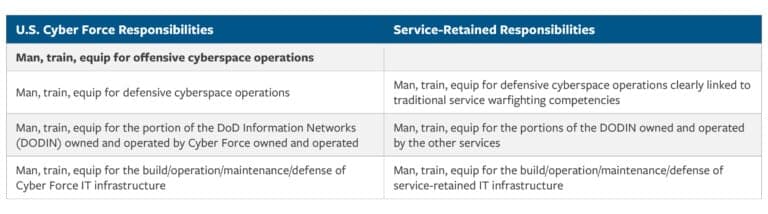
The existing service branches already operate cyber forces under existing authorities. The Army Cyber Command, the Navy's Fleet Cyber Command, the Air Force's 16th Air Force, the Marine Corps Forces Cyberspace Command, and the Space Force's cyber elements all conduct meaningful cyber operations under Title 10 authorities, in support of U.S. Cyber Command's joint mission. The arrangement is not optimal. The arrangement is the arrangement that exists and that the workforce executes against every day.
The arrangement's principal weakness is in the workforce retention and training pipeline, which is fragmented across the service branches in ways that the joint structures cannot fully overcome. A new uniformed cyber service might consolidate the pipeline. A new uniformed cyber service might also produce, in the consolidation process, the kind of disruption that fragments the workforce further before consolidating it. The choice between the two outcomes is a choice between two real costs, not a choice between a cost and a benefit.
The Title 50 Side Of The Equation
The Title 50 side of the equation is the side the service-branch debate has spent the least time on. The intelligence community's cyber capabilities, principally housed at the National Security Agency, operate under authorities and accountabilities that are categorically different from the Title 10 authorities under which the military cyber forces operate. The categorical difference is the difference that the persistent engagement doctrine and its derivatives have tried to bridge operationally without resolving structurally.
A separate uniformed service would not address the Title 10 to Title 50 boundary. The boundary would remain. The friction at the boundary would continue. The structural question of how to manage the boundary has been the structural question since 2004 and remains the structural question now. Operationally, the authority answers the question before the politics does. The politics has not, in twenty years, produced a durable answer.
What The Operations Floor Would Tell You
What the operations floor would tell you, if the operations floor were permitted to speak in the policy debate, is that the structural problems the policy debate is trying to solve are not principally problems of service branch organization. The structural problems are problems of personnel retention, of training pipeline depth, of cleared infrastructure capacity, of acquisition cycle speed, and of the bureaucratic friction between the operational mission requirement and the administrative system that supports the mission.
None of those structural problems would be solved by a new uniformed service. Some of them might be addressed by a new uniformed service, depending on how the establishing legislation was written. Most of them could be addressed within the existing arrangement if the institutional will existed to address them, and the institutional will is the variable that the policy debate is most reluctant to confront. Inside the wire, the variable is the variable. The variable is the variable that decides outcomes.
The Honest Forward Read
The honest forward read is that the cyber force debate will continue, that congressional study groups will produce reports, that the Department of Defense will commission its own assessments, and that the legislative outcome will, in some form, eventually emerge. The legislative outcome may be a separate service. The legislative outcome may be a substantial reorganization within the existing services. The legislative outcome may be a modest set of authorizing language changes that resolve some friction without addressing the structural questions.
The operational outcome, regardless of which legislative outcome arrives, will depend on whether the institutional will to invest in the workforce, in the infrastructure, and in the acquisition process accompanies the legislative outcome. The will has been the variable for twenty years. The next budget cycle will tell us whether the variable is moving. The capability has been there. The will has been the question.


