The Acquisition Tempo Problem
The Department of Defense's major-program acquisition cycle, from initial requirement definition to full operational capability for a major platform, has averaged approximately fourteen years across the trailing twenty-five years. The cycle has produced platforms that, in the categories where the United States has invested the most, are without peer in their respective domains. The cycle has also produced a tempo problem that the strategic environment of the next decade will not tolerate at the levels the prior strategic environment did.
The strategic environment the United States designed the current acquisition system to operate within assumed a peer competitor whose own acquisition tempo was comparable, whose technological development cycle was comparable, and whose industrial base was constrained by economic conditions broadly similar to the U.S. base. The assumption was correct about the Soviet Union for most of the Cold War, was correct about Russia in the post-Cold War period, and is, in the contemporary period, materially incorrect about the People's Republic of China.
What The PRC Acquisition Tempo Produces
The People's Republic of China's acquisition tempo, on the categories where the publicly available reporting permits a comparison, produces major platforms at intervals materially shorter than the U.S. tempo. The PRC's J-20 stealth fighter program, from initial development to fielded squadrons, ran approximately ten years. The U.S. F-35 program ran approximately eighteen years for the comparable milestone. The PRC's Type 055 destroyer program, from keel-laying of the lead ship to commissioning, ran approximately four years. The U.S. comparable destroyer program, the Arleigh Burke Flight III, has run a comparable interval but on a smaller per-year hull-production rate.
The tempo gap is structural. It is the product of the PRC's industrial base scale, of the PRC's defense industrial integration with its commercial industrial base, of the PRC's acquisition decision-making structure, and of the PRC's willingness to absorb prototype and early-production deficiencies in exchange for fielded capability that can be refined through subsequent production blocks. The combination is not the combination the U.S. acquisition system was designed to produce.
The U.S. Acquisition System's Honest Strengths
The U.S. acquisition system has honest strengths the contemporary commentary often underweights. The system produces platforms whose performance, at the high end of capability, exceeds the comparable PRC platforms in most categories. The system produces platforms whose operational sustainability exceeds the comparable PRC platforms. The system produces platforms whose interoperability with allied platforms exceeds the comparable PRC platforms by a margin that the PRC has not yet demonstrated the capacity to close.
The strengths are real. The strengths are also, in the cumulative strategic equation, insufficient to compensate for the tempo gap. The strengths matter most in scenarios in which the U.S. holds a meaningful capacity advantage in absolute terms. The strengths matter less in scenarios in which the PRC's capacity advantage in absolute terms allows the PRC to operate, in volume, against the U.S. and allied force structure. The scenarios are increasingly the second kind.
The Reform Question
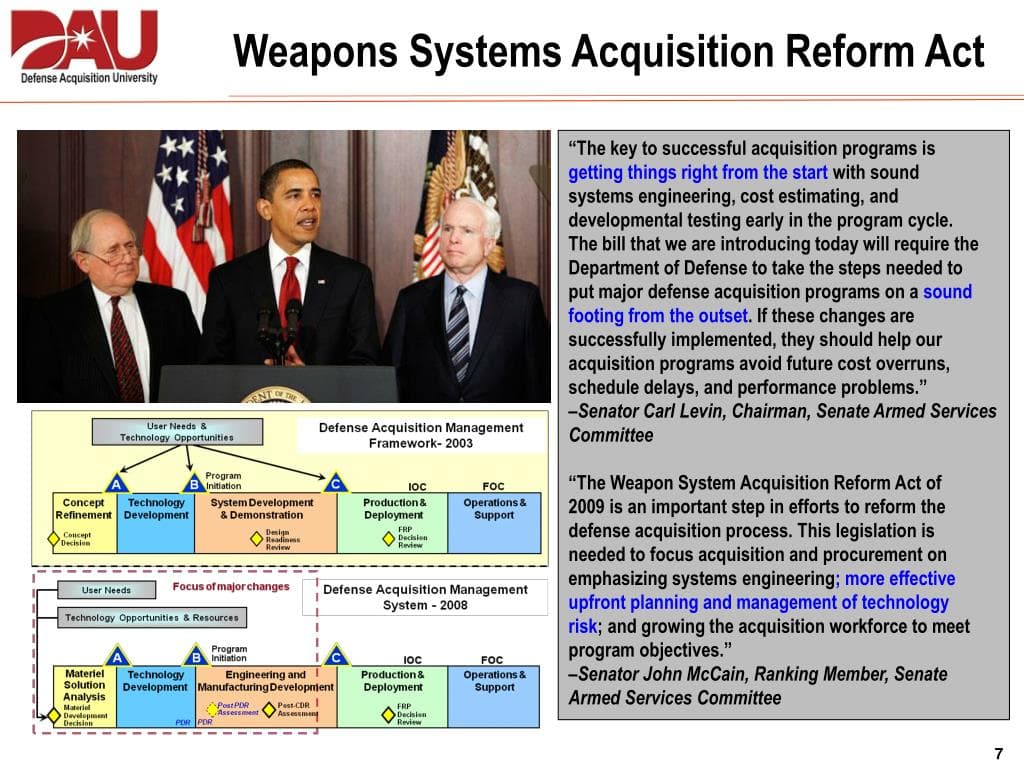
The reform question is the question the Pentagon has been working on for two decades and that has produced incremental improvements without producing the structural change the strategic environment requires. The reform proposals that have been most discussed include faster requirements definition processes, more aggressive use of other transaction authority and middle-tier acquisition pathways, integration of artificial intelligence in the development and testing cycles, and a more disciplined production-program design that emphasizes fielding capable platforms at scale rather than fielding optimal platforms at small numbers.
Each of the reform proposals is, in plain reading, a reasonable response to a specific dimension of the tempo gap. Each has been pursued, in some form, in the trailing decade. None of the reforms, individually or in the aggregate, has produced the tempo reduction that closes the gap with the PRC's contemporary acquisition rate. The cumulative impact has been to slow the rate of tempo divergence rather than to reverse it.
What Reform Would Actually Require
What reform would actually require, in the honest reading, is structural change in the relationship between the U.S. industrial base and the Department of Defense. The relationship has, over the trailing four decades, evolved into a smaller number of consolidated prime contractors whose financial structures incentivize program longevity rather than program completion, whose engineering workforce trajectories have produced the kind of institutional knowledge concentration that limits flexibility, and whose relationships with the Department's acquisition workforce have, over time, become more deeply institutionalized than reform proposals have, in practice, been able to constrain.
The structural change required would include a meaningful expansion of the participating contractor base, a meaningful reform of the contracting incentive structures that produce program longevity, and a meaningful expansion of the in-house Department capacity for program oversight that the trailing decades' workforce reductions have not maintained. The structural change required is the kind of change that, by its scale, requires sustained political will across multiple administrations. The political will has not, in the trailing two decades, sustained across the relevant interval.
The Honest Strategic Read
The honest strategic read is that the United States retains the acquisition capability to close the tempo gap with sustained structural reform. The honest strategic read is also that the structural reform required exceeds the political will the country has, in the contemporary moment, demonstrated. The gap will, in the absence of the reform, continue to widen over the next decade. The strategic consequence will, in the absence of the reform, narrow the operational options available to U.S. leadership in any future contingency in the Indo-Pacific.
This is not a crisis of capability. It is a crisis of will. The acquisition reform debate is the debate that converts the abstract crisis of will into the concrete budget and policy choices that the system requires. The conversion has been deferred for two decades. The deferral is the deferral. The arithmetic of the deferral will, in time, be the arithmetic that defines the strategic constraints of the country's options. Strategic patience is not strategic passivity. The current posture is the latter. The next decade will produce, one way or another, the corresponding consequence.


