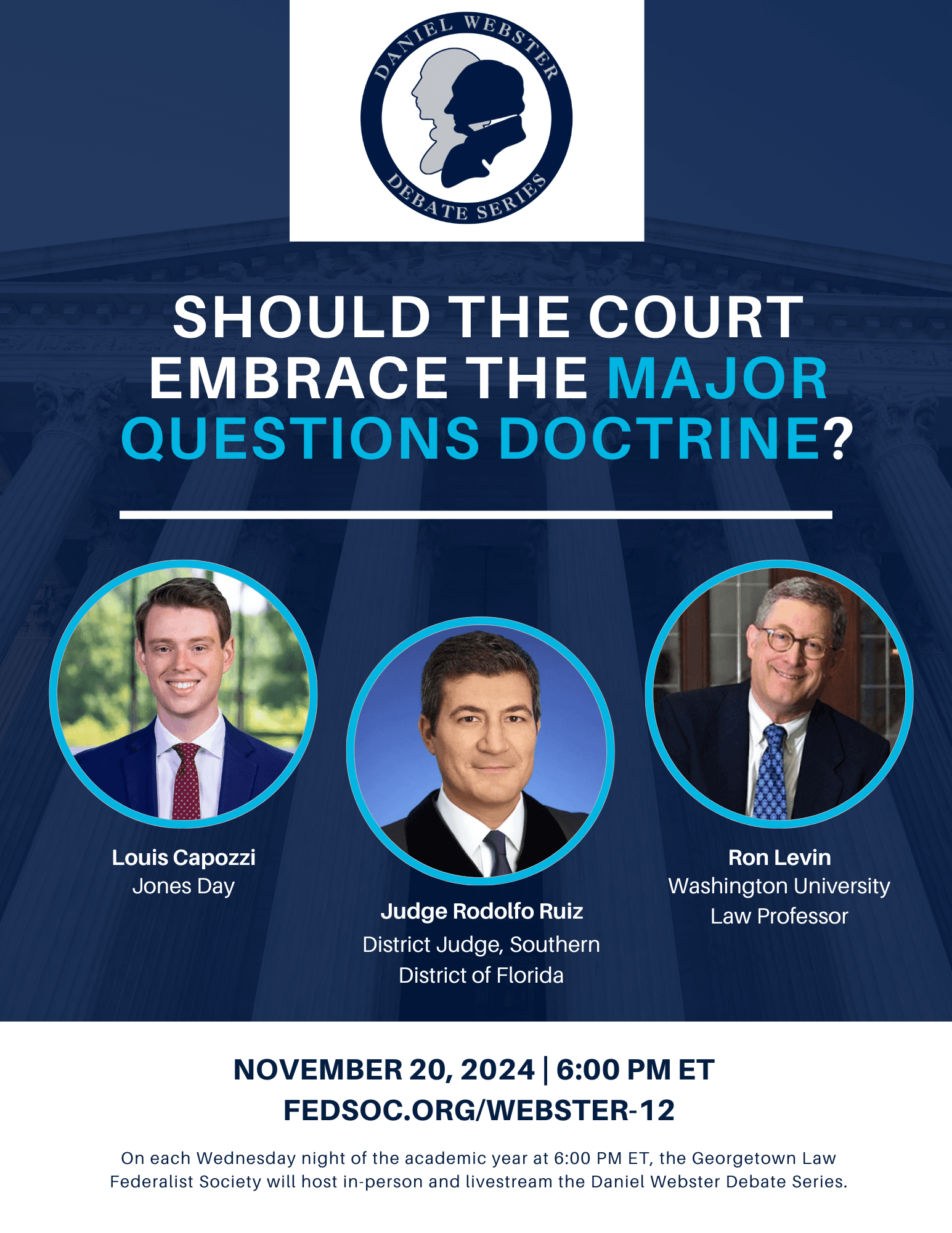
What The Doctrine Says
The Constitution is clear on this point. Article I vests legislative power in Congress. Article II vests executive power in the President. Where Congress has not spoken with sufficient clarity to delegate a question of vast economic or political significance to an executive agency, the agency does not possess the authority to decide that question. The major questions doctrine, as the Supreme Court articulated it in West Virginia v. Environmental Protection Agency in 2022 and refined in National Federation of Independent Business v. Department of Labor in 2022, requires clear congressional authorization for agency actions of vast economic or political significance. The text admits of no other interpretation.
The doctrine has been in operation for four terms now. It has been applied unevenly. Lower courts have struggled with the threshold question of what counts as a major question and what counts as a routine exercise of administrative authority. The three cases now before the Court this term, scheduled for decision before the end of the current sitting, will tell us whether the doctrine is hardening into a durable analytical framework or whether the Court intends to step back from the more expansive readings the lower courts have applied.
The Three Cases
The first case, Securities and Exchange Commission v. Continental Holdings, tests whether the SEC's recent enforcement posture on climate-related disclosure requirements qualifies as a major question. The petitioner argues that the SEC's enforcement actions go beyond the disclosure framework Congress authorized in the Securities Exchange Act of 1934 and effectively conscript public companies into reporting on activities that Congress has not authorized as within the SEC's remit. The agency's defense leans heavily on the proposition that climate disclosure is a routine extension of the materiality framework the Court has approved for decades. The case is the cleanest test of how the Court intends to define the threshold.
The second case, American Hospital Association v. Department of Health and Human Services, presents the major questions doctrine in the context of Medicare reimbursement rule changes that, by HHS's own analysis, will shift approximately $48 billion in annual reimbursement allocations among provider classes. The case is procedurally interesting because the agency action arguably falls within the literal authorization of the Medicare statute but represents a use of that authorization that Congress, when it wrote the statute, almost certainly did not anticipate. The case asks whether the doctrine reaches actions that are within the statutory text but outside the legislative expectation.
The third case, Liberty Bell Resources v. Bureau of Land Management, tests the doctrine in the context of public lands management. The Bureau issued a rule restricting energy development on approximately 11 million acres of federal land, citing climate and conservation authorities. The petitioner argues that the scale of the rule, in acres and in foregone economic activity, places it squarely within the doctrine's reach. The agency's defense is that public lands management has, by statute, been delegated to the Secretary of the Interior in language that historically the Court has read broadly.
What The Oral Arguments Revealed
Let us read what the Justices actually said. The oral argument in the SEC case revealed a clean five-vote bloc skeptical of the agency's position, with Justice Kavanaugh joining the four originalists in pressing the agency's counsel on the textual basis for the disclosure framework. Justice Barrett's questions focused on the institutional competence point, which is the analytical move that has done the heaviest lifting in the doctrine's development. The questions from the Chief were narrower, focused on the remedy rather than the underlying authority.
The oral argument in the AHA case was more fragmented. The agency's counsel had a better day. Justice Sotomayor and Justice Kagan pressed the petitioners on the limiting principle, which is the question every doctrinal expansion eventually has to answer. The Chief's questions in that case were the questions of a Justice looking for a narrow ground to decide on. The narrow ground exists. The narrow ground will probably carry the case.
The Bureau of Land Management argument was the clearest. The agency's position struggled under questioning. The five-vote bloc that has carried the major questions doctrine through its recent development was visibly intact. Justice Gorsuch's questioning was, in characteristic form, focused on the structural question of whether the agency was attempting to do what Congress had not done. The questioning suggested where the votes are.
The Decision Pattern To Watch
The decision pattern matters because the three cases test different versions of the doctrine. A five-four decision in the SEC case, on textualist grounds, paired with a narrower ruling for the agency in the AHA case, paired with a clean win for the petitioner in the BLM case, would tell us that the Court is consolidating the doctrine in its strongest form for genuinely vast questions while declining to extend it to merely large questions. That pattern, if it emerges, would be the most consequential development in administrative law since Chevron's effective overruling in Loper Bright Enterprises v. Raimondo in 2024.
A different pattern, in which the Court declines to apply the doctrine in two of the three cases on narrow procedural grounds, would tell us that the Justices in the middle of the Court are pulling back from the doctrine's recent expansion. That pattern would not overrule West Virginia v. EPA, but it would signal that the doctrine's analytical reach is going to be more contained than the lower courts have assumed.
The Implications For Practice
For practitioners, the implications are direct. Litigants challenging agency action under the doctrine are going to need to make the threshold showing with more analytical rigor than the lower courts have demanded over the last three years. The boilerplate citation to West Virginia v. EPA, on its own, is not going to be sufficient. The challenger is going to need to show, with quantitative specificity, that the agency action falls within the doctrine's scope as the Court is now articulating it.
For Congress, the implications are also direct. The Court is, in effect, telling Congress to legislate with greater specificity if Congress wants the executive branch to exercise the authority Congress has delegated. The legislative drafting practice on the Hill has begun to adjust. The drafting practice will adjust more if the decision pattern in these three cases confirms the doctrine's reach.
What I Will Be Watching For
What I will be watching for, in the opinions when they land before Memorial Day, is the explicit articulation of the threshold test. The Court has been content, for four terms, to apply the doctrine without articulating the test in a form that lower courts can apply mechanically. The lower courts are asking for the test. The litigants are asking for the test. The agencies, in their own way, are asking for the test. The Court has not yet given the test.
If the test arrives in one of these three opinions, the doctrine becomes a durable framework. If the test does not arrive, the doctrine remains a Supreme Court instrument that the lower courts cannot reliably wield. The difference between those two outcomes is the difference between a constitutional principle that constrains agency action and a constitutional principle that constrains agency action only when the Supreme Court chooses to invoke it. The first is the doctrine the Constitution requires. The second is the doctrine we currently have.