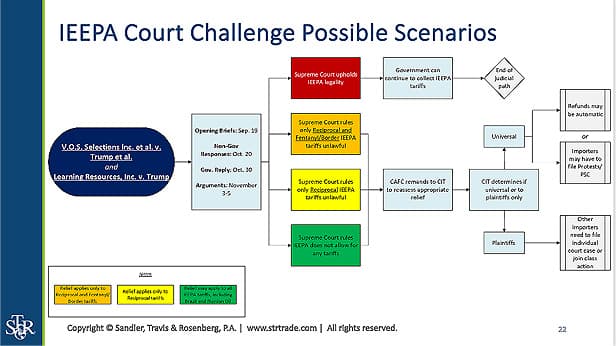
What The Court Is Likely To Hold
The Court is expected to rule this week in the consolidated cases concerning the President's authority to impose tariffs under the International Emergency Economic Powers Act. The cases consolidate the appeals styled Learning Resources, Inc. v. Trump and Trump v. V.O.S. Selections, Inc. On close reading of the November oral argument and of the recent commerce-clause and major-questions jurisprudence, the government's position is weaker than the public commentary has acknowledged. The Court is likely to hold that IEEPA does not authorize the President to impose tariffs.
The text admits of no other interpretation. IEEPA authorizes the President to regulate, investigate, or block transactions with foreign actors when the President declares a national emergency arising from an unusual and extraordinary threat. The statute's enabling language includes the phrase regulate importation. The government has argued, in its brief and at oral argument, that regulate importation includes the authority to impose tariffs. The argument is not without grounding in the broader administrative-law tradition. The argument is, on close reading, in tension with several lines of authority the Court has been developing across the last decade.
The Major Questions Doctrine Frame
The first line of authority that constrains the government's argument is the major questions doctrine the Court has developed since West Virginia v. Environmental Protection Agency in 2022 and refined in subsequent cases. The doctrine requires clear congressional authorization for agency actions of vast economic or political significance. The IEEPA tariffs in question, in their aggregate scope, affect imports valued in the trillions of dollars and reorder the trade relationship between the United States and several of its principal trading partners. The economic and political significance is, by any reasonable measure, vast.
The doctrine, applied to a statute whose enabling text does not explicitly mention tariffs and whose legislative history does not support an interpretation extending tariff authority, produces a strong textualist read against the government. The government's response, that the regulate importation phrase necessarily encompasses tariff authority, requires the kind of textualist stretching that the Court's current jurisprudence has been disinclined to accept. The doctrine has produced consistent results across the trailing four terms.
The Commerce Clause Layer
The second line of authority is the commerce clause jurisprudence the Court has, less explicitly, been refining over the same window. The Constitution vests in Congress the power to lay and collect taxes, duties, imposts, and excises. The vesting is specific. The vesting is in Congress. The executive branch's authority over tariffs derives from delegated congressional authority, not from any inherent executive constitutional power over commerce or revenue.
IEEPA, in its enabling text, delegates specified authorities to the executive in connection with national emergencies. The delegation does not explicitly include tariff authority. The Court's reading of analogous delegation questions in the trailing decade has been consistent: where the delegation language is not specific to the authority being exercised, the executive's claim to the authority is correspondingly weaker. The pattern is the pattern that has produced the recent constraints on agency rulemaking outside specific congressional authorization.
What The Oral Argument Revealed
Let us read what the Justices actually said. The November oral argument produced a clean read of where the votes are likely to fall. The Chief Justice's questions focused on the textualist question of what regulate importation does and does not include. The Chief's questions did not, in the available transcript, suggest a willingness to read the phrase expansively to encompass tariff authority. The questions from Justice Barrett pressed the government's counsel on the institutional-competence point. The questions from Justice Kavanaugh, by contrast, suggested a more receptive posture to the government's argument, anchored in the historical practice of executive emergency authority.
The votes that have been most consistently aligned with the major questions doctrine across recent terms are the votes that the textualist read here points toward. The Chief, joined by Justices Sotomayor, Kagan, Gorsuch, Barrett, and Jackson, would produce a 6-3 majority for the proposition that IEEPA does not authorize tariffs. The dissent, by Justice Kavanaugh joined by Justices Thomas and Alito, would argue from the statutory text and from the historical practice of executive emergency authority. The 6-3 alignment is, on the available signals, the more likely outcome than the alternatives the commentary has been considering.
The Implications For The Trade Architecture
The implications of a 6-3 ruling against the government would be material across several categories. The IEEPA tariffs in their current form would be invalidated, with the Court likely ordering the lower court's judgment affirmed. The tariffs would not be replaceable through equivalent executive action under IEEPA's framework. The executive branch's options would narrow to either congressional action to authorize specific tariffs, or alternative executive authorities under statutes whose textual frame does authorize tariffs, such as Section 232 of the Trade Expansion Act and Section 301 of the Trade Act.
The alternative statutory authorities exist but require distinct procedural predicates. Section 232 requires a national security finding by the Secretary of Commerce. Section 301 requires an investigation and determination by the United States Trade Representative. Each of the alternative authorities has been exercised in the trailing decade. Each carries procedural and litigation risk distinct from the IEEPA framework. The Court's ruling, by eliminating the IEEPA pathway, would direct the executive branch toward the alternative authorities and toward the corresponding congressional engagement that the alternative authorities sometimes require.
The Forward Read
The forward read is that the Court's expected ruling will reorder the architecture of executive tariff authority for the remainder of the current administration and likely for subsequent administrations. The ruling will not eliminate the executive branch's tariff capacity. The ruling will constrain the framework within which that capacity must operate. The constraint reflects, in plain reading, the Constitution's allocation of revenue-related authorities to the legislative branch and the Court's institutional commitment to enforcing that allocation against executive expansion not specifically authorized by the legislative text.
This is not a matter of opinion. It is a matter of law. The text admits of no other interpretation. The doctrine the Court has been developing for four terms produces the outcome the close reading of the briefs and the oral argument suggests. The ruling will be the ruling. The downstream policy adjustments will follow. The architecture of the constitutional separation of powers between the legislative branch and the executive will, in this matter, be the architecture the Court is restoring rather than the architecture the executive branch has been extending.