The Map Isn't Neutral and Neither Are the People Drawing It
My grandmother used to say that a man who complains about cheating is usually the one who got caught first. She was talking about card games, but she'd have understood redistricting perfectly.
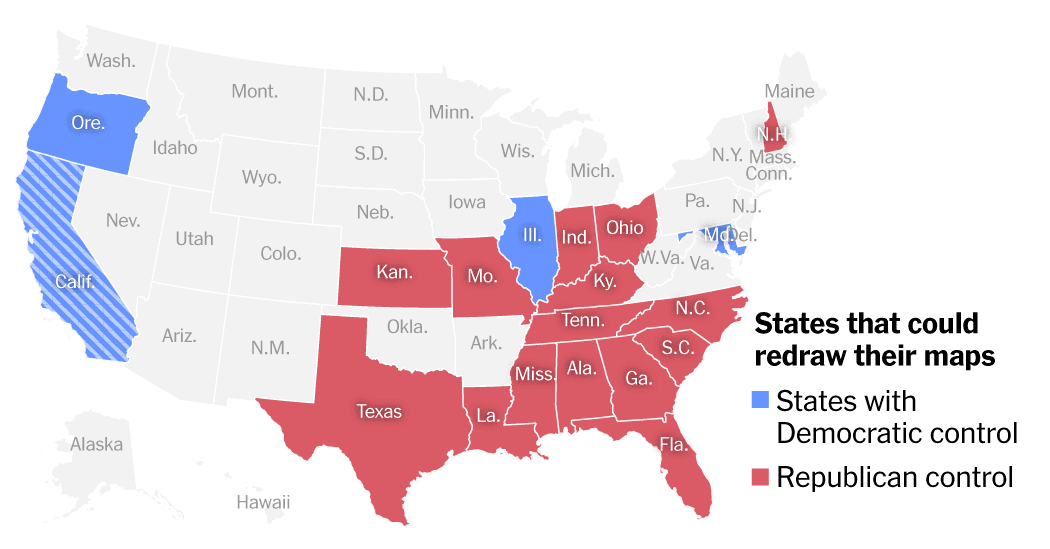
The ongoing fights in Virginia, Maryland, Utah, and Florida over congressional district boundaries are being covered in the national press as stories about Republican overreach, partisan maps, cracked minority communities, diluted Democratic votes. Some of those critiques have merit. But the coverage consistently fails to apply the same standard to states where Democrats control the process, and that failure isn't accidental. It's the story.
Maryland's congressional map has been described by federal courts, plural, repeatedly, as one of the most egregious partisan gerrymanders in the country. Democrats drew it. The 6th Congressional District was redrawn specifically to turn a Republican seat into a safe Democratic one, a maneuver so obvious that even the Supreme Court noted it in Rucho v. Common Cause while declining to intervene on federal grounds. Maryland Democrats celebrated. The press moved on.
What's Actually Happening in These States
In Virginia, the state has been operating under court-drawn maps since a redistricting commission deadlocked along party lines. The fight now is over whether a new legislative session will redraw those maps to favor one party. Republicans control the state Senate; Democrats control the House of Delegates. Neither side is operating from pure principle. Both are operating from pure self-interest. That's the honest description.
Utah is the more interesting case. Republicans dominate Utah's legislature and have drawn maps that Democrats argue crack the Salt Lake City urban area across multiple districts to dilute progressive voters. This is the standard gerrymandering complaint, and in Utah's case there's a legitimate geographic argument to be made. But Utah's Republicans would point out, correctly, that this is exactly what California Democrats do to Republican communities in the Central Valley and Orange County, with far less national media attention.
Florida is its own chapter. The DeSantis administration pushed through congressional maps that the Florida Supreme Court initially rejected, a battle that went through multiple rounds of litigation before a version passed. The maps significantly strengthened Republican positions in several North Florida districts. Democrats are furious. Those same Democrats spent the better part of two decades defending Florida's pre-DeSantis maps, which contained some of the most creative district-drawing I've ever seen, including a district sarcastically called the "I-4 Dumbbell" for connecting two urban populations across a thin suburban corridor.
The Standard That Applies to Everyone, Or to No One
Here's the thing about fair maps: you either want them everywhere or you're just trying to win. There's no intellectually coherent position that says Maryland's gerrymander is fine but Florida's isn't, or vice versa. Either partisan mapmaking corrupts representative democracy or it doesn't.
My position is that it does. I think independent redistricting commissions, with genuinely bipartisan, randomly-selected, or algorithmically-constrained membership, are the right answer. Arizona, California, Michigan, and Colorado have moved in this direction with mixed but generally positive results. The maps produced by independent commissions aren't perfect, but they're more defensible than maps drawn by legislators who are literally choosing their own voters.
But I have exactly zero patience for Democrats who demand reform in states they're losing while defending gerrymanders in states they're winning. If partisan mapmaking is a threat to democracy, it's a threat when everyone does it. If it's just politics as usual, stop pretending it's a constitutional crisis only when Republicans are doing the drawing.
The voters I talk to, in my kids' school parking lot, at church, at the feed store on the edge of town, don't follow redistricting litigation. They follow the results. They know when their vote feels like it matters and when it doesn't. They're losing faith in the fairness of the process at a rate that should alarm everyone in both parties.
But it won't. Because both parties benefit from a rigged map somewhere, and neither one is willing to give that up for principle. That's the redistricting story. Nobody's writing it.