The Numbers The Strategists Cannot Ignore
The Pew Research Center released its latest American Trends Panel survey of Hispanic voters in late April. The headline number, the one the political press picked up, is the partisan identification figure. Forty-six percent of Hispanic registered voters now identify with or lean Republican. The 46 percent number is up from 37 percent in 2020 and 32 percent in 2016. The shift is twelve percentage points over an eight-year window. Mira, that is not a polling blip. That is a structural realignment.
The deeper numbers in the Pew survey tell a clearer story. On economic policy, 64 percent of Hispanic voters now say tax cuts on businesses produce more jobs in their communities than equivalent government spending does. On immigration, 71 percent support increased border enforcement, with 58 percent specifically supporting expanded use of detention for unauthorized crossings. On crime, 73 percent want more police presence in their neighborhoods rather than less. These are not the numbers the Democratic strategists' decks include when they brief candidates on the Hispanic vote.
The Generation Gap That Matters
The generation gap inside the Hispanic vote is the gap that decides the next decade. Pew's data shows that Hispanic voters under 30 are now slightly more conservative on cultural questions than Hispanic voters in the 50-to-64 cohort. That inversion is new. The 18-29 cohort grew up after the immigration debates of the 2000s and the cultural battles of the 2010s. The younger cohort does not carry the partisan attachments their parents carried, and they show their lower attachment in their voting behavior.
My father came here legally. He drove a delivery truck for thirty years. The conservative vote he eventually cast, after twenty years of voting Democratic from habit, was the vote of a man who had been waiting for the parties to compete for his support. Trabajo duro, hard work, is the value that runs through every Hispanic American household I know. The party that speaks to that value has the long-term coalition. The party that speaks past it does not.
The Texas Story
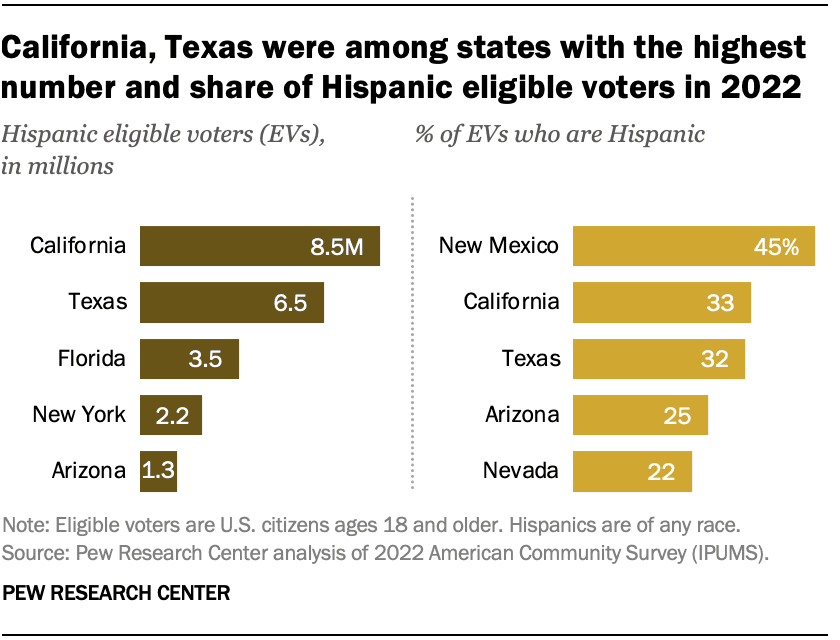
The Texas story is the story that most predicts the national trajectory. The Rio Grande Valley counties that went 60 percent Democratic in 2012 voted Republican for the first time in 150 years in 2024. The Republican margins in those counties grew further in the 2025 special elections that filled state legislative vacancies. The local political infrastructure, the precinct chairs and the small business networks and the church communities, has shifted. The shift is durable because it is happening at the social-network level rather than at the candidate-loyalty level.
What changed in the Valley was not a single issue. The border was the visible issue. The economy underneath it was the deeper issue. The cultural issues that the national press tries to make secondary were not secondary in the Valley. The voters there told the strategists, in election after election, that the Democratic Party's cultural posture was not the posture they wanted representing them in Washington. The strategists listened slowly.
The Florida Story
Florida is the state where the Hispanic realignment matured first and the lessons compounded longest. The Cuban-American coalition in Miami-Dade is the founding piece. The Puerto Rican community in central Florida, which broke heavily Republican in 2022 and again in 2024, is the second wave. The Venezuelan and Colombian communities, smaller but politically engaged at high rates, broke the same direction. The combined effect made Florida a state Democratic candidates have stopped seriously contesting at the statewide level.
The Florida lesson, for any party reading the data, is that Hispanic American voters respond to candidates who treat them as Americans first and Hispanics second. The candidates who run on a single-issue ethnic appeal lose. The candidates who run on economic opportunity, on family safety, on educational standards, and on the country they chose to belong to win. That formula is older than any modern political party.
What The Democrats Are Doing About It
The Democratic Party has spent the last four years running the same Hispanic-outreach playbook that produced the loss. The playbook treats Hispanic voters as a constituency that needs to be educated about its true interests. The educational posture is the posture that has driven the realignment further than any Republican advertising budget could have. The voters who heard the message understood the message. The voters voted on the message they understood.
The internal Democratic post-mortems have, in the documents I have seen quoted in the political press, begun to acknowledge the issue. The acknowledgment is partial. The party's institutional structure makes a full correction expensive in the short term because the donor base and the activist class on the Democratic side prefer the educational posture even when it does not produce votes. The mismatch between the donor preference and the electoral requirement is a structural problem, not a tactical one.
What The Republicans Should Not Do
The Republican Party, having earned the share it now holds, has a corresponding risk. The risk is overconfidence. The Hispanic vote is not now and never will be a captive Republican vote. The voters who moved Republican over the last decade moved because the Republican Party finally competed for them. The voters will move back if the Republican Party stops competing. The party that treats the new coalition as permanent will lose it the way the Democratic Party lost it.
Oye, I will say it plainly. The American Dream is not dead. The voters whose families came here for it are not finished living it. Don't tell me what Latinos think. I am one. The data tells the story. The story is the realignment. The realignment is durable for now. The realignment is contingent on the parties continuing to compete for the votes that produced it. That is the truth.