The Night Nancy Guthrie Vanished
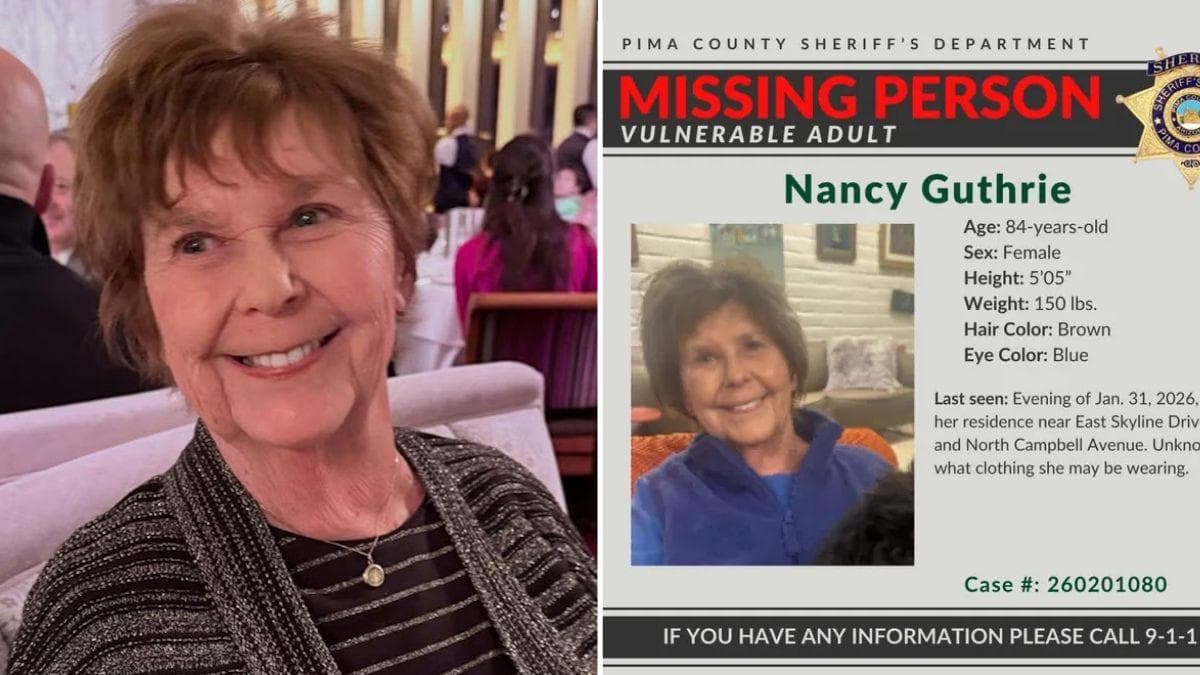
On the night of January 31, 2026, Nancy Ellen Guthrie, the 84-year-old mother of NBC's Today co-anchor Savannah Guthrie, returned to her home in Catalina Foothills, Arizona, a quiet community north of Tucson where she had lived for more than five decades. Her son-in-law had dropped her off around 9:50 p.m. By the next morning, she was gone. The facts that followed are as chilling as they are damning for the institutions tasked with protecting her.
According to the Pima County Sheriff's Department and reporting by NBC News, Guthrie's doorbell camera was disconnected at 1:47 a.m. A person was detected on another camera at 2:12 a.m. Her pacemaker, monitored through a phone app, lost its connection at 2:28 a.m. When family members arrived at her home at 11:56 a.m. on February 1, they found her cellphone left behind and blood on the front porch that matched her DNA. Her belongings were untouched inside. This was not a confused elderly woman who wandered away. Every indicator pointed to an abduction.
The vulnerability of the victim is what makes the institutional response so infuriating. Guthrie was not a young woman with mobility and resources. She was 84 years old, with limited mobility, daily medication requirements, and a pacemaker. She lived, as her daughter put it publicly, in constant pain and needed medicine both to survive and to avoid suffering. Whoever took her knew what they were doing, and they did it with a precision that suggested careful planning. The question that haunts the public is not simply who took Nancy Guthrie. It is why the agencies charged with finding her have spent so much energy pointing fingers at one another.
When Agencies Fight, Families Suffer
Within days of Guthrie's disappearance, the case stopped looking like a straightforward kidnapping investigation and started looking like a case study in bureaucratic dysfunction. The FBI quickly became involved, as one would expect when an elderly woman vanishes under suspicious circumstances and ransom demands begin surfacing in the media. Yet reports soon emerged that Pima County Sheriff Chris Nanos was blocking the FBI from testing key physical evidence, choosing instead to send that evidence to a private lab in Florida.
On Fox News, legal commentator Nancy Grace warned that this decision risked destroying the case. Touch DNA on a discarded glove found in desert shrubbery is not an infinite resource. Once a private lab consumes it during testing, it is gone. The FBI laboratory in Quantico, Virginia, is one of the most sophisticated forensic facilities in the world, and federal agents had already been deployed to assist in the search for Guthrie. There may be legitimate reasons to use a specialized private lab for degraded samples, but the public has not been given a convincing explanation for why federal cooperation was apparently treated as a threat rather than a resource.
The problem here is not unique to Pima County. Across the country, local law enforcement agencies have grown territorial about high-profile cases, even when federal resources could speed the investigation. The result is delay, confusion, and squandered evidence. In Guthrie's case, the FBI released black-and-white doorbell footage on February 10 showing a masked man wearing gloves and a backpack, apparently tampering with the camera while armed with what appeared to be a gun in a holster. That image gave the public a focal point, but it did not produce the immediate breakthrough that might have come from a more coordinated, less politicized investigation in the earliest hours.
The dysfunction has not been limited to evidence handling. On April 17, the Pima County Sheriff's Department posted an update on X declaring that Nancy had been located, only for readers to discover that the post referred to a different woman entirely, Nancy Radakovich. The department later explained that the update followed a post about Radakovich and had been rushed out without clarity. To a family that has offered a $1 million reward for information leading to Guthrie's recovery, that kind of carelessness is not a minor social media slip. It is another wound.
What This Case Demands of Us
Conservatives have long argued that government institutions exist to serve citizens, not to protect bureaucratic fiefdoms. The Guthrie case tests that principle in the most painful way imaginable. An 84-year-old woman, dependent on medication and a pacemaker, was taken from her home in the middle of the night. More than two months later, she remained missing, and the public had seen more evidence of institutional friction than of institutional competence.
The facts that matter are stark. A woman in her eighties disappeared from a secured home. Her doorbell camera was disabled, her pacemaker stopped transmitting, and her blood was found on her porch. A masked intruder was recorded, yet no suspect had been publicly identified. A local sheriff reportedly resisted federal forensic assistance. A major law enforcement agency published a misleading update that briefly convinced the public the case was solved. These are not the ingredients of a well-run investigation.
Accountability is the only acceptable response. Sheriff Nanos and his department owe the public a full explanation for the handling of evidence, the coordination with federal partners, and the communications failures that have compounded the family's anguish. State officials in Arizona should review whether local protocols adequately protect vulnerable adults and whether the early hours of a suspected abduction are being treated with the urgency they deserve. Congress, too, should ask hard questions about the conditions under which federal assistance is welcomed or refused in cases that cross jurisdictional lines.
The Guthrie family has done everything a family can do. They have pleaded for information, offered a reward, and begged the public to keep praying. Their love for Nancy Guthrie is beyond question. What is in question is whether the institutions that exist to protect people like her are still capable of putting service ahead of ego. The longer this case drags on without answers, the harder that question becomes to answer in the affirmative. Nancy Guthrie deserves better. Her family deserves better. And every American who still believes that government exists to serve the people deserves a thorough reckoning with why this case has gone so wrong.