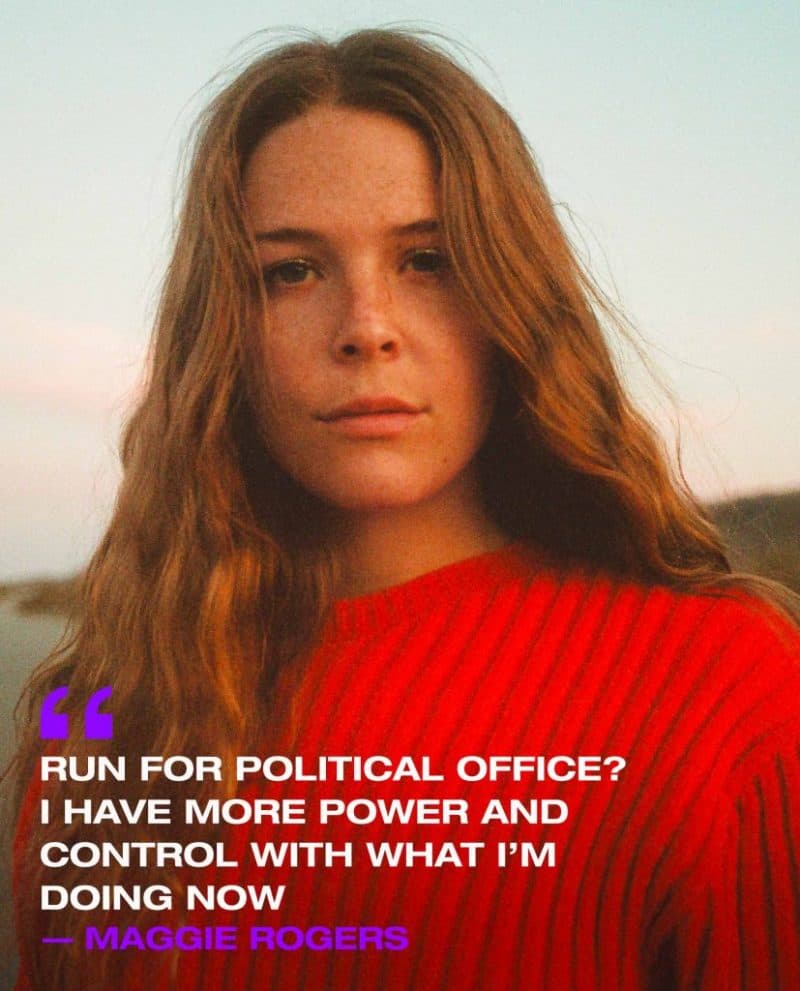
Pop culture in 2026 often feels like a race to the bottom. The loudest voices get the clicks, the most divisive lyrics get the streams, and the artists who play the victimhood game land the magazine covers. Then there is Maggie Rogers. The Maryland-born singer-songwriter is easy to dismiss if you only scan the surface. She is young, she is based in Brooklyn, and her politics do not line up neatly with a conservative bumper sticker. But Rogers matters precisely because she represents something the right should champion: an artist who won by working harder, writing better, and refusing to let the culture industry define her. Her story is not about ideology. It is about excellence, and excellence is supposed to be the conservative answer to the grievance economy.
The Viral Moment Was Only the Introduction
Most Americans first heard Maggie Rogers in 2016, when a video of Pharrell Williams listening to her unfinished song "Alaska" went viral. The producer sat in an NYU classroom, closed his eyes, and looked genuinely stunned. Within days, the internet did what the internet does: it turned a private classroom moment into a public spectacle. Commenters called her an overnight success, as if the footage captured the birth of a star rather than the payoff of a decade of practice.
That narrative misses the point. Rogers did not spring from nowhere. By the time Pharrell pressed play, she had already released independent projects stretching back to 2011, including home-recorded collections that she later remastered for her archival release, Notes from the Archive: Recordings 2011-2016. She grew up playing banjo and harp in the countryside outside Washington, D.C., studied at the Clive Davis Institute, and learned to produce her own tracks. The viral clip was the spark, but the kindling had been stacked for years.
There is a lesson here for anyone tired of celebrity culture. Rogers did not build her name on a reality show, a political rant, or a corporate marketing budget. She built it the old-fashioned way: by showing up, doing the work, and letting the songs speak. In an age when fame is increasingly bought, rented, or manufactured by publicists, that approach looks almost radical.
The Numbers Back Up the Hype
Sentiment only gets an artist so far. The market is the real judge, and the market has been kind to Rogers. Her 2019 Capitol Records debut, Heard It in a Past Life, entered Billboard's Top Album Sales chart at No. 1 and debuted at No. 2 on the Billboard 200. For context, that is the kind of opening week that most major-label acts would trade their tour buses to achieve. The record was not a fluke. It went on to earn a Gold certification from the RIAA, while the singles "Light On" and "Alaska" were certified Platinum. Combined global streams for the album have surpassed one billion.
The industry noticed. Rogers earned a Grammy nomination for Best New Artist at the 62nd Grammy Awards, sharing a category with some of the biggest breakout names of the decade. She followed her debut with 2022's Surrender, which peaked at No. 2 on the Billboard Top Alternative Albums chart, and 2024's Don't Forget Me, co-produced at the legendary Electric Lady Studios. Her touring resume is just as impressive: sold-out headline runs across North America and Europe, plus multiple nights at venues like Red Rocks Amphitheatre, Forest Hills Stadium, and the Hollywood Bowl.
These are not the credentials of a novelty act or a one-hit wonder. They are the credentials of a musician who has found an audience and kept it. That audience is not buying politics. It is buying songs about heartbreak, faith, restlessness, and joy. Rogers sings about the messy business of being human, and she does it with a melodic sense that recalls the best of 1970s singer-songwriter craft. There is nothing inherently conservative or progressive about a well-constructed chorus. There is something deeply American about it.
What the Right Should Learn From Her
Too often, conservatives treat culture like a battlefield of slogans. We complain about Hollywood, boycott brands, and wonder why young Americans tune us out. But complaining is not a cultural strategy. Building is. Maggie Rogers offers a case study in what building looks like. She did not ask permission from gatekeepers. She did not shape her art to fit a demographic formula. She made music that was true to her own experience, and she trusted listeners to come along.
That trust is the missing ingredient in much of conservative cultural output. We do not need more political songs that sound like campaign ads. We do not need more artists whose primary credential is that they annoy the right people. We need painters, writers, filmmakers, and musicians who are good enough to make the mainstream come to them. Rogers proves that excellence can still cut through the noise. Her fans do not love her because she performed the rituals of the culture war. They love her because she is excellent at her craft.
None of this requires conservatives to agree with every lyric or every public statement. Rogers has supported causes on the left, and her worldview is not a secret. But political agreement is not the price of cultural respect. The price is honesty, skill, and the courage to create something lasting. Those are values conservatives claim to defend, and we should have the humility to recognize them even when they show up in unexpected places.
The Quiet Rebellion of Doing the Work
Maggie Rogers matters because she is a reminder that the old rules still work. Show up early, stay late, master your instrument, write the song, book the gig, and repeat. The culture industry wants artists to believe that success comes from controversy, identity, or access to the right publicist. Rogers proved it comes from songs people want to hear twice. Her three albums, her Platinum singles, her Grammy nomination, and her sold-out arena tours are not accidents. They are evidence.
Conservatives who care about the future should stop looking for the next political celebrity and start looking for the next Maggie Rogers. The future of the right will not be won by the loudest voice on cable news. It will be won by artists, builders, and craftsmen who create a culture so compelling that the country wants to join it. Maggie Rogers has already built part of that culture. The only question is whether the rest of us are paying attention.