The Calendar Is the First Primary
Long before the first bus rolls into Des Moines or the first diner handshake in Manchester, the 2028 Republican presidential primary is being decided in conference rooms at the Republican National Committee. The proposed early-state calendar is not a neutral map. It is a loaded deck, and the dealer is the same donor class that has spent two decades trying to turn the GOP nomination into a television auction rather than a job interview.
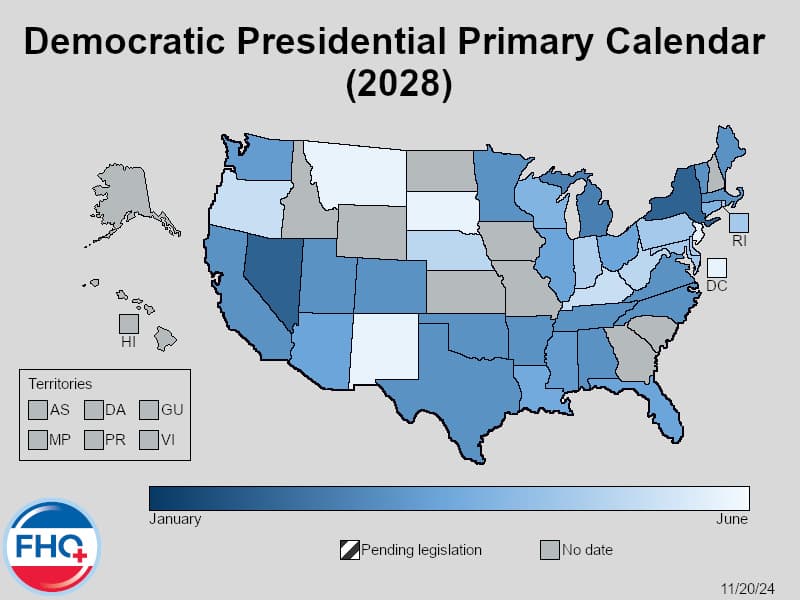
The draft 2028 schedule would send Iowa to the caucuses on February 5, New Hampshire to its primary on February 9, South Carolina to the polls on February 17, Michigan on February 23, and then to a Super Tuesday on March 2. That is four weeks from the first contest to the day when roughly 35 percent of all delegates are awarded. In 2024, Super Tuesday put 865 delegates on the line in a single day. Compress that window by even a few days and the only candidates who survive are the ones who can buy their way through.
This is not some abstract complaint about process. The rules committee will finalize the calendar months before most candidates announce, which means the field is being narrowed by geography and arithmetic before a single voter has seen a bumper sticker. A party that claims to distrust centralized planning should be the last one to centralize its own nomination.
How the Early Map Got Tilted
For decades, Iowa and New Hampshire served as the partisan equivalent of spring training. A long-shot senator could camp out in Sioux Center, take 200 questions in a VFW hall, and build a coalition one handshake at a time. The system was not perfect, but it rewarded organization, message discipline, and the kind of persistence that separates a candidate from a celebrity.
That model is now under siege. Michigan has muscled its way into the pre-Super Tuesday window, bringing with it a media market that covers Detroit, Grand Rapids, and Chicago advertising spillover. A single week of television there costs more than the entire budget of some past winning Iowa campaigns. Add Florida, California, and Texas to an early March Super Tuesday and you have a national primary disguised as a calendar.
The data tell the story. In 2024, the Iowa Republican caucuses drew about 110,000 participants. New Hampshire's first-in-the-nation primary attracted roughly 308,000 voters. By contrast, South Carolina's Republican primary pulled in more than 753,000 voters, and that was only one early contest in a much larger map. The jump from diner conversations to multi-million-dollar ad buys is not gradual. It is a cliff, and the calendar is pushing more states right to the edge.
We have seen this movie before. The 2008 calendar front-loaded so many states that the nomination was effectively settled by the first week of February. Candidates who lacked a national fundraising base were gone before voters in later states even tuned in. The 2016 cycle showed what happens when celebrity exposure replaces county chair relationships. Neither result produced a process conservatives should want to repeat.
Retail States Still Matter, If We Let Them
Conservatives who believe in federalism and bottom-up politics should be the first to defend the early retail states. Iowa forces a candidate to explain himself to church elders and county chairs. New Hampshire forces him to answer hostile questions in a living room. These are filters, not favors. They expose the difference between someone who has read the briefing book and someone who has lived the argument.
The proof is in the winners. In 2012, Rick Santorum won Iowa by visiting all 99 counties and talking to anyone who would listen. In 2016, Ted Cruz matched that grind and beat a competitor who had dominated the national polls. Those victories did not last through the nomination, but they proved that a candidate with stamina and a coherent message could still break through the noise. Take away the retail window and you take away the last path for an underfunded conservative.
Front-loading the calendar does the opposite. It turns delegate accumulation into a cash-burn contest where name identification, earned media, and super PAC rescue lines matter more than town hall stamina. A candidate with a billionaire patron can paper over policy ignorance with mail and television. A candidate without one is eliminated before voters in later states ever get a fair look. That is not democracy. That is a primary designed by consultants who bill by the week.
What the Party Should Do Before It Is Too Late
The RNC should freeze the early window at four states, keep Iowa and New Hampshire at the front, and require any state that jumps the line to lose half its delegates. The penalty must be real, not rhetorical. When Florida or Michigan threatened to leap ahead in past cycles, the party issued warnings and then carved out exceptions. That habit has to end.
Republicans should also stretch the calendar so that Super Tuesday arrives no earlier than March 10. Three weeks between New Hampshire and a delegate bonanza is the minimum breathing room a lesser-known candidate needs to turn a surprise showing into real momentum. The 2024 cycle proved that compressed windows produce front-runners who look unbeatable until a general election exposes their weaknesses.
The debate schedule needs the same treatment. Right now, a candidate can be locked out of the stage by polling thresholds written by networks that have no stake in a conservative outcome. A calendar that forces early, multi-state spending favors candidates who can rent a campaign. A debate cartel that hides behind the same polling numbers does the same. The RNC should set its own standards, pick its own moderators, and refuse to let outside gatekeepers finish the winnowing that the calendar started.
Finally, the party must stop treating caucuses like an embarrassment. Iowa's caucus system is demanding, time-consuming, and easy to mock from a television studio. It is also the closest thing the GOP has to a genuine deliberative process, where neighbors talk to neighbors before committing. A national party that claims to value civic engagement should protect that tradition, not pave over it with beauty contests.
The 2028 primary will not be won in February. But it can be lost in the rules that are being written right now.