My Neighbor's Cousin Called From Havana
My neighbor Maria, she's lived three houses down from me for eleven years, got a call from her cousin in Havana last November. The cousin had been without electricity for six days. Not rolling blackouts. Six consecutive days of no power, in a city of two million people, in November when it's still hot and humid enough to make you miserable.
The cousin was cooking on a wood fire in her kitchen. In 2024. In a capital city.
Maria cried in my driveway for twenty minutes. I stood there and I didn't know what to say because there wasn't anything to say. This is what it looks like when a government fails its people completely, and has been failing them for sixty-five years, and the people have nowhere to go and no one in power who will honestly say why.
Cuba has been trending. People are searching the country by name in numbers that spike and fade and spike again. The crisis gets covered in fits and starts, a blackout here, a protest there, a celebrity tweet about something unrelated that accidentally puts the island in the news for forty-eight hours. And then it fades again.
What Actually Happened to Cuba
Let me be plain about something that shouldn't be controversial but somehow still is in certain American circles: Cuba is poor because of its government. Full stop.
The Cuban economy was not destroyed by the US embargo. I know that's the line, I grew up hearing it, and I've heard it trotted out every time someone needs an explanation that doesn't implicate socialism. The embargo is real. It's also been largely symbolic for decades. Cuba trades with Canada, Spain, Mexico, China, Brazil. European tourists have been vacationing there for thirty years. The island has access to international markets.
What it doesn't have is private property, free enterprise, or a government that answers to its people. That's why the lights are off.
Cuba's electrical grid is running on Soviet-era infrastructure that hasn't been properly maintained since the Special Period in the 1990s. The thermoelectric plants are decrepit. Fuel supplies are inconsistent because the government can't pay for them reliably because the state-run economy doesn't generate enough hard currency because centrally planned economies never do. This isn't a mystery. It's a pattern that has repeated itself from East Germany to Venezuela to North Korea.
In October 2024, a series of failures at the Antonio Guiteras thermoelectric plant, Cuba's largest, triggered a cascading national blackout that left the entire island without power for days. The government's response was to blame the United States, appeal to Venezuela for emergency fuel shipments, and arrest people who protested in the streets.
The American Left's Cuba Problem
There is a strain of American progressive thought, you find it on university campuses, in certain magazines, in the speeches of certain politicians, that has never been able to let Cuba go. The revolution is romantic. Castro was anti-imperialist. The literacy campaigns, the healthcare statistics (which were and remain largely fabricated), the David vs. Goliath story of a small island defying the Yankee empire.
That romanticism costs real people real things.
When American politicians signal sympathy for the Cuban government, when they oppose any policy that increases pressure on Havana, when they frame the suffering of ordinary Cubans as a product of American aggression rather than Cuban governance, they provide ideological cover for a system that has imprisoned dissidents, executed political opponents, and immiserated eleven million people across three generations.
Maria's cousin isn't suffering because of the embargo. She's suffering because she lives under a government that spent sixty-five years building a system where the state owns everything, controls everything, and answers to no one. That government's failures are its own. The left's refusal to say so is a choice. And choices have consequences.
What We Owe Maria's Cousin
I'm not writing this to argue for any particular Cuba policy. Reasonable people disagree about the details, sanctions, diplomacy, migration, remittances. Those are legitimate debates.
What I am saying is that the starting point for any honest conversation about Cuba has to be the truth: the Cuban people are suffering because they have a government that does not serve them, has never served them, and is constitutionally incapable of serving them because it answers only to itself.
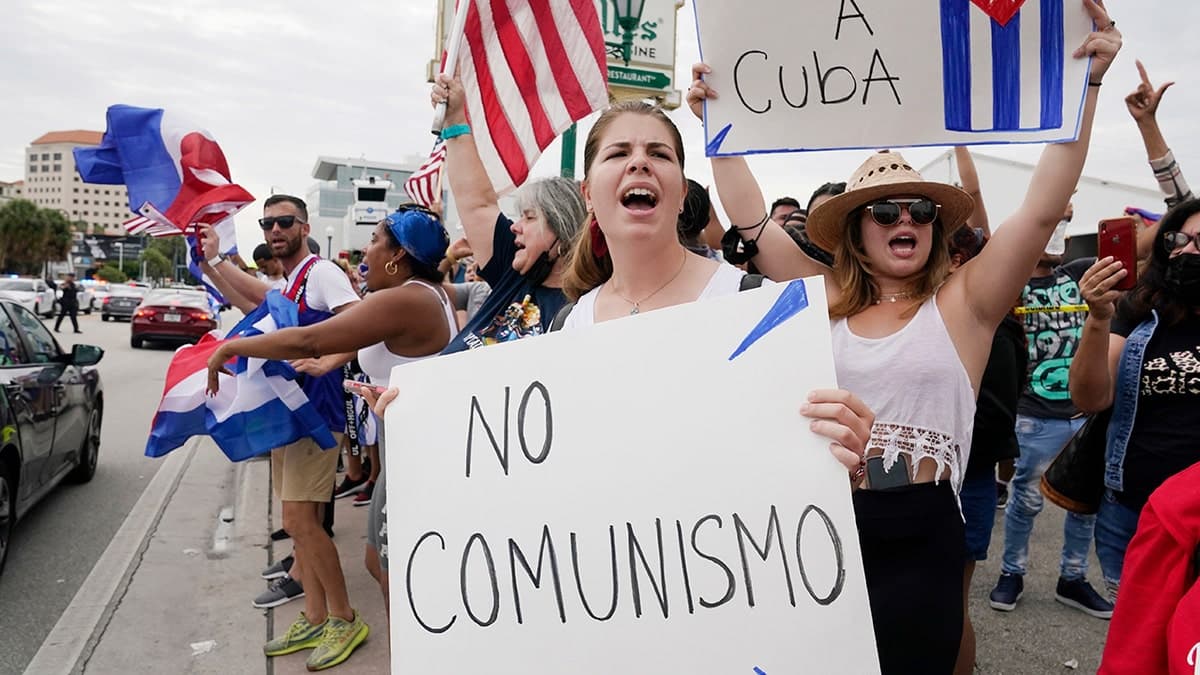
When Cuba trends on Google, it means people are paying attention. Most of them are Cubans in Miami and Tampa and Union City with family members going hungry. Some of them are journalists and policymakers and students trying to understand what's happening.
Tell them the truth. Communism did this. Sixty-five years of one-party rule did this. The empty shelves and the dark nights and the wood fires in Havana kitchens, those are not accidents or mysteries or the fault of the American government. They are the predictable, documented, endlessly repeated product of a system that places state power above human dignity.
Maria's cousin deserves to hear someone say that out loud. So do the eleven million people living it.