The April Numbers and Seasonal Patterns
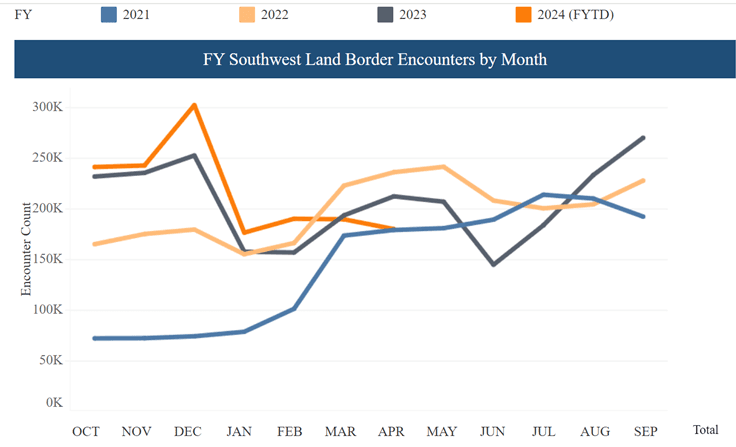
U.S. Customs and Border Protection released monthly enforcement data on May 15, showing 142,000 total encounters at the southwest border in April. That figure includes apprehensions of single adults, family units, and unaccompanied minors crossing between ports of entry. The 142,000 total represents a 12 percent increase from March encounters and a 23 percent increase compared to April of last year. Those comparisons matter because they show a trajectory rather than a snapshot. The trend is up. The seasonality is expected. The persistence is worth examining.
Border Patrol agents told reporters that the April surge followed a predictable seasonal pattern but with elevated baseline numbers. Spring migration waves are standard. As weather improves in the Northern Hemisphere and Central American planting seasons end, migration pressure increases at the southern U.S. border. What is notable this year is not the seasonal wave itself but rather the height of the baseline around which the wave oscillates. In April of 2023, the border encountered 104,000 people. In April of 2024, the number was 115,000. In April of 2026, it is 142,000. Over three years, the April baseline has grown by 37 percent.
The composition of arrivals matters operationally. Family units represent 48,000 of the 142,000 encounters, or roughly 34 percent. That is significant because family units consume more processing resources, more detention capacity, and more personnel time per encounter than single adults. A Border Patrol agent can process a single adult in thirty minutes. A family unit requires paperwork, coordination with Health and Human Services for minor processing, and scheduling for credible-fear interviews. The same agent can process four family units in the time it takes to process twelve single adults. When family units represent one-third of the flow, operational bottlenecks predictably emerge.
Capacity and System Strain
CBP detention facilities reported occupancy rates at 96 percent capacity in early May. That means the system is operationally at the edge of its physical limits. The facilities are not over capacity, technically. But they are functionally full. Any surge beyond current levels would require either releasing people without processing or expanding holding facilities. Both options carry political and operational costs. Releasing people accelerates the catch-and-release dynamic that opponents of immigration have criticized for years. Expanding facilities requires funding and construction time that does not exist in the current budget cycle.
The alternative to CBP detention is Home Monitoring, a program where migrants are released with electronic monitoring devices and told to report to immigration court. The program expanded significantly under Biden administration policy. Participation numbers now exceed 15,000 active monitors spread across CBP field offices. The program costs roughly 12 dollars per person per day compared to 80 dollars per day for facility detention. That math explains why CBP expanded it. But the expansion created a separate problem: about 87 percent of people released on home monitoring fail to appear for their immigration court hearings. That figure comes from CBP administrative data. It means the system released 13,000 people in the last year who did not show up for court. That is the hidden cost of avoiding detention facility expansion.
The Political Pressure and Border Community Impact
Republican members of Congress from border districts have increased pressure on the Biden administration for more detention resources and higher enforcement pace. Congressman tony Gonzales from Texas told reporters that the April numbers represent a policy failure. He pointed to the increase in family units and the corresponding increase in no-show rates for immigration court as evidence that the system is broken. That criticism is directionally accurate. The system is strain. What is less clear is whether more detention capacity and more enforcement actually solves the underlying problem or simply delays migration decisions while consuming more federal resources.
Border communities reported mixed reactions to the April surge. In El Paso, local nonprofits reported that they processed 8,000 migrants in emergency sheltering in May, up from 5,200 in April. That surge overwhelmed local capacity. The Annunciation House, a faith-based nonprofit, reported that it ran out of sleeping capacity and had to turn away families. Those stories are real. The operational strain is real. What remains contested is whether the strain reflects law enforcement failure or reflects structural conditions in Central America that no U.S. border policy alone can address. Remittances to Guatemala exceeded 5.2 billion dollars in 2025, meaning that migration and foreign aid are now economically intertwined. Any serious attempt to address migration requires addressing the economic conditions that make migration rational.
The practical reality is that April 2026 encountered migrants at near-Biden-era peak volumes. That means the policy choices are now visible. Do you increase enforcement resources and detention facilities and attempt to deter migration through discomfort? Do you process people quickly and release them into the interior, accepting that many will not show for court? Do you attempt policy negotiation with Guatemala, Honduras, and El Salvador to reduce emigration pressure at the source? Those are the actual options. The April numbers make it clear that the status quo is unsustainable.