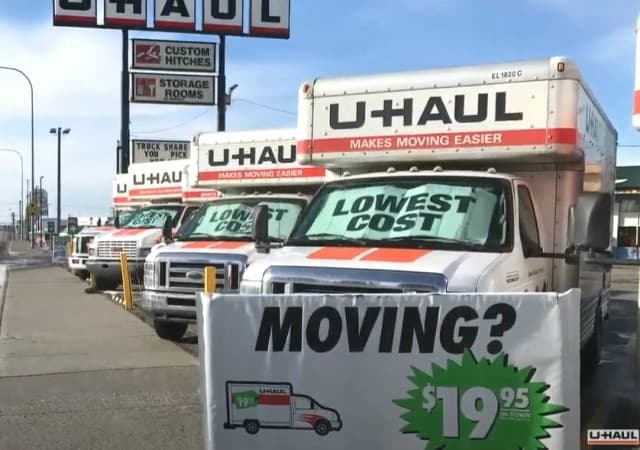
Americans are voting with their feet, and the ballot box this time is a U-Haul cab. Every one-way truck, trailer, and moving container that crosses a state line is a verdict rendered by a family that has had enough. It is a verdict on taxes, crime, energy costs, schools, and the basic competence of state government. For 2024, U-Haul's annual Growth Index delivered the same blunt verdict it has been delivering for years: blue-state governance is driving people out, and conservative states are reaping the rewards.
The U-Haul Index Has No Spin Cycle
U-Haul is not a partisan outfit. It is a moving company. Its growth rankings are compiled from more than 2.5 million one-way transactions across the United States and Canada. The metric is simple: where did the trucks go, and where did they stay? In 2024, the winners were unmistakable. South Carolina topped the index for the first time in history, with more than 51.7 percent of its U-Haul traffic inbound. Texas placed second, North Carolina third, Florida fourth, and Tennessee fifth. Every one of those states is governed by conservative principles: low taxes, right-to-work laws, reasonable regulation, and respect for law enforcement.
Meanwhile, the usual suspects brought up the rear. California ranked 50th for the fifth consecutive year. New York sank to 47th, its lowest showing in a decade. Illinois and New Jersey lingered near the bottom as well. These are not one-year anomalies caused by a harsh winter or a temporary tax hike. California has been dead last for half a decade. Texas has ranked first or second every year since 2016. Florida has placed fourth or higher every year since 2015. When a trend holds for that long, it stops being a weather report and starts being a policy report.
It Is Taxes, Not Tanlines
The lazy explanation for the blue-state exodus is climate. Sunbelt states are warm, the argument goes, so of course people move south. That story collapses the moment you look at California. The Golden State has 840 miles of coastline, mountains, deserts, and the most forgiving winters on the continent, yet it cannot keep residents from bolting. If sunshine were the decisive factor, Los Angeles and San Francisco would be swelling, not shrinking. Weather is a footnote; policy is the headline.
The Tax Foundation cuts through the excuses. Among the top third of states for domestic migration growth, the average top marginal state income tax rate sits at roughly 3.5 percent. In the bottom third, the states losing the most residents, the average top rate is about 6.7 percent, nearly double. Four of the top five U-Haul growth states impose no state income tax at all or have moved toward flat, low rates. Compare that to California's 13.3 percent top rate, New York's 10.9 percent, or New Jersey's 10.75 percent. Families notice the difference. A software engineer, a small-business owner, or a retiree on a fixed income can save tens of thousands of dollars a year simply by changing zip codes. They do the math, reserve the truck, and head for the freeway.
The cost squeeze does not stop at the statehouse door. Blue states layer property taxes, sales taxes, gas taxes, and utility mandates on top of income taxes. Zoning laws and environmental review processes make housing artificially scarce and absurdly expensive. Energy policies that shutter reliable power plants drive electricity rates higher. The result is a middle class that works harder, earns less in real terms, and still cannot afford a starter home. United Van Lines' 2024 National Movers Study confirmed the same pattern: the top outbound states were New Jersey, Illinois, New York, California, and Massachusetts, while the top inbound destinations included South Carolina, North Carolina, and Delaware. The moving vans are not following the sun; they are following the money.
Blue States Are Paying for Their Own Departure
Mass migration is not a victimless trend. Every family that leaves takes with it tax revenue, consumer spending, volunteer hours, and often a small business or two. States that raise taxes to fund bloated bureaucracies discover that the very people expected to pay those taxes are the first ones to bolt. The exodus hollows out the middle class, leaving behind a smaller pool of earners to shoulder an even heavier load. Politicians then raise rates again to close the gap, which pushes more residents toward the exits. It is a fiscal death spiral, and it is entirely self-inflicted.
The damage extends beyond budgets. Major employers have noticed. In recent years, companies such as Oracle, Tesla, Charles Schwab, and Caterpillar have relocated headquarters or significant operations from California, Illinois, or New York to Texas, Tennessee, or Florida. Those moves do not merely shuffle jobs across a map. They transfer innovation, philanthropy, property tax bases, and political influence to states that treat businesses as partners instead of piggy banks. The census reapportionment that follows will send more congressional seats and Electoral College votes to growth states. The departing families are not just changing addresses; they are redrawing the nation's political map.
None of this means red states are perfect. Growth brings traffic, housing demand, and the challenge of preserving local culture. But the fundamental choice is clear. Americans are free to live wherever their values and wallets lead them. When millions of them keep choosing the same low-tax, limited-government, law-and-order states, the message is unmistakable. The U-Haul index does not lie, and it is not kind to the blue-state model.