The Voting Pattern and Its Significance
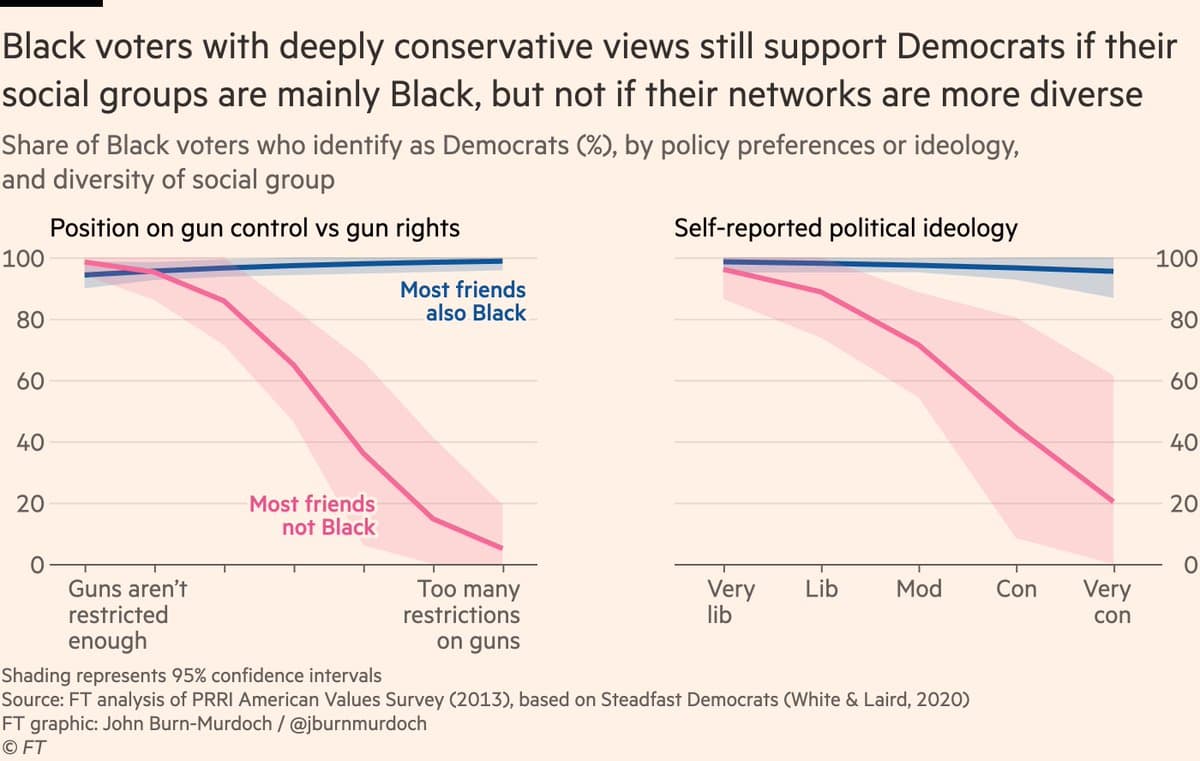
Exit polling from the 2024 presidential election showed that 18 percent of Black voters cast ballots for the Republican candidate. That figure represents the highest proportion of Black Republican voting in the post-civil-rights era. In context: in 2020, Black Republican support stood at 8 percent. In 2016, it was 6 percent. The shift from 6 to 18 percent in eight years is not a marginal movement. It is a realignment. More than one million Black voters switched to or began supporting the Republican Party between 2016 and 2024.
The political significance is straightforward. Black voters have been a Democratic constituency for 60 years. The Democratic Party built its post-1960s coalition on Black voter support. That support averaged 85 to 95 percent in presidential elections for four decades. When that support starts fragmenting, the coalition that was built on it becomes vulnerable. The margin matters in close elections. In six swing states in 2024, the Republican margin of victory averaged 2.1 percent. An increase of 10 percentage points in Republican Black support would have flipped at least four of those states. That did not happen. But the trend is moving in that direction.
What distinguishes the 2024 shift from previous fluctuations in Black Republican voting is its durability and its demographic concentration. Past Republican Black voting surges, like the ones in 1980 and 1984, were rooted in Reagan's economic messaging and did not persist. They represented temporary movements within a stable Democratic coalition. The current movement shows signs of being different. Post-election surveys conducted in early 2025 show that Black Republicans remain more likely to vote Republican in 2026 and 2028 than they were in previous cycles. That persistence suggests a structural shift rather than a temporary tactical movement.
Demographic Profile of the Emerging Constituency
Analysis of voter preference data from exit polls and subsequent surveys reveals who the new Black Republicans are. They are disproportionately male, 62 percent male versus 38 percent female. They are concentrated in the 25 to 45 age group, meaning they are younger than the Black Democratic voter base. They have higher educational attainment in some categories: 27 percent have college degrees compared to 18 percent of Black Democratic voters. But they have higher representation in lower-income categories as well, earning less than 50,000 dollars annually. That combination suggests a mixed profile: some college-educated professionals, some small business owners, some working-class voters who are economically mobile.
Regionally, the new Black Republicans are concentrated in the South and Midwest. Texas, Georgia, North Carolina, and Michigan show the highest percentage increases in Black Republican voting. That concentration matters because those states have both growing Black populations and growing political significance. The South now has the majority of the Black American population, reversing the Great Migration pattern of the mid-20th century. Republicans are gaining in the South among Black voters. That translates to significant electoral implications.
The religious dimension is notable. Black Republicans are more likely to be evangelical Protestant than Black Democrats. Exit data from evangelical Protestant voters shows that Black evangelicals shifted toward Republicans at a higher rate than Black voters overall. That shift reflects both generational change within Black Christianity and the political salience of social issues like abortion and parental rights education curriculum. Black evangelical voters are more culturally conservative on these issues than the Democratic Party is comfortable representing.
Economic Identity and Political Messaging
Surveys conducted by the American Enterprise Institute in late 2024 found that the new Black Republicans identified primarily with economic nationalism and small-business protection rather than traditional Republican supply-side economics. When asked about preferred policies, 58 percent of Black Republicans prioritized tariff protection for domestic workers and manufacturing over free trade. That differs from traditional Republican orthodoxy. It suggests that the appeal is not the traditional Republican tax-cut-and-deregulation platform but rather a different conservatism rooted in economic self-protection and skepticism of globalization.
The messaging that resonated with this constituency emphasized pro-business entrepreneurship at the small scale and skepticism of government spending. Crime and public safety were the second-most-important issue for Black voters considering Republican voting in 2024. That was true across socioeconomic categories. Democratic crime policies, particularly decriminalization and police reform rhetoric, created an opening for Republicans to position themselves as the pro-law-enforcement party. That positioning succeeded among Black voters who experienced crime victimization more directly than other populations.
Immigration policy was the third-most-important differentiator. Black voters with lower education and lower income were more likely to view immigration as economic competition for jobs and community resources. Republican messaging on immigration restriction found receptive audiences in Black communities. That message differed from traditional Republican anti-immigration rhetoric only in emphasis, not in substance. The substance was the same. The audience was new.
Forward Dynamics and Democratic Risk
The durability of this shift will depend on whether the Republican Party can deliver on the messaging and whether the Democratic Party can recapture voters by shifting its own policy position. Democrats currently have two strategic options: compete for Black Republican voters by moving rightward on crime and immigration, or cede some portion of the Black vote and accept a smaller but more ideologically consistent coalition. Both options have tradeoffs. Moving rightward on crime and immigration alienates progressive constituencies. Accepting a smaller coalition creates electoral vulnerability in the swing states where Black voters are decisive.
Republicans, conversely, have every incentive to consolidate and expand the new Black Republican voter base. That will require delivering tangible policy results on the issues that matter to this constituency: economic opportunity, crime reduction, and immigration control. Messaging alone will not sustain this coalition if the material conditions do not improve. If Republicans govern in ways that benefit the small-business owners and working-class voters in this emerging constituency, the coalition becomes durable. If Republican governance reverts to traditional supply-side priorities that benefit large corporations and wealthy individuals, the coalition will fracture.