The Narrative That Doesn't Survive Contact with Reality
There's a story being told in certain foreign policy circles and amplified by media outlets with a particular worldview, and the story goes like this: American engagement in the Middle East is essentially religious in character. A Christian nationalist project. A crusade wearing the clothes of counterterrorism.
I'm a woman of faith. I take religious questions seriously, more seriously than most of the commentators pushing this narrative. And the narrative is wrong. Not debatable. Wrong.
You cannot launch a religious war with an irreligious army. Full stop.
Church attendance in the United States has dropped from 73% in 1937 — when Gallup first started asking — to 47% in 2021. That number has been in freefall for two decades. The fastest-growing religious category in American survey data is "none" — people who identify with no religious tradition at all. Among adults under thirty, it's the majority category in many regions of the country.
This is a nation that can't keep its own churches open. The idea that it's marshaling its foreign policy around a coherent theology of holy warfare requires ignoring basically everything we know about American religious life.
Who Actually Believes This and Why
My daughter attends a university in the South, and she came home last semester describing a class discussion in which a professor presented American foreign policy as fundamentally driven by Christian nationalism. Several of her classmates — raised in secular households, genuinely unfamiliar with what actual Christian nationalism looks like — nodded along. They had no framework to evaluate the claim.
That's the target audience for this narrative. People unfamiliar enough with faith to accept a caricature of it. To people who haven't been inside a church since a grandparent's funeral, "Christian nationalism" sounds plausible as an explanation for things they don't understand. The phrase does a lot of work for people who don't interrogate it.
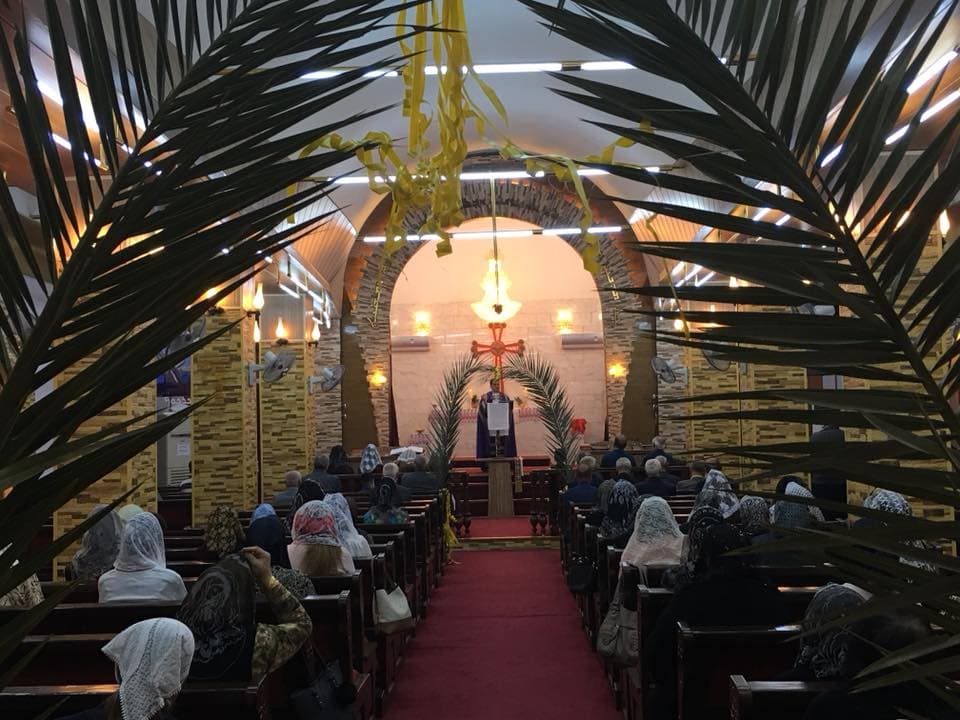
But actual Christians — the ones filling pews, running Sunday schools, supporting missionaries, doing the hard quiet work of faith — are not a unified political force with a coordinated foreign policy agenda. They're Baptists arguing with Methodists about worship style. They're Catholic parishes debating immigration. They're evangelical churches split down the middle over every political question you can name.
The "Christian crusade" narrative requires a coherent, theologically motivated political bloc that doesn't exist. American Christianity is too fractured, too diverse, and in too many places too weak to drive the foreign policy of a superpower. Anyone who's spent time in actual American churches knows this instantly.
What the Real Stakes Are
Here's why this matters beyond the academic. When American engagement in the Middle East gets framed as religious warfare, it delegitimizes the genuine security rationale for that engagement. It transforms counterterrorism — the entirely legitimate project of protecting American citizens from people who want to kill them — into something that can be dismissed as ideological aggression.
And it serves the interests of adversaries who genuinely do operate from religious motivations. When you tell people that America is engaged in a crusade, you validate the framing that jihadist organizations have used to recruit for thirty years. You confirm the story they tell their recruits about why Americans are the enemy. You do their information warfare for them.
The scholars and commentators who push this narrative are not, in most cases, doing so with hostile intent. Most of them are making what they believe is a sophisticated critique of American power. But the effect of the narrative is to validate the worldview of people who actually do want to conduct religious warfare against the United States and its allies.
That's not a sophisticated critique. That's an own goal.
What Faith Actually Demands
Real religious convictions, the kind forged in genuine community and sustained by genuine practice, produce a very different kind of engagement with the world than the cartoon version in the narrative. The Christian tradition — the actual tradition, not the politicized caricature — demands humility in the exercise of power, care for the vulnerable, honest accounting of costs and consequences, and a deep skepticism toward the idea that earthly governments are vehicles for divine purposes.
Augustine wrote about just war theory in the fifth century, and the tradition that developed from his work is enormously complicated and demanding. It places heavy burdens on those who would invoke religion to justify warfare. The people shouting "crusade" from either direction — the critics who use it as an accusation and the rare voices who've used it as a rallying cry — are both operating outside that serious tradition.
If American foreign policy is going to be criticized on religious grounds, the criticism should engage the actual theological tradition rather than a pop-culture version of it. And if the American church is going to speak to questions of war and peace, it should do so with the full weight and complexity of its own intellectual heritage. Neither thing is happening in mainstream discourse.
What's happening instead is noise. And noise serves no one — not the policymakers who need clear thinking, not the citizens who deserve honest analysis, and certainly not the men and women whose lives are on the line in places where the noise never quite reaches.