The Deficit Widens
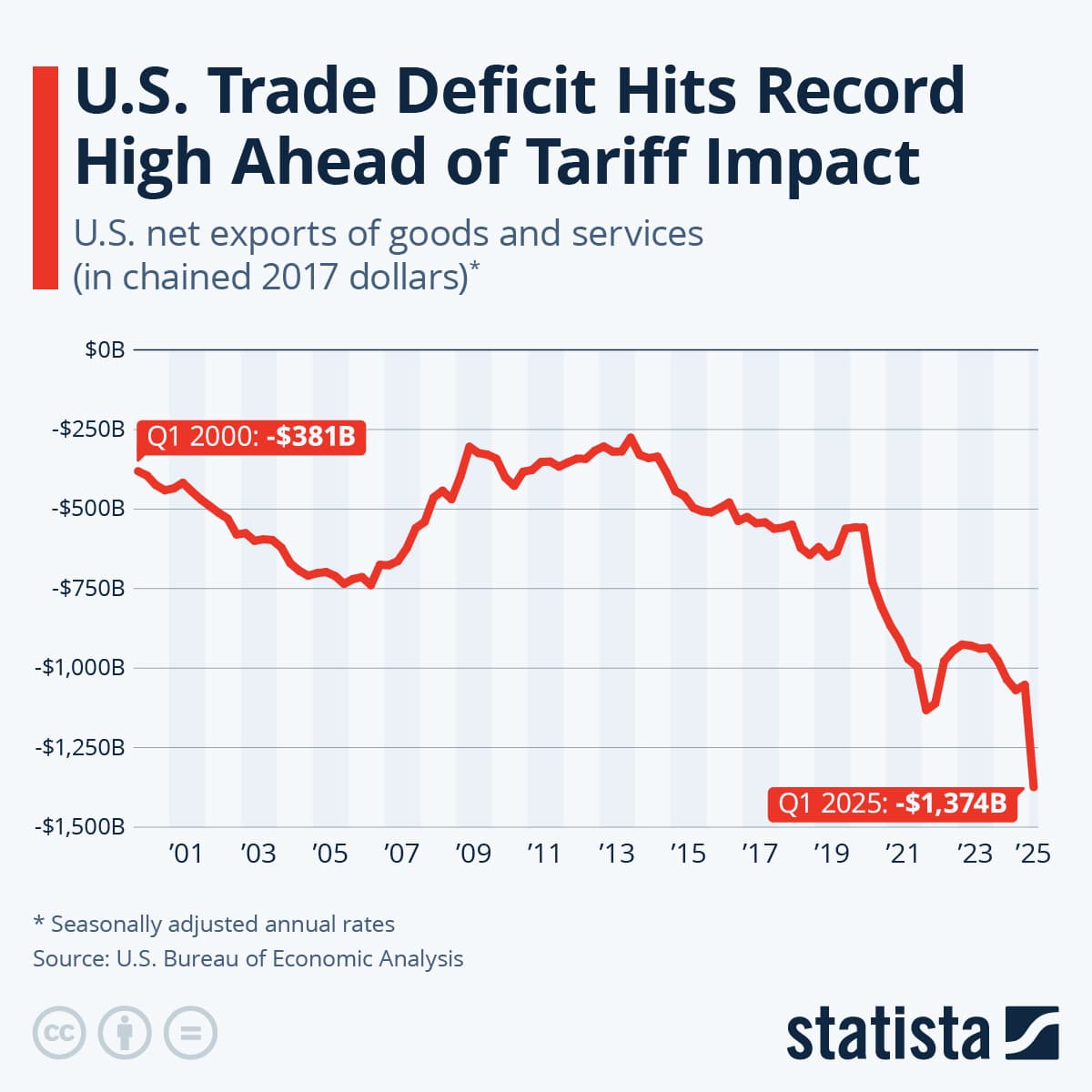
The U.S. trade deficit in goods reached 73.1 billion dollars in January 2026. That's the highest monthly figure recorded in government statistics going back to 1980. The deficit widens while import volumes remain historically high. Manufacturers and retailers are importing at record pace, apparently betting that tariff threats will materialize after an announcement period, not before implementation.
Imports from China totaled 18.3 billion dollars in January. That's up 8 percent from December despite the administration's repeated signals that tariffs on Chinese goods are coming. Imports from Mexico, Canada, and Vietnam also surged. The import surge suggests that businesses are front-running potential tariffs, importing now at lower prices before duties apply and costs rise.
This behavior is economically rational for individual importers. If you import 100 containers in January at 10,000 dollars per container, and tariffs will be 25 percent starting in April, your calculation is simple: pay 1 million dollars now, or pay 1.25 million dollars later. You pay now. The aggregate effect is that imports spike in advance of tariffs, then flatten once tariffs take effect and the underlying demand for imports returns to normal levels.
Why the Deficit Matters and Why It Doesn't
Populist concern about the trade deficit stems from a mercantilist logic: imports are bad, exports are good, and a deficit means the U.S. is losing. That framing misunderstands how trade works. The trade deficit exists because Americans prefer to spend money on imported goods rather than domestic goods. That's revealed preference, not a loss. If Americans voluntarily buy more from foreigners than foreigners buy from Americans, that reflects American consumption preferences.
But the trade deficit does reveal something real: American manufacturing capacity has shifted overseas. Where the U.S. once produced consumer goods domestically, it now imports them. That's not in itself problematic, but it means the U.S. manufacturing sector is smaller and the service sector is larger. That reshuffles employment and regional economies. Manufacturing-dependent regions face decline. Service-sector regions flourish.
The policy response that's emerging is tariffs. The Trump administration is threatening 25 percent tariffs on all imports from Mexico and Canada, and higher tariffs on specific items from China. The stated goal is to reduce the trade deficit and restore U.S. manufacturing. The mechanism is to make imports more expensive so that domestic production becomes competitive.
What Tariffs Would Actually Do
Tariffs raise prices for consumers and businesses that use imports. If the tariff on clothing imports is 25 percent, the price of clothing rises 25 percent. Consumers pay more. Domestic clothing manufacturers may expand production, but they won't expand enough to replace all the foregone imports. The result is higher prices, reduced consumption of clothing, and modest domestic production gains. The consumer loses more than the domestic producer gains. It's a bad trade economically.
But it's a good trade politically. Domestic manufacturers are concentrated in specific places and politically organized. Consumers are dispersed and often don't realize that price increases are tariff-driven. Politicians face pressure from concentrated interest groups and don't face equivalent pressure from dispersed consumers. Tariffs are therefore politically rational even when they're economically harmful.
The tariff threat has also created a temporal arbitrage opportunity for importers. Businesses are front-running the tariffs by importing in advance. This creates a spike in imports that makes the trade deficit look worse in the short term, but once tariffs take effect and front-running stops, the deficit may actually shrink because underlying import demand is lower. The headline will be that tariffs reduced the deficit, but the mechanism is that tariffs dampened demand rather than boosted production.
The Longer Strategic Question
The Trump administration frames the trade deficit as a sign of weakness and a problem to be fixed. The alternative framing is that the trade deficit is a sign of strength. Americans prefer to consume imports. American capital is invested overseas in productive ventures. American investors earn returns. The trade deficit is the flip side of capital flows and investment returns.
Eliminating the trade deficit through tariffs would require either reducing consumption or increasing production dramatically. Neither is happening. The U.S. will have a trade deficit because American consumers want to buy imported goods and American investors want to export capital. Tariffs can reduce the deficit by reducing consumption and investment, but that's a loss, not a gain.
What's likely is that tariffs will be implemented, the deficit will temporarily shrink due to reduced demand, the headline will be claimed as a victory, and then the deficit will revert upward as demand and investment patterns resume. That cycle has repeated under previous administrations and it'll repeat again. The trade deficit isn't a problem to solve. It's a feature of a consumption-heavy, investment-heavy economy.