The Numbers
The Congressional Budget Office projects federal spending of 7.2 trillion dollars in fiscal 2026. That's 4.8 percent growth from 2025. Real GDP growth is projected at 2.1 percent. Simple arithmetic: spending is growing 2.3 times faster than the economy that funds it. That pattern has held for twelve years. The structural imbalance is not temporary. It's permanent until policy changes.
To put this in perspective: thirty years ago, federal spending was 18 percent of GDP. In 2026, it's 26.7 percent. That's growth of 49 percent relative to economic capacity. Meanwhile, federal revenues have grown from 17 percent to 17.8 percent of GDP. The gap between what the government spends and what it collects is the deficit. That deficit is structural and it's growing.
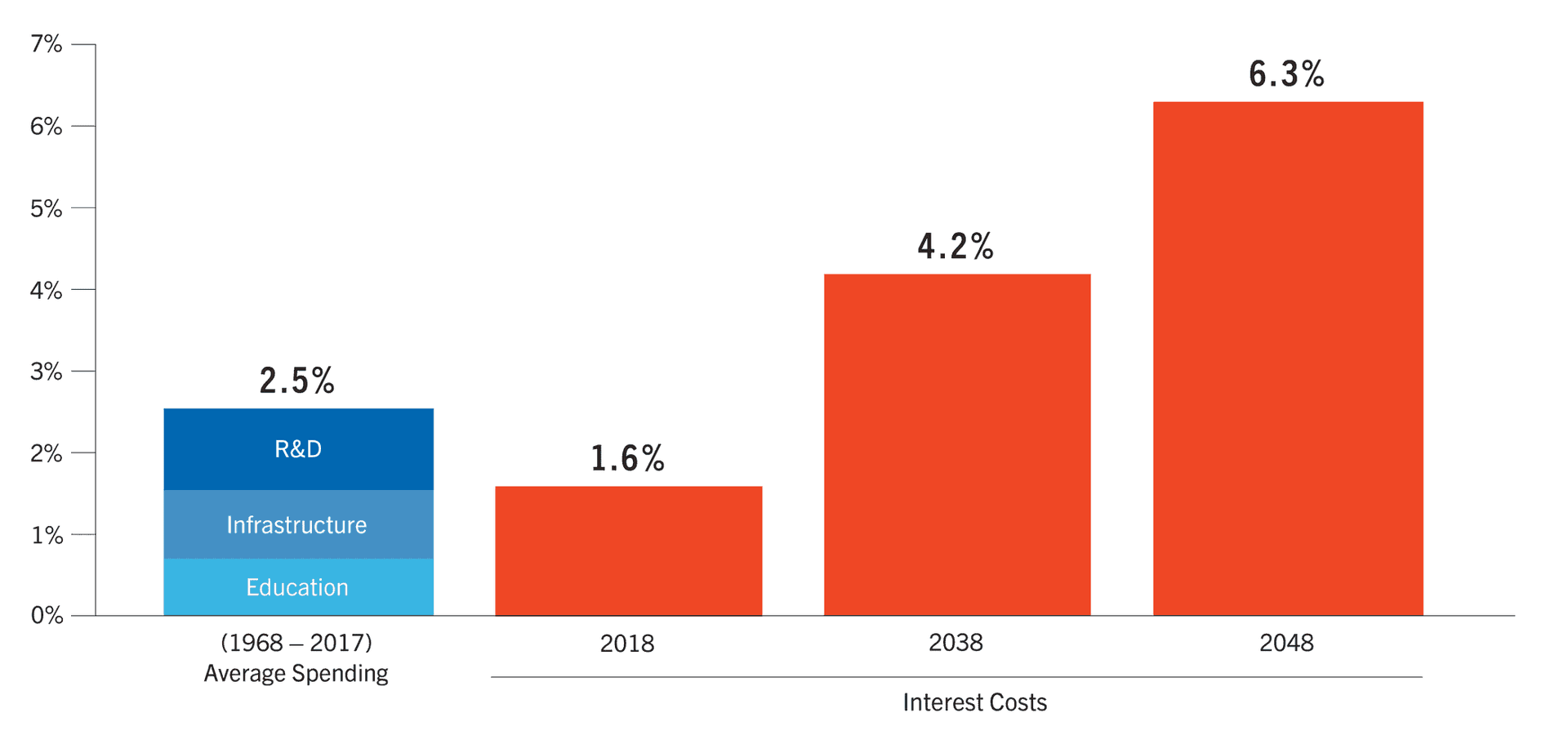
Interest payments on the national debt are the fastest-growing budget item. In 2000, interest payments were 3.2 percent of the budget. In 2026, they're 14.7 percent. That's a shift of 11.5 percentage points. Every dollar the government once spent on programs, defense, or infrastructure now goes partially to interest payments instead. That's the invisible crowdout effect of deficit spending.
Why Spending Exceeds Revenue
Politicians have a simple incentive structure: spending is popular because it benefits identifiable groups. Taxes are unpopular because they hurt identifiable groups. Elections reward politicians who spend and punish those who raise taxes. The structural result is that spending drifts upward and revenues stay flat. The deficit is the predictable output of that incentive system.
Entitlements are the driver. Social Security, Medicare, and Medicaid together represent 48 percent of federal spending. These programs are populated with politically powerful constituencies: retirees and healthcare recipients. Both groups vote. Both groups oppose cuts. Politicians know that proposing cuts to entitlements creates electoral risk. So they don't. Instead, they watch spending drift upward as the population ages and healthcare costs rise.
Defense spending is the second-largest category at 13 percent of budget outlays. Defense also has powerful constituencies: military contractors, defense-dependent districts, veterans. Unlike Social Security, defense is somewhat discretionary. Policymakers could theoretically reduce defense spending. They don't because defense provides security goods that are politically valuable and defense contractors are distributed across enough congressional districts that cutting defense triggers opposition from many quarters.
The Deficit Spiral
The deficit creates new spending in the form of interest payments. Interest payments grow, which increases the deficit, which increases interest-payment growth. That's a compounding spiral. At some point, interest-payment growth overwhelms everything else. At that point, the government has no fiscal flexibility. All revenue goes to interest. All discretionary spending becomes impossible.
The timeline for hitting that constraint is debated among fiscal economists. Some say ten years. Some say twenty. Some say thirty. The numbers depend on interest rates and GDP growth assumptions. But regardless of the timeline, the direction is unmistakable. Unless policy changes, the U.S. will eventually face a fiscal reckoning where interest costs consume all available revenue.
That reckoning typically arrives through one of three mechanisms. First, a fiscal crisis where debt becomes unpayable and the government defaults. Second, inflation where the government effectively devalues the debt by creating new money to pay it. Third, a policy change where spending is cut or revenues are raised. The Trump administration is signaling interest in spending cuts. The Democratic Party is signaling interest in tax increases. Neither is politically easy, but both are ultimately unavoidable.
What Could Change This
The most straightforward path would be a combination of entitlement reform, defense efficiency, and tax increases. But that requires agreement across political divides that doesn't exist currently. Republicans favor defense spending and entitlements but oppose tax increases. Democrats oppose defense spending cuts and entitlements cuts but favor tax increases. The overlap is zero.
Some fiscal hawks argue for a constitutional balanced budget amendment that would force Congress to spend only what it collects. That would make spending discipline automatic rather than relying on political will. But a balanced budget amendment would require painful cuts immediately. No politician wants to vote for that.
The most likely scenario is slow drift toward a fiscal crisis punctuated by periods of reform. When the deficit gets bad enough, politicians get serious. When it gets manageable again, they go back to deficit spending. This cycle has repeated throughout history. The U.S. will probably cycle through it again before dealing with the structural issue permanently.