The Price of a Seat at the Table
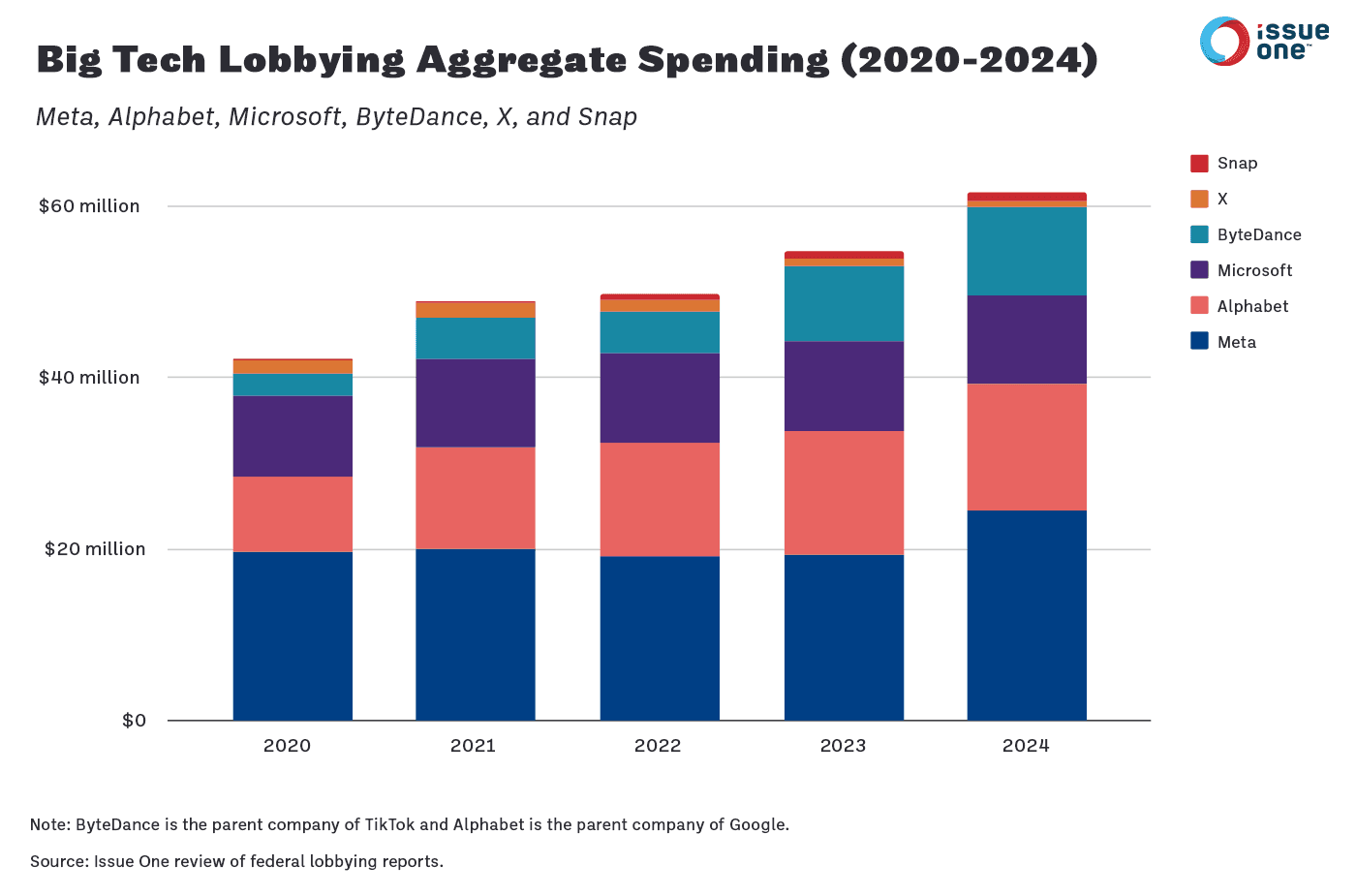
Last year the largest technology companies in America spent more than $100 million on federal lobbying. That is not the cost of doing business in a free market. It is the down payment on a protection scheme. While ordinary families struggled with inflation and small business owners worried about rising interest rates, Apple, Amazon, Alphabet, Meta, and Microsoft wrote checks to Washington with one goal: keep regulators, legislators, and the bureaucracy looking the other way.
The numbers are staggering, and they are public. Disclosure reports from 2024 show that Meta spent $20.3 million on lobbying, Amazon spent $19.8 million, and Alphabet spent $14.8 million. Apple added another $9.4 million, while Microsoft spent $9.9 million. Throw in the trade associations and front groups these firms bankroll, and the total quickly clears the nine-figure mark. That money does not go toward engineering better phones or faster delivery. It pays for former staffers turned lobbyists, plush conference rooms on K Street, and whisper campaigns designed to turn complex bills into favors.
Put the scale in perspective. A single suburban hardware store might clear $1 million in revenue during a strong year. The five largest tech firms spent roughly that amount on lobbying every few days. Yet when a small business owner complains that an app store takes up to 30 percent of every sale, he is told to build his own platform. The rules that protect the giants are written by people who attend the giants' fundraisers.
What did the American people receive in return? A social media landscape that suppresses dissent. App stores that treat conservative publishers like second-class citizens. Search engines that bury stories they dislike. Cloud contracts that hand government agencies more power to watch citizens. The lobbying tab keeps climbing, and the public keeps losing.
From Innovation to Regulatory Capture
For decades conservatives defended Silicon Valley as the crown jewel of American enterprise. We cheered the garage start-up, the risk-taking founder, and the platform that let millions speak without a gatekeeper. That romance is over. Today's tech titans are not scrappy underdogs. They are some of the wealthiest corporations on earth, and they have built a business model that depends on government protection.
The arrangement works like this. The industry floods the capital with cash, hires former regulators, and funds think tanks that produce friendly white papers. In exchange, Congress slows antitrust enforcement, waters down privacy rules, and writes carve-outs for content moderation. The result is not deregulation. It is regulatory capture dressed up in start-up hoodies.
Consider the fate of legislation meant to check this power. The American Innovation and Choice Online Act once commanded bipartisan support in both chambers. It aimed to stop dominant platforms from preferencing their own products and suffocating smaller competitors. Then the tech lobby went to work. By the end of the session, the bill was buried under amendments and procedural delays, and the firms that spent tens of millions to kill it went back to collecting rent.
The revolving door spins fastest at the agencies meant to police these companies. Senior officials cycle in and out of tech law firms and consulting shops. They arrive promising to enforce the law and leave with lucrative retainers. It is a conveyor belt of conflicted loyalties, and the taxpayer is left paying for both ends of the trip.
Conservatives should be the first to call out this racket. We believe in markets, but markets require competition. We believe in free speech, but free speech requires platforms that do not collude with government censors. When a handful of firms can buy the process, we do not have capitalism. We have cronyism with better public relations.
A Conservative Answer: Competition, Not Concessions
The answer is not to beg these companies to be nicer. The answer is to strip away the protections that let them rig the game. Start with transparency. Every meeting between a tech lobbyist and a member of Congress or a regulator should be disclosed within days, not buried in quarterly filings. Every provision inserted into a bill at the request of a tech donor should carry the sponsor's name.
Next, enforce the laws we already have. Antitrust statutes were written to stop exactly this kind of concentrated power. The Federal Trade Commission and the Department of Justice should stop treating Big Tech like a fragile science project and start treating it like any other industry that crushes competitors. Break-ups, interoperability mandates, and data portability are not punishment. They are the preconditions for a market that works.
Congress should also end the acquisition strategy that lets dominant firms buy or bury every promising rival. When a company already controls a platform, it should not be allowed to purchase the next competitor that threatens its gatekeeper status. Real competition requires that challengers can grow, not that they become acquisition targets the moment they gain traction.
Finally, conservatives must stop letting the industry hide behind the First Amendment when it suits its business model. A platform that silences lawful speech while taking taxpayer-funded contracts is not a neutral publisher. It is a participant in the public square, and it should be treated as such. That means clear rules against viewpoint discrimination, fair access for independent media, and an end to the revolving door between Silicon Valley and the agencies meant to police it.
This is not a call for government to pick winners. It is a call for government to stop being rented by the winners it has already picked. Big Tech spent $100 million last year because it expects a return on investment. So far, Washington has been happy to oblige. The bill is being paid by the American taxpayer, the small business owner, and the citizen who wonders why his voice keeps getting quieter online. It is time to close the account.