The Confiscation Without Conviction
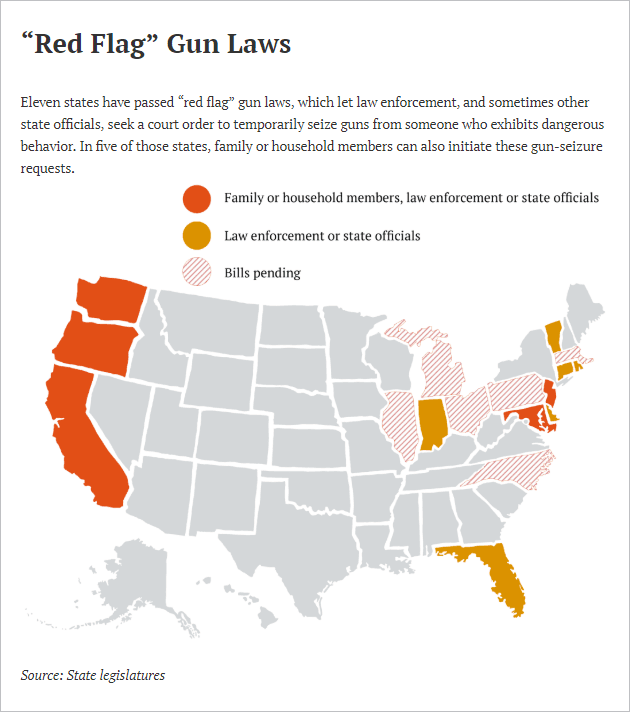
Red flag laws, formally called Extreme Risk Protection Order laws, allow courts to temporarily or permanently confiscate firearms from individuals based on allegations of dangerousness without requiring a criminal conviction or even criminal charges. Supporters claim the laws prevent mass shootings by disarming dangerous individuals before they commit violent acts. Critics note that the laws violate due process and create opportunities for political abuse and private vendettas. Nineteen states plus Washington D.C. have enacted red flag laws. The laws differ in procedural details, but all share a common feature: someone can report another person to police or courts based on alleged dangerousness, and a judge can order the temporary or permanent confiscation of firearms without the accused having an opportunity to present a defense. In some jurisdictions, the accused does not even know about the confiscation order until law enforcement arrives to seize the weapons. A divorced man in California had his firearms confiscated based on a report from his ex-wife that he had made vague statements about the unfairness of divorce proceedings. He was never charged with a crime. He had no criminal history. But his constitutional right to own firearms was suspended indefinitely based on an ex-wife's allegation and a judge's assessment of dangerousness that is inherently subjective and unreliable. Courts use threat assessment tools that have accuracy rates of only around fifty percent, which is worse than random chance. Basing permanent constitutional deprivations on test results with fifty percent accuracy is not justice. It is arbitrary confiscation.
The Due Process Violation
The Fifth Amendment to the Constitution guarantees that no person shall be deprived of property without due process of law. The Fourteenth Amendment applies that guarantee to the states. Red flag laws violate that guarantee by allowing property confiscation before a hearing, before the accused has a chance to defend themselves, and based on evidence standards that would never hold up in criminal court. In criminal court, a defendant has the right to counsel, the right to confront witnesses, the right to present evidence, and the right to require the government to prove guilt beyond a reasonable doubt. In red flag proceedings, the accused may not have counsel, may not be able to confront the person making allegations, may not be able to present evidence effectively, and the government only needs to meet a preponderance of the evidence standard, which is a much lower bar than reasonable doubt. That is not due process. That is deprivation without process. Multiple federal courts have found red flag laws to be constitutional, but the reasoning in those decisions is weak and relies on the assumption that the government's interest in public safety outweighs individual constitutional rights. That is the same reasoning that could justify confiscating other constitutional rights without due process.
The Political Abuse Potential
Red flag laws create tools for political suppression and private revenge disguised as public safety. A political activist can report his opponent's firearms as dangerous and request a confiscation order. A neighbor can report a neighbor he dislikes for making politically incorrect statements. An ex-partner can weaponize the law in a custody dispute. Police can use the law to disarm political activists without criminal charges. The potential for abuse is enormous and documented. Multiple cases have emerged where red flag laws were used by political actors to suppress political opponents or in personal disputes that had nothing to do with public safety. A man in Florida had his firearms confiscated based on posts criticizing the government. He was never charged with a crime. He had no criminal history. But the government used a red flag law to disarm him based on his political speech. That is political suppression dressed up as public safety. The law has become a tool for authorities to confiscate weapons from citizens who have not committed any crime based on subjective assessments of dangerousness that are motivated by politics or personal grudges. Once confiscation occurs, it is difficult and expensive to recover the weapons through the legal system. Most accused individuals cannot afford lawyers to fight the confiscation. So weapons are confiscated from people who have committed no crime and who cannot afford to fight for their constitutional rights through the courts.
The Second Amendment Problem
Red flag laws conflict with the Second Amendment right to keep and bear arms for self-defense. The Supreme Court has held that the Second Amendment protects an individual right to own firearms for lawful purposes including self-defense. Red flag laws allow the government to confiscate firearms based on alleged future dangerousness rather than current criminal conduct. That is inconsistent with a constitutional right. If the government can confiscate a constitutional right based on allegations and subjective threat assessments, then the constitutional right is not a right. It is a privilege subject to government permission. That is not how rights work under the Constitution. Congress should pass legislation prohibiting red flag laws or requiring them to include full due process protections before any confiscation occurs. Those protections would include the right to counsel, the right to confront accusers, the right to present evidence, the right to a jury trial, and the requirement that the government prove dangerousness beyond a reasonable doubt before confiscating constitutional rights. With those protections, red flag laws might be constitutional. Without those protections, they violate the Constitution and the rights of citizens.