The Attendance Numbers
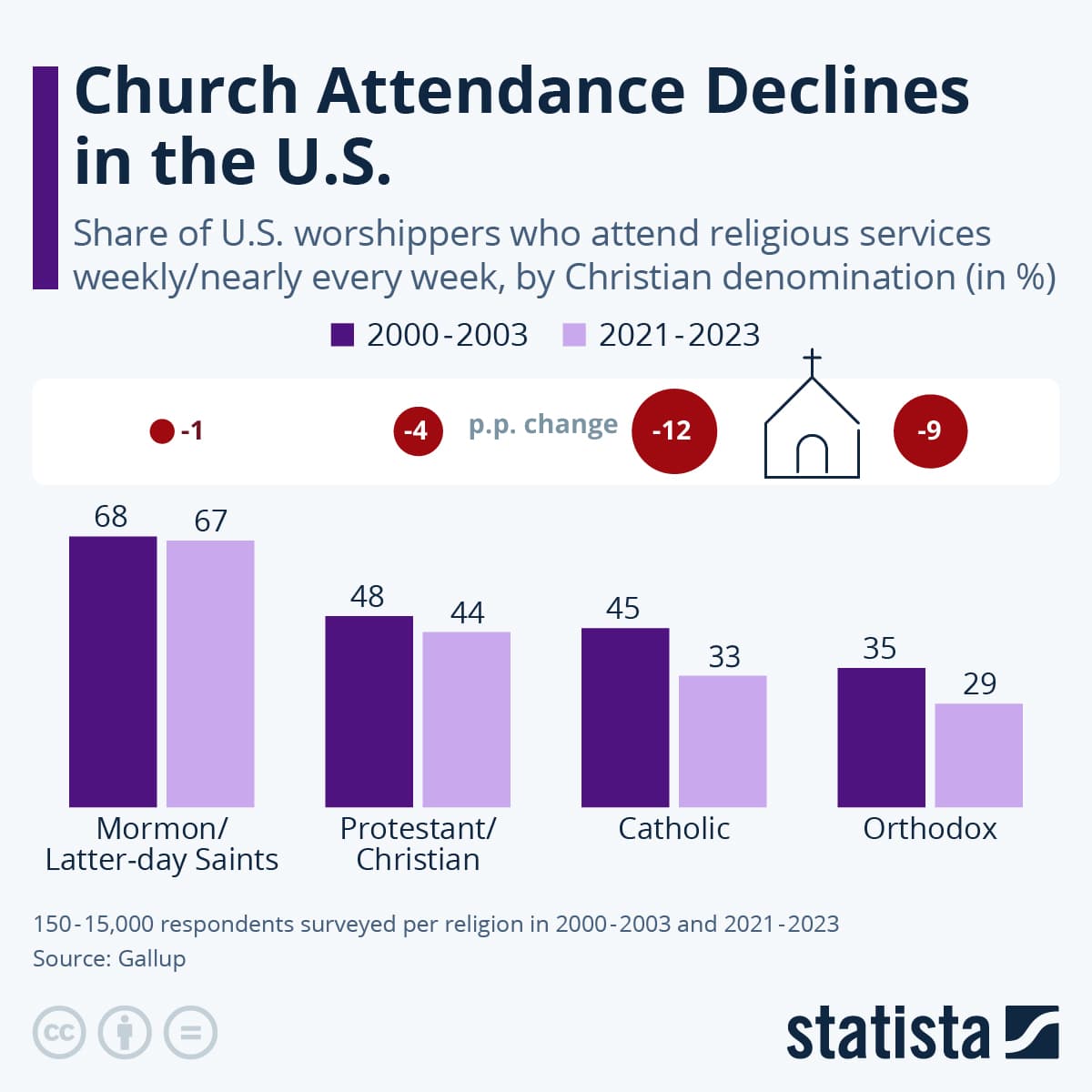
The General Social Survey, a long-running sociological study conducted at the University of Chicago, measures religious attendance across generations. In 1972, when the survey began, 43 percent of young adults aged 18 to 29 attended religious services at least monthly. In 2026, that number is 22 percent. The decline is linear. Every five-year cohort attends less than the one before it.
This isn't a temporary dip. Young adults are leaving organized religion and not coming back. The percentage of young adults who claim no religious affiliation has risen from 5 percent in 1972 to 43 percent in 2026. The trajectory is clear and it's accelerating.
But the attendance decline is steeper than the disaffiliation rate suggests. Some unaffiliated young adults still attend services occasionally. Some young adults identify as religious but don't attend regularly. The net effect is that only 22 percent of young adults have monthly or better attendance, and many of those are women marrying into religious families.
Why Young Adults Are Leaving
The reasons are complex. First, major religious institutions have been rocked by scandal. The Catholic Church's abuse crisis remains a defining memory for young adults who came of age in the 1990s and 2000s. Evangelical churches have fractured over politics and pastoral behavior. Mainline Protestant denominations have lost credibility through perceived moral compromise. Young people looking at these institutions see failures, not faith.
Second, religious formation happens in families. Young people raised in religious homes are more likely to remain religious as adults. But family formation itself is delayed. Young adults are marrying later, having children later, and having fewer children. That delays the life stage where family religious practice becomes important. By the time some young adults have kids, they've been away from church for fifteen years and the reentry barrier is high.
Third, the cultural and political polarization around religion has made religious identity feel politicized. Evangelical churches have become associated with Republican politics. Mainline Protestant churches have become associated with progressive causes. Young people who are apolitical or progressive find the religious right off-putting. Young people who are conservative sometimes find the religious left off-putting. Religion feels like politics dressed in theological language.
What Religious Leaders Are Doing
Some denominations are trying to reverse the trend. The Southern Baptist Convention has launched a youth engagement initiative. The Roman Catholic Church is pushing young adult ministries. Evangelical churches are experimenting with contemporary worship and less formal settings. But these efforts are running upstream against powerful currents.
A Catholic priest in Denver said this week that his church is aging. "The parish is full of people in their sixties and seventies. We have very few families with young children. The young people who do show up are mostly adults without kids, often tied to the church by family loyalty or romantic partnership. But they're not staying and they're not raising children in the faith." That's not a Denver problem. It's national.
Some religious organizations are doubling down on countercultural identity. If young people are leaving mainstream religion, the reasoning goes, appeal to young people looking for countercultural community. That strategy is working in some cases. Fundamentalist churches emphasizing traditional sexuality and counter-progressive stances are attracting some young adults. But they're winning a tiny sliver of the population that's leaving the mainstream.
The Societal Implications
Religious participation has historically served social functions beyond spirituality: community, moral formation, social capital, volunteer networks, and rites of passage. As participation declines, secular institutions are filling some of those gaps. But the transition is incomplete and ragged. Young adults without religious community often lack the institutional support systems that organized religion provided.
This creates a generational dividing line. Young adults with religious upbringings and ongoing participation have networks and moral frameworks. Young adults outside those communities are building new ones, but the process is slower and less institutional. Some find community in political movements. Some find it in online communities. Some remain isolated.
The long-term consequence is a less religiously coherent America. For two centuries, religious institutions were the primary shapers of American culture and morality. That role is eroding. The institutions filling that space now are primarily technological and political: social media platforms and interest groups. That's a fundamentally different cultural arrangement, and we won't understand its implications for another generation.