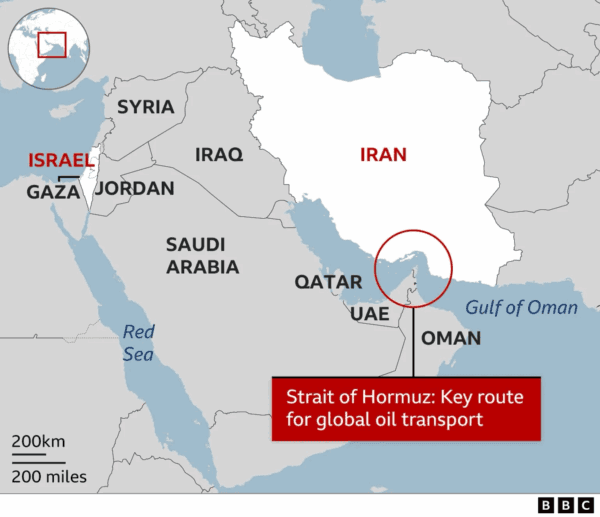
The Strait of Hormuz is closed. That sentence, once unthinkable, is now the headline every American family will feel at the gas pump, the grocery store, and in every heating bill. Iran's Revolutionary Guard has effectively shut the world's most important energy choke point, and the consequences will not stay confined to the Persian Gulf. When roughly 21 million barrels of oil per day stop moving, the shock waves reach every corner of the global economy, starting here at home. This is not a distant regional skirmish. It is a deliberate economic attack on the United States and our allies, and it has been made worse by years of self-sabotage dressed up as green virtue. The thesis is straightforward. A nation that refuses to control its own energy destiny will eventually find its prosperity held hostage by foreign tyrants. The Hormuz blockade is the bill coming due for an energy policy that prioritized climate symbolism over hard security, and it is ordinary Americans who will pay the price. Washington can either reverse course and restore American energy dominance, or it can watch the economy stagger under another avoidable shock.
The Scale of the Crisis
The Strait of Hormuz handles about one-fifth of global petroleum consumption. On a normal day, tankers carrying roughly 21 million barrels squeeze through that narrow waterway, feeding refineries from Rotterdam to Singapore to Houston. The Energy Information Administration has long ranked Hormuz as the world's most critical oil transit route, and for good reason. Global oil demand heading into 2026 sat near 103 million barrels per day, which means more than one in every five barrels consumed worldwide passed through that twenty-one-mile-wide channel. There is no practical alternative pipeline network capable of replacing that volume quickly. Closing the strait does not merely inconvenience traders in London or boardrooms in Riyadh. It removes a fifth of the world's daily oil supply from circulation at a moment when spare production capacity was already thin.
The market reaction was immediate and brutal. Brent crude surged past $95 per barrel within 48 hours of the first Iranian harassment campaign, a jump of nearly 30 percent from pre-crisis levels. West Texas Intermediate followed close behind, and futures contracts for gasoline and diesel spiked even faster. For the average household, that translates into higher prices for every product moved by truck, ship, or plane, which is to say nearly everything. The sticker shock at the pump is only the most visible symptom of a broader inflationary pressure that will punish working families already stretched thin by years of rising costs. Analysts are already warning that sustained triple-digit oil could tip a fragile economy back toward recession.
Energy Weakness Invites Aggression
Iran did not choose this moment by accident. Tehran watched as American leadership spent the last half-decade dismantling the very production base that once gave us strategic leverage. Federal leasing on public lands slowed to a crawl, pipeline permits were canceled or delayed, and refineries faced a regulatory maze designed to discourage investment. The result is a nation that still consumes roughly 20 million barrels of oil per day while producing less than it could and importing more than it should. The United States currently imports roughly 8 million barrels per day, a dependency that would have been unthinkable just a few years ago. Our own Strategic Petroleum Reserve has been drawn down to roughly 380 million barrels, its lowest level in four decades, leaving the country with a thinner cushion than at any point since the early 1980s. That is not prudence. It is inviting a predator to test your defenses.
The Biden-Harris administration and its allies in Congress treated domestic energy as an embarrassment rather than a pillar of national security. They begged Venezuela and Saudi Arabia for more barrels while choking off Texas, North Dakota, and Alaska. They celebrated net-zero rhetoric at international conferences while ignoring the hard reality that oil and gas remain the blood supply of the modern economy. A country that refuses to develop its own resources is a country that must rely on the goodwill of hostile or unstable regimes. The closure of Hormuz exposes that policy for the dangerous fantasy it always was.
The Path Back to Security
Restoring American safety and economic stability requires more than strongly worded statements from the United Nations. First, Washington must reopen the spigots of domestic production. That means streamlined permits for drilling, pipelines, and refining capacity, and an end to the regulatory war on American fossil fuels. Second, the Strategic Petroleum Reserve must be replenished and protected as a genuine emergency stockpile, not a political piggy bank used to paper over bad polling numbers. Third, the United States must guarantee freedom of navigation in partnership with regional allies, including a credible naval presence and clear consequences for any vessel that threatens commercial shipping.
The lesson of this crisis extends beyond energy markets. It is a reminder that ideology cannot repeal geography or physics. The world still runs on oil, and the Strait of Hormuz remains the jugular vein of global commerce. Pretending otherwise did not make the strait less important; it only made the United States less prepared. The mullahs in Tehran understand power. They understand weakness even better. The question is whether our leaders are finally willing to learn the same lesson.
Conservatives have argued for years that energy independence is national independence. The Hormuz crisis proves the point with punishing clarity. American families should not have to wonder whether the mullahs in Tehran can afford their commute. American farmers should not see diesel prices dictated by Iranian speedboats. The path forward is not complicated, but it demands a political class willing to put prosperity and security ahead of ideological fantasy. Texas energy workers stand ready. It is long past time Washington let them get back to work.