The Promise That Someone Else Will Pay
Every election cycle brings a fresh chorus of politicians promising to make college tuition free. The slogan sounds generous. It also sounds simple: wipe out tuition bills, cancel existing debt, and let Washington pick up the tab. What the advocates rarely mention is that nothing in government is truly free. The bill does not disappear. It merely gets rerouted to the Treasury, then to the tax returns of truck drivers, welders, plumbers, retail clerks, and millions of other Americans who never set foot on a four-year campus. That is not compassion. It is a wealth transfer dressed in academic regalia.
The logic behind free college rests on a comforting fiction: that the rich will pay for it. In reality, the burden falls most heavily on working families who lack the political connections to avoid it. A forklift operator in San Antonio pays sales tax, fuel tax, payroll tax, and eventually income tax. He is asked to finance a credential that may raise the lifetime earnings of someone who already sits above him on the income ladder. It is difficult to find any definition of fairness that fits that arrangement.
The advocates of free tuition often frame the debate as a struggle between compassion and indifference. That framing is false. The real divide is between those who believe individuals should bear the consequences of their own decisions and those who believe those consequences can be shuffled onto strangers. A parent who saved for a decade to send a child to a state university receives no refund under most free-college schemes. A grandparent who worked overtime to pay off a loan receives no apology. Instead, both are told that fiscal duty is now a sucker's bet, and that responsibility must be nationalized along with the tuition.
Who Really Writes the Check
The scale of the proposal matters. Federal student loans already total more than $1.6 trillion, a figure larger than the gross domestic product of all but a handful of nations. Adding universal free tuition to that ledger would push the cost into the hundreds of billions of dollars per year, depending on which version of the legislation one examines. Those hundreds of billions do not materialize from a vault in the Capitol. They come from current and future taxpayers, many of whom will receive no direct benefit.
The distribution of that benefit is just as troubling as the size. Only about 37% of Americans age 25 and older hold a bachelor's degree. The remaining 63%, a clear supermajority, would be asked to subsidize a service used by a minority. Worse, the college graduates who would gain from debt cancellation or free tuition are already positioned to earn substantially more over their lifetimes. The median college graduate can expect lifetime earnings near $2.8 million, while the median worker with only a high school diploma earns closer to $1.6 million. The policy therefore asks the lower earner to prop up the higher earner, inverting the usual justification for public assistance.
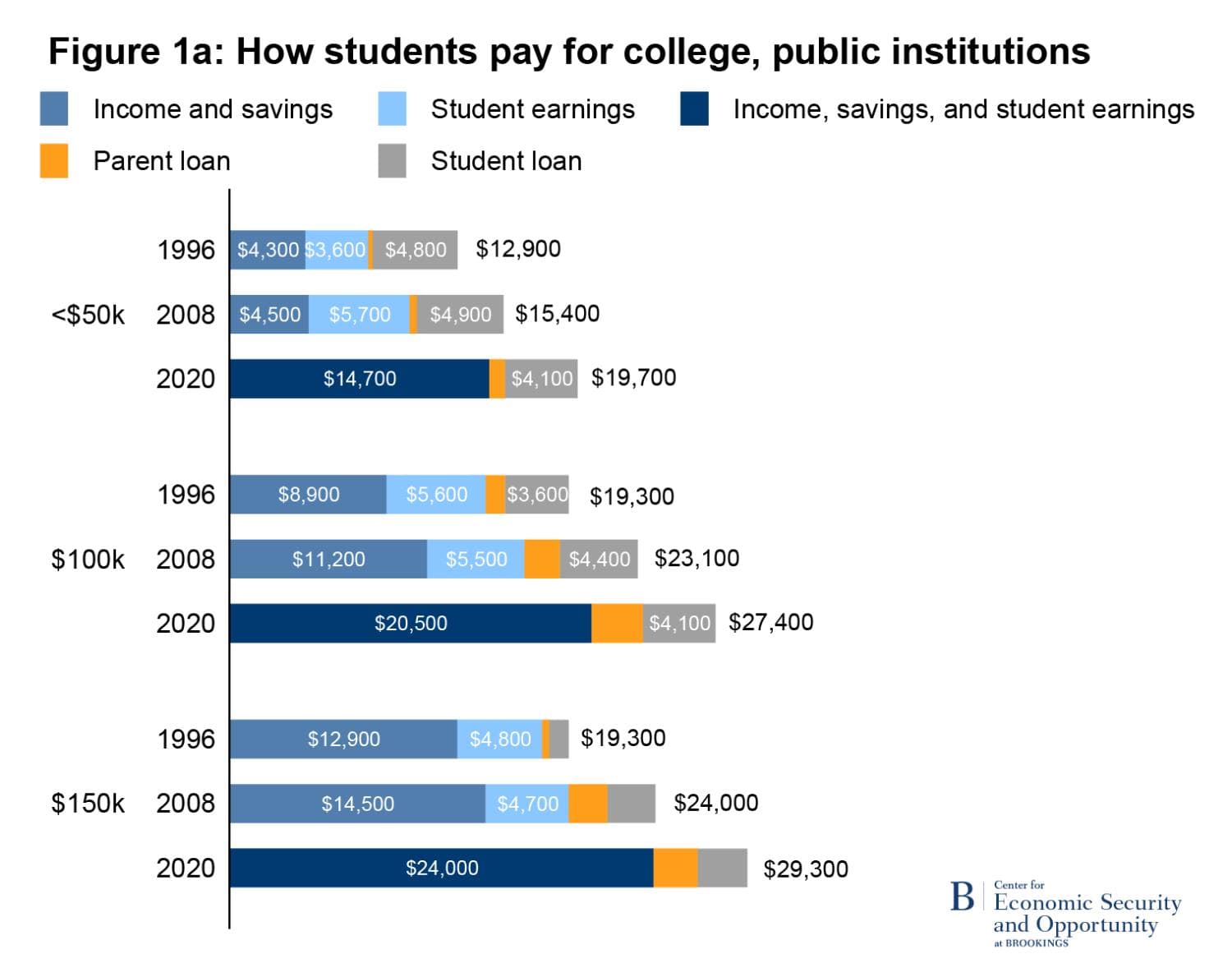
There is also the question of colleges themselves. When Washington promises to pay, colleges respond the way any subsidized industry responds. They raise prices, add administrators, and expand amenities that have little to do with learning. Tuition has outpaced inflation for decades, partly because federal loans and grants have insulated students from the true sticker price. Making tuition entirely free would complete that separation. Students would demand more; colleges would supply it at public expense; and taxpayers would be left holding a bill that grows faster than any congressional estimate.
Subsidies also obscure quality. When the customer does not pay, the customer stops comparing value. A student who pays even a portion of tuition asks whether a particular major leads to a job. A student who pays nothing has less incentive to finish quickly, choose a rigorous program, or demand that professors actually teach. Graduation rates at many institutions are already sobering; removing the price signal is unlikely to improve them. The result is more time in school, more public spending, and too many credentials that fail to translate into employment.
A Better Path Forward
None of this means higher education has no value. It means the value should be borne by those who receive it, not by their neighbors. A young adult who chooses to study engineering, nursing, or accounting makes a voluntary investment in human capital. That investment pays dividends in higher wages, better mobility, and greater job security. It is not cruel to expect that person to repay a loan used for that purpose. It is a basic recognition that adults are responsible for their own choices.
For those who do not choose college, the country owes something better than a tax bill. We owe robust vocational training, apprenticeships, and trade schools that do not require four years of classroom instruction or tens of thousands of dollars in debt. A welder or electrician can earn a solid middle-class income without borrowing a dime. Yet the current conversation treats these paths as consolation prizes, as if only a bachelor's degree counts as success. That snobbery hurts working families twice: first by devaluing honest work, and second by making those workers pay for the ambitions of others.
Conservatives should make the case plainly. Education is a private good with public benefits, not a blank check from the treasury. If taxpayers are going to invest in workforce development, they should do so through portable credentials, transparent pricing, and accountability for outcomes. They should not do so by socializing the cost of a credential that primarily rewards the person holding the diploma. The real cost of free college is not measured in campaign slogans. It is measured in the paychecks of people who never went.