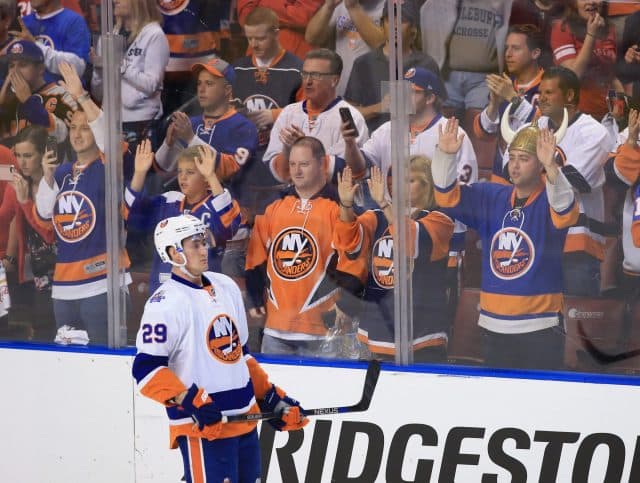
Watching a Franchise Fail in Slow Motion
I grew up watching my father pace in front of a television set in our apartment in Flushing, hands clasped behind his head, waiting for the Islanders to either validate or destroy his week. He was a fan the way immigrants become fans of their adopted teams, completely, permanently, with the full weight of displaced identity riding on every shift. He passed that onto me. Which means I've been watching this franchise's management problems with a kind of grief that goes beyond sports analysis.
The NHL trade deadline is approaching and the conversation around the Islanders is the same conversation it's been for three years running: the team needs significant upgrades to contend, the pieces to make compelling trades exist on paper, and the organization keeps arriving at the deadline having done approximately nothing of consequence. The beat reporters covering the team have been remarkably consistent in their diagnosis: the Islanders aren't willing to make the kind of deal that would actually move the needle.
This isn't unusual in sports, but the Islanders' version of organizational paralysis has some specific causes that the hockey press tends to dance around. The franchise has had ownership and front-office instability that has made coherent long-term planning nearly impossible, and the on-ice product is the result.
The Trade Calculus That's Keeping Them Stuck
The Islanders have genuine assets, draft picks accumulated through years of defensive-first hockey that kept them in playoff contention without quite breaking through. They have young players with real value to contending teams. They have the kind of cap situation that, managed correctly, gives them flexibility.
What they lack is a clear vision of what they're building toward and a front office with the authority and stability to execute that vision over multiple seasons. Teams that make transformative deadline trades do so because the people making the decisions know what they need, trust their evaluation, and have ownership support to pull the trigger on something uncomfortable. The Islanders' track record suggests they have none of those three things aligned simultaneously.
The specific trade the team needs, according to virtually every serious hockey analyst, is a top-six forward who can drive offense at even strength and has enough term remaining to matter in a potential playoff run. The price for that kind of player at the deadline is a first-round pick and a quality prospect. Contending teams pay that price regularly. The Islanders have historically treated first-round picks as untouchable, a posture that made some sense during their rebuilding years and makes considerably less sense now that the rebuild is theoretically complete.
I understand the instinct. Draft picks are certainties. Trade targets are variables. A first-round pick in a strong draft class might develop into a core player. The rental forward might get hurt in March or disappear in the playoffs. The risk calculus of a deadline trade is genuinely complicated. But the Islanders are not a team that can afford to play it safe, they're caught between rebuilding and contending, and that middle position is the most dangerous place to be in professional hockey. Too good to get the draft position that accelerates a rebuild. Too thin to compete with the genuine contenders in the East.
What This Has to Do with How Organizations Actually Work
Here's the analogy that strikes me: the Islanders' trade deadline paralysis looks exactly like what happens to companies that have unclear decision-making authority at the executive level. Individual managers know what needs to happen. The analysis is complete. The recommendation is sitting on someone's desk. And nothing happens because nobody knows who actually has the power to say yes, or because the people who do have that power are optimizing for something other than the organization's stated mission.
In business, that produces missed market opportunities, lost talent, and eventual decline that the organization's leadership consistently fails to anticipate because they were managing internal politics instead of external competition. In hockey, it produces another first-round exit. Or another year watching the Metropolitan Division's stronger franchises extend their windows while yours quietly closes.
The Islanders' fans, my father's people, my people, deserve better analysis of why this keeps happening than "they weren't willing to pay the price." The price isn't the problem. The question is who in that organization has the standing to decide that paying the price is worth it, and whether that person will be there next year to live with the consequences. Until that's resolved, the deadline trade is the least of their problems.