The Consolidation Pattern
Twenty years ago, the hospital industry was fragmented. Thousands of independent hospitals, regional chains, and local health systems competed for patients. That competitive landscape is gone. Today, three hospital corporations control 28 percent of all U.S. hospital beds. The top 25 corporations control 67 percent. In many regions, one or two systems dominate local healthcare delivery.
The consolidation happened through acquisition. Large hospital systems bought smaller competitors. They bought independent hospitals from retiring physicians. They bought struggling regional chains. The government did not stop this. The FTC nominally enforces antitrust law in healthcare, but enforcement has been weak. Hospital mergers that reduce local competition have been approved repeatedly. The pattern has been consolidation without constraint.
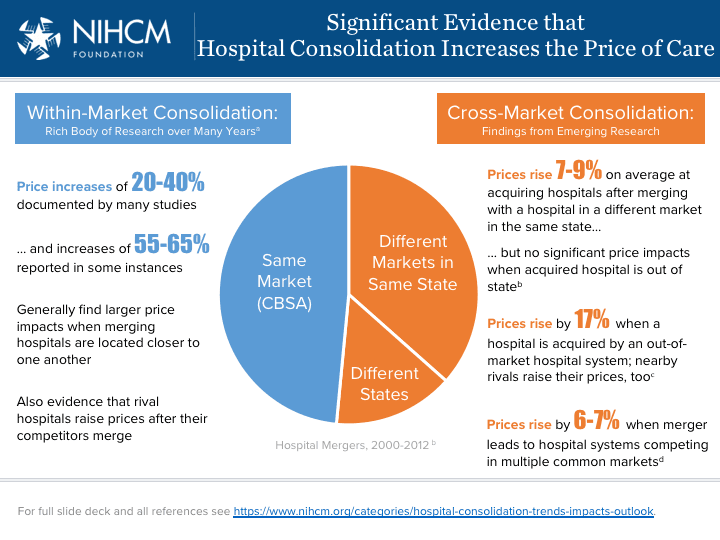
The economic consequence is predictable. Where hospitals face little local competition, they exercise pricing power. A hospital system in a rural county with no competitor nearby can raise prices without fear that patients will switch to a different system. The hospital that faced 50 competitors in 1990 faced extreme pricing pressure from substitutes. The hospital facing 6 competitors in 2026 faces minimal pressure.
What Consolidation Does to Prices
Research from the American Hospital Association and independent economists shows a correlation: increased consolidation correlates with higher prices. A hospital merger that reduces local competition by 25 percent correlates with price increases of 5 to 7 percent relative to competitive benchmarks. Multiply that across hundreds of hospitals and you get systemic price increases that push up costs for employers and government programs.
This is why your health insurance premiums are rising. It's partly because medical care itself is expensive. It's partly because hospitals have pricing power. Where they have more competition, they charge less. Where they have less competition, they charge more. The consolidation trend is reducing competition systematically. That's a structural driver of premium inflation.
Hospitals argue that consolidation creates efficiency. Large systems can invest in technology, share best practices, and achieve economies of scale. That's true in some cases. But the efficiency gains are offset by pricing power. A hospital system that can raise prices by 10 percent and only improve efficiency by 3 percent will absolutely do the former. That benefits the hospital and harms patients.
The Quality Question
The theory of competition is that it drives quality. Hospitals compete on reputation, outcomes, and patient experience. But if competition is weak, quality has no direct benefit. A hospital can provide poor quality care and still retain patients if there's nowhere else to go. Consolidation removes the quality pressure that competition provides.
Some hospital systems have improved quality after consolidation by implementing best practices across acquired hospitals. But others have allowed quality to stagnate. Without competitive pressure, there's no incentive to improve. And without alternative options, patients can't vote with their feet.
Patient experience scores have declined at many consolidated systems. Wait times have increased. Appointment availability has decreased. These are metrics that matter. A patient can tolerate higher prices if they get responsive care and good outcomes. But when consolidation brings both higher prices and worse experience, that's a pure loss.
What Regulation Can Do
The Trump administration has signaled skepticism of consolidation and commitment to antitrust enforcement. That could mean the FTC becomes more aggressive in blocking hospital mergers. Some pending hospital acquisitions are facing regulatory scrutiny that would have been approved under previous administrations.
But regulation is slow. Even if the FTC starts blocking every hospital merger, the consolidation that has already happened remains in place. The hospital landscape would have to de-consolidate, which means breaking up existing systems or encouraging spin-offs. That's harder than preventing consolidation in the first place.
A more direct approach would be price regulation or transparency requirements. Hospitals could be required to publish prices for common procedures. Employers and patients could then shop based on price and quality. But price transparency requires a political will that hasn't existed. Congress talks about it. Regulators don't pursue it. The hospital industry has strong lobbying power and it's used that power to prevent transparency.
The most likely scenario is slow regulatory tightening without fundamental change. Future hospital mergers will face higher scrutiny. But the existing consolidated landscape will remain. That means structural healthcare cost inflation will continue as a feature of the system, not a problem to be solved.