The Architecture As Built
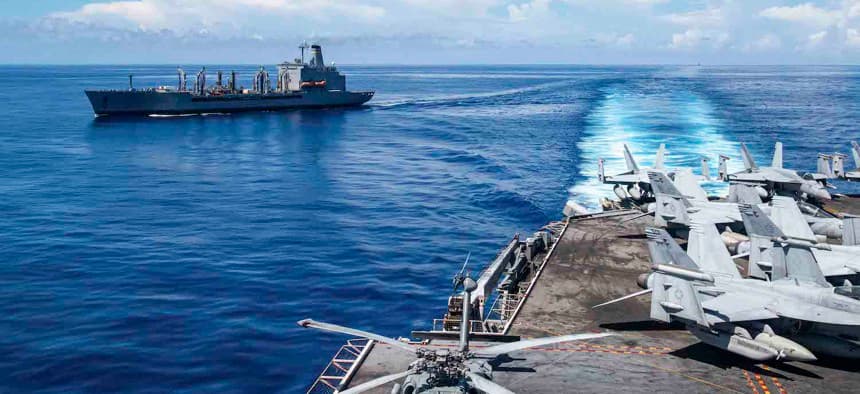
The deterrence architecture the United States constructed in the Indo-Pacific over the last thirty years rested on three pillars. It rested on forward-deployed naval and air capacity sufficient to impose unacceptable costs on a regional adversary considering large-scale action. It rested on a network of treaty alliances, principally with Japan, the Republic of Korea, Australia, and the Philippines, that provided the geographic basing and the political endorsement required to make the forward deployment credible. It rested on an industrial base capable of replenishing the deployed capacity faster than any plausible adversary could attrit it.
The architecture worked, for the period in which it was designed to work, against the adversary it was designed to deter. The adversary has changed. The architecture has not changed in the corresponding ways. History does not repeat, but it rhymes. The current mismatch between the architecture and the threat is the kind of mismatch that, in prior eras, has preceded the conflicts the architecture was supposed to prevent.
The Adversary As It Now Stands
The People's Republic of China that the architecture was designed to deter is not the People's Republic of China the architecture is now expected to deter. The current adversary operates an industrial base whose shipbuilding capacity exceeds the combined shipbuilding capacity of the entire alliance system the United States has constructed to balance it. The current adversary operates a missile inventory in the Indo-Pacific theater that exceeds, in usable strike volume, the missile defense capacity the United States and its allies have deployed to counter it. The current adversary operates a space-based reconnaissance capability that has, over the last five years, materially eroded the operational opacity that U.S. naval forces have historically relied on.
The U.S. industrial response to these shifts has been incremental. The Navy's shipbuilding plan, as reflected in the most recent Future Years Defense Program, increases the fleet in the back half of the decade. The increase, in absolute hull count, is approximately one combatant per year above the trend line. The corresponding Chinese fleet expansion, by the public reporting of the U.S. intelligence community, has been running at materially higher annual rates for five consecutive years. The cumulative effect is a fleet posture gap that closes at the calendar but does not close at the operational level.
What Allies Are Doing
The allies are doing more than the public commentary credits them with. Japan's defense budget, under the framework Tokyo announced in 2022 and has implemented progressively since, is on track to reach two percent of gross domestic product by 2027. Australia's AUKUS commitments, while subject to the well-known delivery risks on the conventionally armed nuclear-powered submarine track, represent a structural investment in the alliance's collective capacity. The Republic of Korea has consistently maintained defense spending above the OECD median and has invested specifically in capabilities that contribute to allied operational depth in the theater.
The Philippines has, since 2022, materially expanded its Enhanced Defense Cooperation Agreement footprint with the United States, adding bases on Luzon that close a longstanding geographic gap in the alliance system. The expansion is real and is operationally consequential. The expansion is also vulnerable to the political vicissitudes of Philippine domestic politics in a way that the older bases were not. Strategic patience is not strategic passivity. The Philippines requires the patience.
The Industrial Base Gap
The industrial base gap is the gap that the public commentary least addresses and the gap that most determines the outcome of any extended competition. The United States produces, in a typical year, approximately 4 percent of the world's commercial shipbuilding output measured in gross tonnage. The People's Republic of China produces approximately 46 percent of the world's commercial shipbuilding output. The military shipbuilding capacity follows the commercial capacity with a lag and a discount. The lag is approximately five years. The discount is approximately 60 percent. The arithmetic is what it is.
The Department of Defense's industrial base strategy, published in 2024 and refined in 2026, acknowledges the gap. The strategy proposes incremental investments in domestic shipyard capacity, in critical component supply chain resilience, and in workforce development. The proposals are real. The proposals are also slow, in the sense that the earliest meaningful output from the proposed investments arrives in the late 2020s, by which point the adversary's industrial advantage will have compounded for an additional five years.
The Hard Question
The hard question, the one that the public discussion avoids and that the strategy documents address only obliquely, is whether the United States is willing to undertake the kind of national industrial mobilization that the architecture's restoration would require. The mobilization required is on the order of magnitude of the 1950s rearmament. The political conditions for such a mobilization are not currently visible in either party's posture. The strategic conditions, by contrast, are increasingly clear.
This is not a crisis of capability. It is a crisis of will. The United States retains the capability to undertake the industrial mobilization the architecture restoration requires. The United States has not, in this generation, demonstrated the will to undertake it. The gap between capability and will is the gap that closes either deliberately, through policy choice, or catastrophically, through events.
The Allied Read
The allied read on the architecture's current condition is, by the candid reporting of allied diplomatic and military officials in working-level conversations, more concerned than the official allied statements suggest. The official statements are calibrated to support the alliance's deterrence posture and to avoid feeding adversary narratives about U.S. resolve. The working-level conversations are the place where the actual assessment lives.
The allies are hedging. The hedging is rational. The hedging is also the early indicator of the kind of strategic drift that, in prior eras, has preceded the unraveling of alliance systems that took generations to construct. The U.S. interest in arresting the drift is structural. The U.S. capacity to arrest the drift, at acceptable cost, is closing. Our adversaries are watching. Strategic patience is not strategic passivity. The current posture is the latter dressed in the former's clothing.


