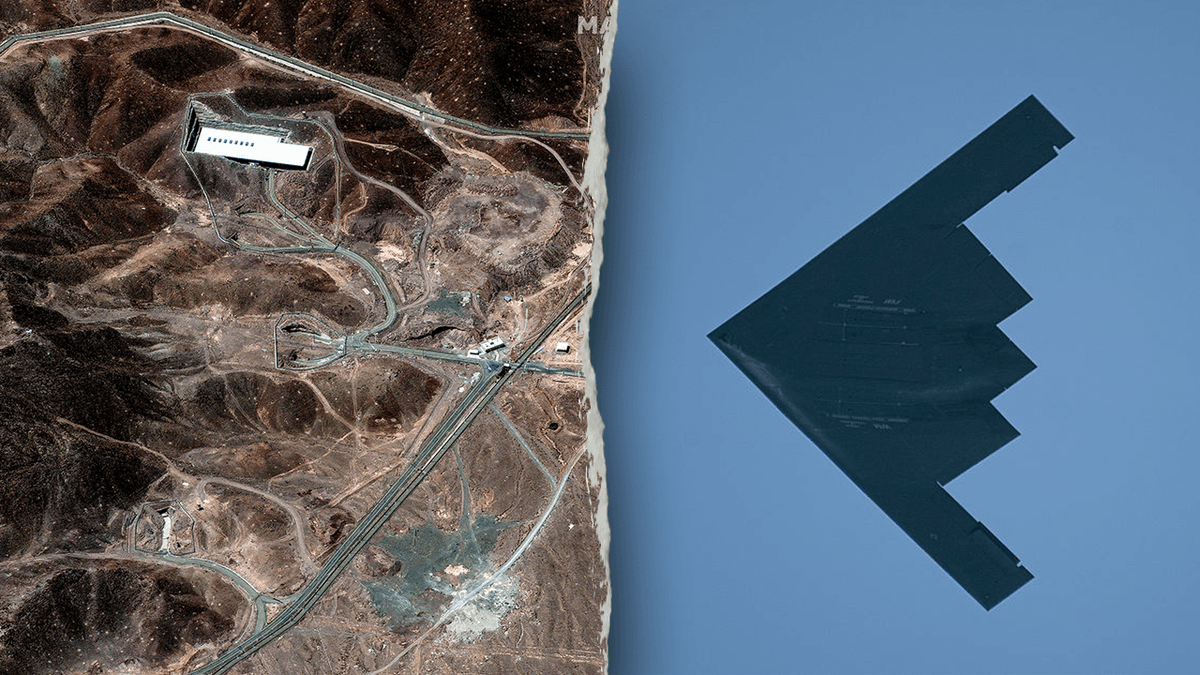
When the first American munitions hit Iran's nuclear facilities in June 2025, the objective was clear: set back the Islamic Republic's march toward a nuclear weapon and give diplomacy, sanctions, and regional deterrence a chance to work. For a few months, the world watched to see whether Tehran would finally come to its senses. It did not. By the time the Pentagon authorized the second wave of strikes in early March 2026, Iran's nuclear complex had not only recovered from the summer bombing, it had accelerated. The decision to strike again was not an escalation. It was the logical continuation of a policy that the ayatollahs forced upon the United States through their own defiance.
The June 2025 Strikes Only Bought Time
Last summer's operation succeeded in its narrow military aim. Satellite imagery confirmed heavy damage to the underground halls at Natanz, and secondary explosions suggested that a significant portion of Iran's advanced centrifuge cascades had been destroyed. The Fordow enrichment site, buried deep inside a mountain near the holy city of Qom, suffered partial damage to its above-ground support structures and power systems. At the time, administration officials estimated that the program had been delayed by between one and three years.
That delay was meant to create space for a diplomatic breakthrough. Instead, it created space for deception. Rather than accepting the destruction as a warning, Iran's Revolutionary Guard treated it as a repair challenge. Within weeks, work crews were photographed clearing rubble at Natanz. New tunneling equipment arrived at Fordow. The regime's nuclear chief, Mohammad Eslami, publicly boasted that Iran's enrichment capacity was "more resilient than the enemy imagined." Diplomats in Vienna and Geneva reported no serious Iranian engagement on limits to enrichment, inspections, or ballistic missile cooperation. The regime pocketed the pause and kept building.
The uncomfortable truth is that kinetic strikes alone rarely alter an enemy's strategic intent. They alter his timetable. June 2025 altered the timetable in America's favor, but only temporarily. By the winter of 2026, Western intelligence agencies were warning that Iran had rebuilt enough centrifuge capacity to produce weapons-grade uranium on a much shorter timeline than before the first strike. The time purchased in 2025 was running out. A policy that depends on one-time demonstrations of force is not a policy at all. It is a postponement.
Iran's Centrifuges Spun Faster, Not Slower
The specific numbers behind the March 2026 strikes are worth examining, because they expose just how hollow the regime's claims of peaceful nuclear energy had become. By late January, the International Atomic Energy Agency confirmed that Iran had enriched uranium to 83.7 percent purity at Fordow, a technical hair away from the 90 percent threshold required for a nuclear weapon. No civilian power reactor on earth requires fuel enriched to that level. A country interested only in civilian energy does not bury centrifuges under 295 feet of mountain rock. It does not block inspectors from military sites. It does not produce uranium metal, a material with virtually no peaceful use.
Meanwhile, Iran's stockpile of uranium enriched to 60 percent had grown to roughly 215 kilograms, according to agency estimates. At that enrichment level, the material can be converted into bomb-grade fuel in a matter of days. The breakout timeline, which had stretched to several months after June 2025, had collapsed to less than three weeks. By early February, American analysts believed Iran could assemble a crude device within six to ten months if the remaining technical and weaponization work proceeded without interruption.
The regime's behavior confirmed the analysis. Iranian officials openly discussed withdrawing from the Non-Proliferation Treaty. Missile tests increased in frequency. Cooperation with North Korea on ballistic technology reportedly expanded. Tehran was not backing away from the nuclear threshold. It was sprinting toward it, under the assumption that the United States lacked the will to strike a second time. That assumption was a miscalculation, and a costly one.
America's Credibility Demands Consistency
The most important reason for the March 2026 strikes is one that transcends uranium enrichment curves and bunker-busting ordnance. It is credibility. A superpower that issues red lines, enforces them once, and then looks away while the offending party rebuilds is not a superpower for long. It becomes a paper tiger. Iran, Russia, China, and every other adversary watching the Middle East needed to learn that American resolve does not expire after one operation.
Some critics, including a few voices on the isolationist right, will argue that Iran's nuclear program is Israel's problem or that another round of strikes risks dragging the United States into a wider war. These arguments ignore reality. A nuclear-armed Iran would not merely threaten Tel Aviv. It would hold every American base in the Persian Gulf hostage. It would trigger a regional arms race, with Saudi Arabia, Turkey, and Egypt pursuing their own nuclear options. It would embolden Hezbollah, the Houthis, and every Iranian proxy from Baghdad to Beirut. The cost of inaction would far exceed the cost of finishing the job.
The March strikes should not be treated as an endpoint. They must be the foundation of a sustained strategy: tighter sanctions on missile and drone components, expanded intelligence sharing with regional partners, and a clear message that any attempt to reconstitute the program will meet the same response. America cannot bomb its way to a permanent solution, but it can demonstrate that defiance carries a price.
June 2025 began a necessary mission. March 2026 completed it, at least for now. The Iranian regime was given a chance to choose restraint. It chose escalation instead. Washington's response was measured, precise, and justified. The American people should expect nothing less from a government sworn to protect them.


