A Bullet Doesn't Solve a Business
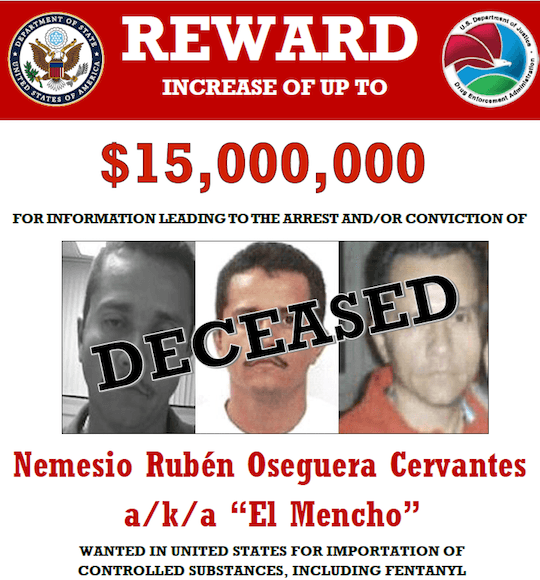
The headline hit like a thunderclap: El Mencho, the founder and commander of the Cartel Jalisco Nueva Generación, one of the most ruthless drug trafficking organizations on the planet, is dead. Killed. Gone.
I'll give you a moment to feel good about that. It lasts about thirty seconds if you've been paying attention to this war for any length of time.
Nemesio Oseguera Cervantes built CJNG from a regional operation into an organization with a presence in all of Mexico's 32 states and distribution networks across Europe, Asia, and every major American city. He was the most wanted drug lord in the Western Hemisphere. The DEA had a $10 million bounty on his head. He evaded capture for years while his organization became arguably more dangerous than the Sinaloa cartel at its Chapo-era peak.
Now he's dead. And Mexico is about to get messier.
What History Teaches About Decapitation
I deployed twice to Afghanistan. We called it "mowing the grass", killing mid-level Taliban commanders, disrupting networks, watching them reconstitute six months later with new personnel and sometimes new tactics. The same dynamic applies to cartel decapitation, and it's been documented consistently in Mexico for fifteen years.
When Arturo Beltran Leyva was killed in 2009, his organization splintered into at least four competing factions that fought each other and the remnants of the Zetas across a bloody two-year period. Civilian casualties spiked. When Chapo was finally captured and extradited, the Sinaloa cartel didn't collapse, it restructured around the Mayo faction and kept running. Violence in Sinaloa actually increased after Chapo went to Brooklyn.
The pattern is this: killing or capturing the top leader creates a power vacuum. Power vacuums get filled violently. The transition period is always the most dangerous, because every mid-level commander who survived is now calculating whether to submit to the new boss or make a play for the throne. That calculation produces bodies. Lots of them.
CJNG without El Mencho still has billions in revenue, thousands of armed soldiers, sophisticated weapons, including, by DEA assessment, military-grade drones modified for bombing runs, and entrenched distribution networks across the United States. Whoever inherits that organization will feel pressure to prove their strength immediately. That's how cartels work. Weakness is a death sentence.
The American Border Question Nobody's Asking
The news coverage of El Mencho's death has been heavy on the takedown and light on the obvious follow-up: what does this mean for Americans?
CJNG is the primary supplier of fentanyl across the southwestern United States. Not the only supplier, Sinaloa still moves product, but the dominant one. The synthetic opioid supply chain runs from Chinese chemical precursors through Mexican labs and across a southern border that, whatever you've been told, is not under control.
In 2023, over 74,000 Americans died of synthetic opioid overdoses. Seventy-four thousand. That's more than the entire U.S. death toll in Vietnam, in a single year. These aren't statistics to be noted and moved past. These are fathers, sons, sisters, neighbors. I've buried two people I grew up with from my hometown in West Texas. Fentanyl doesn't care about your politics.
CJNG territory includes the primary smuggling corridors through Jalisco, Colima, and the ports of entry in the Pacific. A succession struggle within CJNG doesn't slow the fentanyl pipeline, it potentially accelerates it, as the new leadership looks to generate revenue and demonstrate capability. The drugs keep moving. The border remains the variable we actually control.
The Trump administration has pushed hard on border security and has engaged Mexican President Claudia Sheinbaum on cartel pressure, including the designation of cartels as foreign terrorist organizations, a move that opens legal and military options that weren't previously available. That's the right direction. Killing El Mencho is satisfying. Closing the border to his product is what actually saves American lives.
Celebrate the kill for one news cycle. Then get back to work.


